Explore Cyprus with Our Interactive Map

Explore our top stories and discover ideas worth your time.

Pepper Trees of Cyprus

Pepper Trees of Cyprus

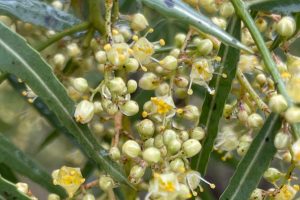
Imagine strolling through a sun-drenched village square or along a quiet coastal road in late summer. A graceful tree with feathery, weeping branches catches your eye, its small greenish-white flowers having given way to clusters of shiny pink-red berries that sparkle like strings of tiny jewels. These are the Schinus species of Cyprus – elegant South-American guests whose light, peppery fragrance and airy beauty have quietly woven themselves into the island’s everyday scenery. The Pepper Trees of the Cashew Family Schinus belongs to the Anacardiaceae family – the same remarkable group that includes pistachios (Pistacia vera), mastic trees (Pistacia lentiscus), cashews, mangoes and even sumacs. This family is known for resinous bark, compound leaves and often aromatic fruits. The genus Schinus contains about 30 species, nearly all native to South America. In Cyprus the two most common are Schinus molle (Peruvian pepper tree or false pepper tree) and Schinus terebinthifolius (Brazilian pepper tree). Locally they are called Αρτυμαθκιά (Artumathkiá – “pepper tree”) for S. molle, and Μαστισιά (Mastisiá – “mastic-like”) or Σχίνος η τερεβινθόφυλλη for S. terebinthifolius, evoking their resinous family ties. A Journey from the Andes to Cypriot Soil Both species are native to subtropical and tropical South America. Schinus molle comes from the Andes foothills of Peru, Bolivia and neighbouring countries, while S. terebinthifolius hails from Brazil, Argentina…

Read more
Mamonia Mélange Cyprus

Mamonia Mélange Cyprus

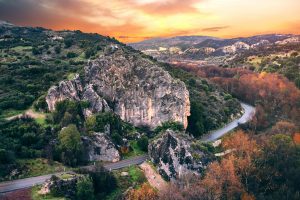
You can arrive at Mamonia without planning to. You stop to watch the sunset near Petra tou Romiou. You follow a narrow road inland from Paphos. You walk a riverbed after winter rain and pick up a stone that feels heavier and smoother than it should. The land looks familiar yet slightly unsettled. A hillside glows deep red. A green rock appears among pale gravel. A white cliff rises abruptly above darker slopes. VasilyPapkovskiy It takes a moment to realise the reason. You have not left Cyprus. You have stepped onto land that existed before the island itself. The Mamonia Mélange, a geological area occupying a large portion of West Cyprus: from Akamas Peninsula to Petra Tou Romiou and all the way up to Troodos foothills, belongs to the material tied to the African tectonic plate. Long before Troodos rose and long before Cyprus took shape, this land lay along the margin of the African continent facing the Neo-Tethys Ocean. When that ocean began to close, the seabed fractured violently. Mantle rock, submarine lava and coral reef were compressed together and later lifted above the sea, scrapping themselves ontop of slowly rising Troodos range. Much later the rest of Cyprus formed around it. Therefore, Mamonia Mélange represents an accretionary complex, a term geologists use to describe similar unique occurrences. The…

Read more
Cyprus Fertile River Valleys

Cyprus Fertile River Valleys

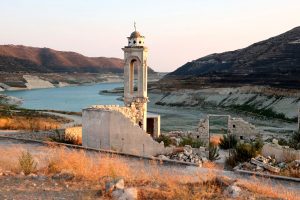
Cyprus contains approximately 35 streams and rivers, though most qualify as temporary watercourses that flow only during winter rains. These rivers create fertile valleys that have supported agricultural communities for over 9,000 years. The island receives an estimated 600 million cubic meters of usable runoff from annual rainfall, a limited resource distributed unevenly across the landscape. Major rivers, including the Pedieos, Kouris, Xeros, Vasilikos, and Diarizos originate in the Troodos Mountains, flow through productive valleys, and terminate either at the Mediterranean coast or in modern reservoir systems. theislandofcyprus.com The Pedieos River Valley and Central Plains Agriculture The Pedieos River extends 100 kilometers from its source near Machairas Monastery in the Troodos range, making it the longest river in Cyprus. The river flows northeast through the Mesaoria Plain, passes through Nicosia, and then continues east to Famagusta Bay near the ancient city of Salamis. Archaeological evidence confirms continuous agricultural settlement along the Pedieos valley from the Bronze Age through modern times. The ancient town of Tamasos developed on the left bank of the Pedieos, its ruins extending across a hill overlooking the rich valley below. wikipedia.org The river derives its name from ancient Greek words meaning to see the east, as its course coincides with the path of the dawn goddess. The Mesaoria Plain, traversed by the Pedieos and several tributary…

Read more