Explore Cyprus with Our Interactive Map

Explore our top stories and discover ideas worth your time.

Cyprus Mount Olympus Hiking Snow Troodos Adventures

Cyprus Mount Olympus Hiking Snow Troodos Adventures

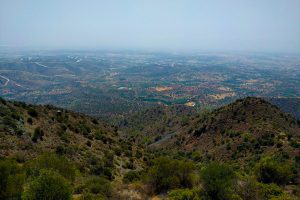
Mount Olympus, also called Chionistra in Greek, represents the highest point on an island better known for beaches than mountains. The peak sits within the Troodos range, a vast expanse of pine forests, rocky slopes, and endemic wildlife that covers roughly a third of Cyprus. Unlike its famous Greek namesake associated with Zeus and the ancient gods, Cyprus's Olympus tells a different story through geology, nature, and seasonal transformation. alamy-com The mountain serves multiple purposes throughout the year. In winter, it becomes the only ski destination in Cyprus. During warmer months, hikers take to trails that wind through black pine forests and offer panoramic views across the entire island. The summit itself houses British and Cypriot radar stations, making the actual peak off limits to visitors, but numerous viewpoints just below provide spectacular perspectives of the surrounding landscape. Historical Background Mount Olympus formed approximately 92 million years ago as part of the Troodos Ophiolite Complex, an uplifted fragment of ancient oceanic crust from the prehistoric Tethys Ocean. The mountain's core consists of ultramafic rock, primarily serpentinized harzburgite, which represents exposed upper mantle from deep beneath an ancient seabed. Tectonic forces pushed this oceanic crust upward through a process called obduction, eventually lifting it above sea level to create the island's mountain spine. This geological origin makes Troodos globally significant among…

Read more

Cyprus Olympic Museum Nicosia Sports History

Cyprus Olympic Museum Nicosia Sports History

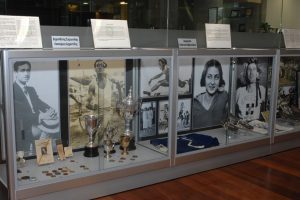
The Cyprus Olympic Museum preserves the athletic heritage of the island. It exhibits 400 artifacts that document Cyprus's participation in the Olympic Games and international sporting competitions since 1980. cyprushighlights-com The museum occupies all three floors of the Olympic House, the headquarters of the Cyprus Olympic Committee, located at 21 Amfipoleos Street in Nicosia. The Olympic House opened on September 16, 2006, in a ceremony attended by President Tassos Papadopoulos and International Olympic Committee President Jacques Rogge. The three-story building covers 7,500 square meters and cost 5.63 million Cyprus pounds to construct. The Cyprus Olympic Museum began operations in 2012, six years after the building's inauguration. The facility houses almost every sporting federation on the island, including sports not on the Olympic schedule. This centralized location makes the Olympic House a hub for athletic administration and a resource center for Cyprus's sporting community. The museum component transforms the building from merely an administrative center into an educational space that celebrates Cyprus's Olympic journey. Historical Background The Cyprus Olympic Committee was founded on June 10, 1974, and gained membership in the International Olympic Committee in 1979. Before this recognition, Cypriot athletes competed internationally under the Greek flag. Notable Cypriots who represented Greece include Ioannis Frangoudis, who won three shooting medals at Athens 1896, and Aristidis Konstantinidis, who claimed cycling gold at…

Read more
Kampanopetra Basilica

Kampanopetra Basilica

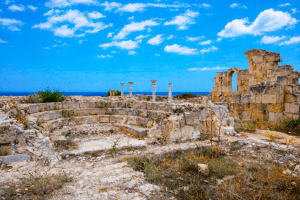
The Basilica of Kampanopetra is a large Early Christian church complex located at the archaeological site of ancient Salamis, near modern Famagusta in the Turkish-occupied part of Cyprus. Built during the late 5th or early 6th century CE, the basilica served the city of Constantia, the name given to Salamis after it was rebuilt following devastating earthquakes in 332 and 342 CE. The complex consists of four major sections arranged in a linear sequence. From west to east, these include a large western courtyard, a second western atrium connected to a narthex (entrance hall), the main three-aisled basilica, and an eastern atrium. The entire structure measures approximately 152 meters in length and reaches nearly 38 meters at its widest point. This makes it one of the largest Early Christian basilicas in Cyprus. The name "Kampanopetra" has been interpreted in different ways. Some sources translate it as "stone by the monks' cells," while others suggest it means "stone bell." The name likely refers to features or traditions associated with the site during medieval times when a small monastic community continued to use portions of the ruined basilica. Historical Background Salamis was one of Cyprus's most important cities throughout antiquity. According to legend, it was founded around the 11th century BCE by Teucer, a hero from the Trojan War who was exiled…

Read more