Few animals in Cyprus inspire as much fascination – or as much fear – as the blunt-nosed viper (Macrovipera lebetina lebetina).
Ask almost any Cypriot about snakes, and sooner or later the conversation will turn to the “fina”: a large, thick-bodied viper said to chase people, guard water sources, climb trees, or even jump several meters through the air. Like many stories passed down through generations, these tales contain a mixture of observation, exaggeration, and folklore.
The reality is far more interesting.
The blunt-nosed viper is not only Cyprus’s largest snake but also one of the island’s most important predators. Hidden among stone terraces, vineyards, river valleys, and rocky hillsides, it quietly performs a vital ecological service by controlling rats and mice.
For most visitors to Cyprus, seeing one in the wild is a memorable event. For the snake itself, however, remaining unseen is usually the preferred option.
The Largest Snake on the Island
Adult blunt-nosed vipers commonly reach lengths of 80–120 cm, although exceptional individuals may exceed 130 cm. Their bodies are heavy and muscular, with a broad triangular head and distinctive camouflage pattern.
Unlike the sleek whip snakes that often dart across roads, vipers move deliberately. Their strength lies not in speed but in concealment.
A viper can remain motionless for hours, blending perfectly into dry grass, stone walls, or rocky ground. Many people walk within a few meters of one without ever noticing it.
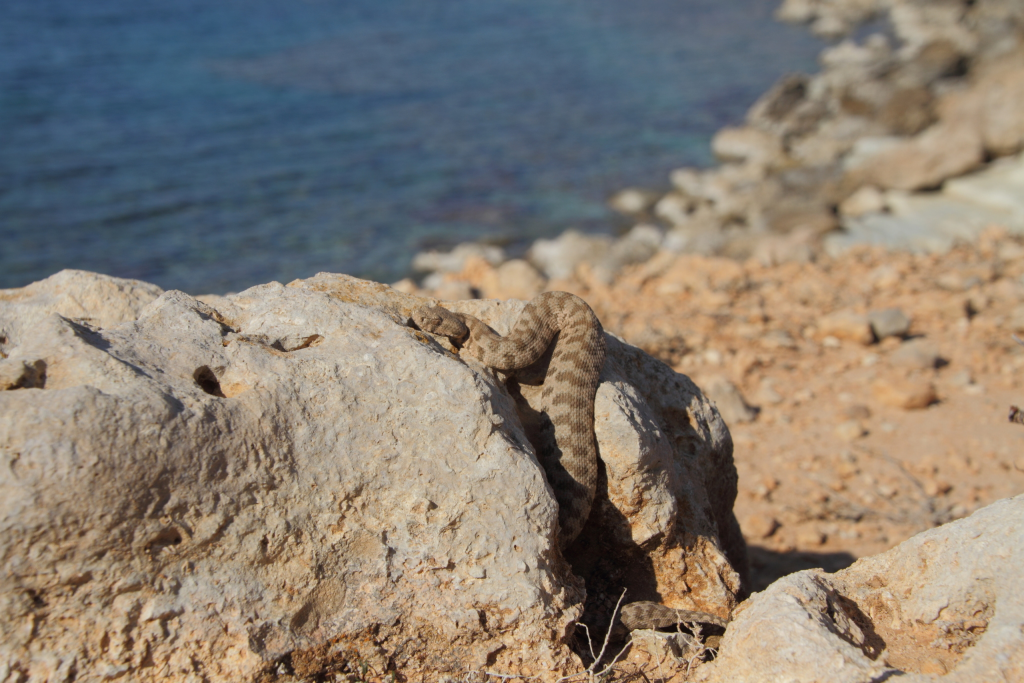
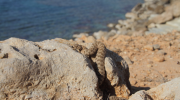
Adult blunt-nosed viper resting among limestone rocks. The species relies heavily on camouflage and often remains undetected even at close range.
Where Can You Find Them?
The species occurs across much of Cyprus and is found from sea level to the Troodos Mountains.
Particularly suitable habitats include:
- Rocky slopes
- Dry river valleys
- Traditional agricultural landscapes
- Vineyards and orchards
- Stone terraces
- Reservoir margins
- Riparian vegetation
- Garrigue and phrygana shrubland
Contrary to popular belief, vipers are not restricted to remote wilderness. Many live surprisingly close to villages and farms.
The reason is simple: where there are rodents, there are vipers.
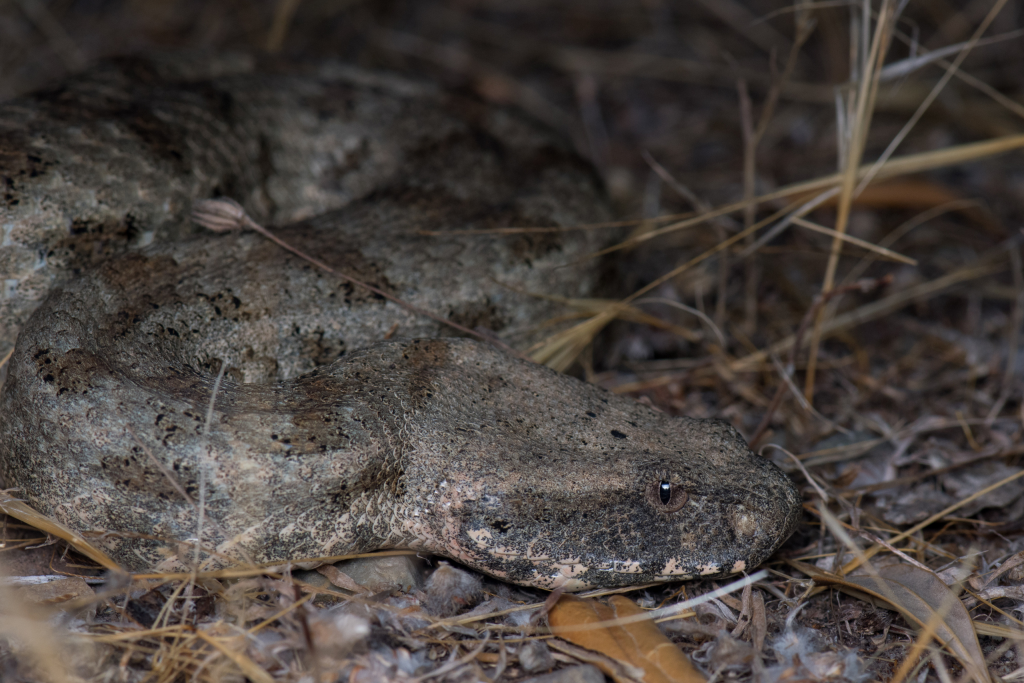
Traditional agricultural landscapes provide ideal habitat because stone walls offer shelter while rodents provide abundant prey.
Distribution Map
Figure 1. Distribution of the Cypriot Blunt-Nosed Viper
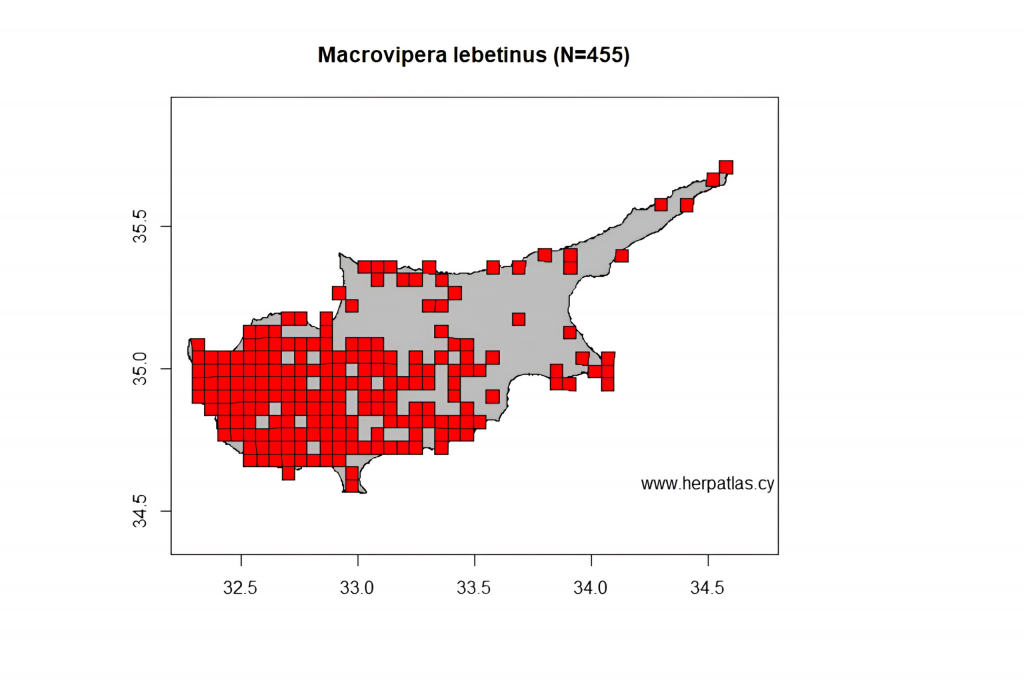
Map note: The species occurs throughout much of Cyprus but is absent or uncommon in heavily urbanized environments.
Why Do People Often See Them Near Water?
One of the oldest Cypriot beliefs is that vipers are attracted to water.
In reality, the relationship is indirect.
Water supports vegetation. Vegetation supports rodents, birds, and lizards. These animals attract predators – including vipers.
During the hot Mediterranean summer, riverbeds, springs, reservoirs, irrigation channels, and dams often become biodiversity hotspots. As a result, vipers may be encountered more frequently in such places.
The snake is not seeking water itself as much as it is seeking food and shelter.
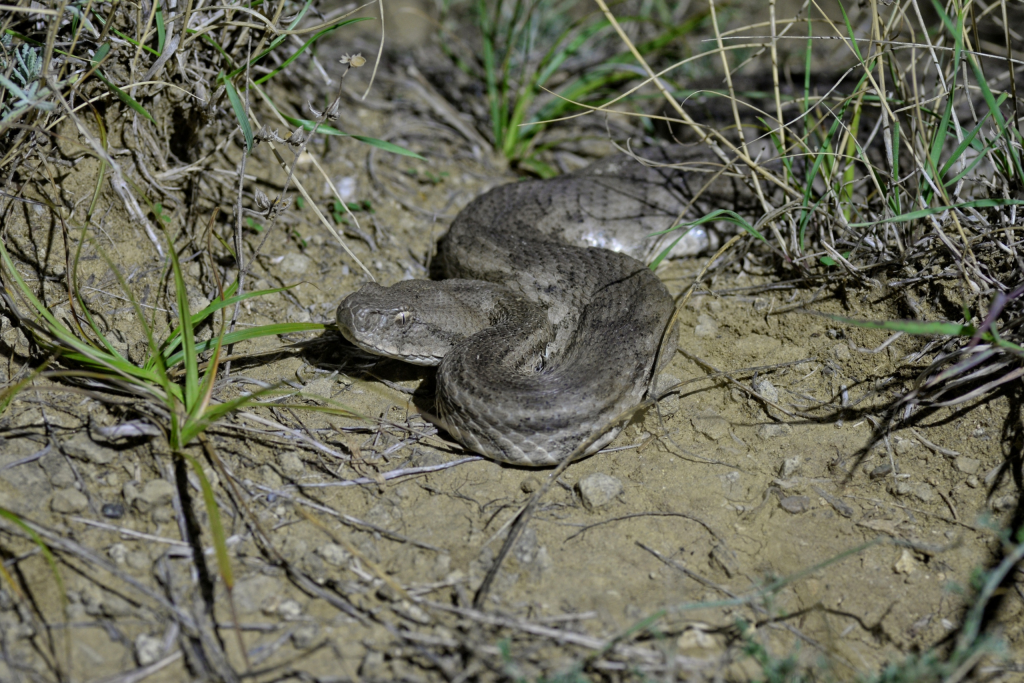
A viper habitat beside riparian vegetation. Areas with water often support higher prey abundance.
Nature’s Rodent Control Expert
The blunt-nosed viper is an ambush predator.
Instead of actively searching for prey, it selects a promising location and waits patiently. Sometimes this location is beside a stone wall. Sometimes it is under a caper bush. Sometimes it is near a rodent burrow.
When an unsuspecting rat or mouse approaches, the strike is over in a fraction of a second.
This hunting strategy makes the viper one of the most effective natural rodent-control agents in Cyprus.
Without predators such as vipers, rodent populations could increase dramatically, causing greater agricultural losses and increased disease risks.
Is It Dangerous?
The blunt-nosed viper is Cyprus’s only truly medically significant snake.
Its venom is powerful and should never be underestimated.
However, the species is not aggressive.
Most bites occur when people:
- Attempt to kill a snake
- Try to capture it
- Accidentally step on it
- Reach into vegetation or rock crevices without looking
If left alone, the snake’s first response is usually to remain motionless or retreat.
For hikers and visitors, simple precautions greatly reduce risk:
✓ Wear sturdy shoes
✓ Avoid wearing earphones in the wild. A viper will usually warn you with a loud hiss before resorting to a defensive strike
✓ Avoid placing hands under rocks
✓ Watch where you step in tall vegetation
✓ Use a flashlight at night
✓ Never attempt to handle a snake
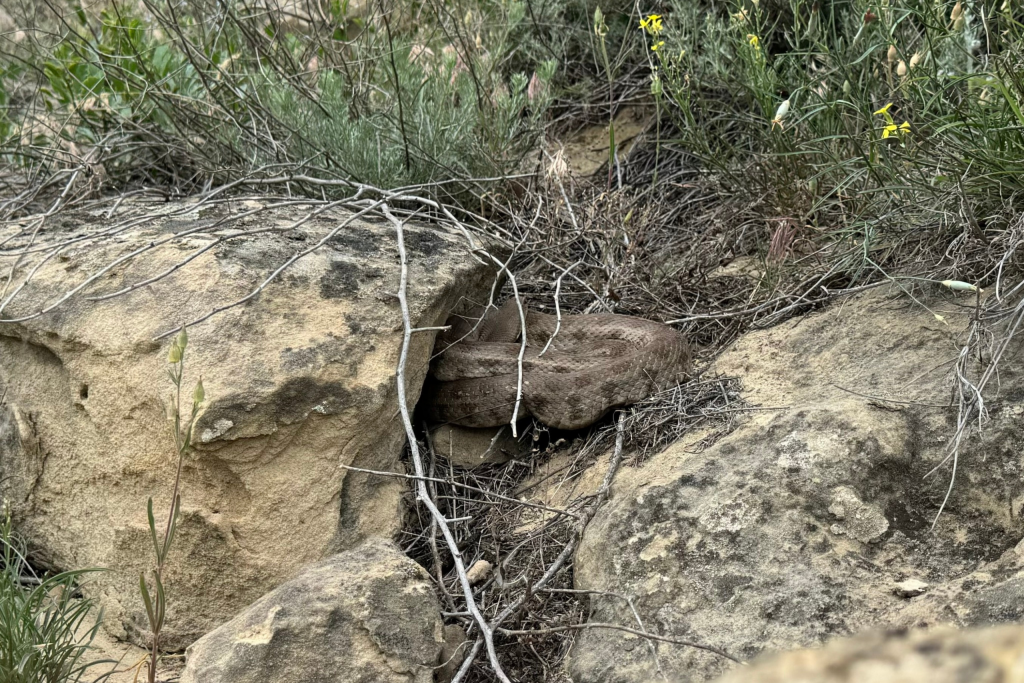
Excellent camouflage is both the viper’s defense and the reason many encounters occur accidentally.
A Victim of Its Reputation
Ironically, one of the greatest threats facing the blunt-nosed viper is human fear.
Many snakes are killed every year because they are mistaken for vipers. Harmless species such as the coin snake often become victims of misidentification.
Road mortality, habitat fragmentation, and urban expansion also affect populations.
Despite widespread fear, the species performs valuable ecological functions and forms an important part of Cyprus’ natural heritage.
A Living Relic of Mediterranean History
The ancestors of today’s blunt-nosed vipers were already present in the eastern Mediterranean long before humans arrived on Cyprus.
The island population has remained isolated for thousands of years and represents a unique component of Cypriot biodiversity.
Every individual encountered today is part of a lineage that survived climatic shifts, geological changes, and centuries of human settlement.
If You Encounter a Viper
The best advice is simple:
Stop. Observe. Appreciate. Leave it alone.
Most sightings last only a few seconds before the snake disappears into nearby vegetation or rocks.
For nature enthusiasts, seeing a wild blunt-nosed viper is one of Cyprus’s most exciting wildlife experiences – a glimpse of one of the Mediterranean’s most remarkable predators.
Far from being a monster, the giant viper of Cyprus is a shy, highly specialized hunter that has shared the island with people for millennia.
Learning to understand it may be the most important step toward protecting it.