Hala Sultan Tekke is a mosque complex located on the western shore of Larnaca Salt Lake. It was built between 1760 and 1817.

This Ottoman-era monument marks the burial site of Umm Haram, a companion of the Prophet Muhammad who died in Cyprus during the first Arab raids in 647 or 649 AD. The site is considered the third or fourth holiest place in Islam by various sources and remains an important pilgrimage destination for Muslims worldwide.
Historical Background
According to Islamic tradition, Umm Haram was either the foster sister of Muhammad’s mother Amina or the wife of Ubada bin al-Samit, a companion of the Prophet. She accompanied Arab forces under Caliph Muawiyah during their expedition to expand Muslim territory in the Mediterranean. Historical accounts describe her as elderly when she arrived in Cyprus. During the siege of Larnaca, she fell from her mule and died from the injuries. She was buried at the spot where she fell, near the salt lake.
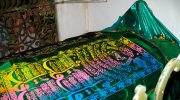
The tomb remained known through oral tradition but was formally identified by the Ottomans after they conquered Cyprus in 1571. In the 18th century, a dervish named Sheikh Hassan discovered a two-chambered tomb at the site with inscriptions in Old Ottoman. This discovery confirmed the location and prompted religious authorities to develop the site as a place of worship.
During the Ottoman period, the site held special significance. Ottoman naval vessels passing Larnaca would lower their flags to half-mast and fire cannon salutes in honor of Umm Haram. This custom demonstrated the reverence accorded to the site by Turkish authorities and the wider Muslim world.
Development of the Complex
Construction of the current complex occurred in stages over several decades. In 1760, Cyprus governor Ali Agha enclosed the tomb with a wooden barrier. According to Italian traveler Giovanni Mariti, who visited between 1760 and 1767, builders used stones from a standing church in a nearby ruined village as construction materials. One year later, in 1761, the wooden barrier was replaced with a wall and two bronze gates.
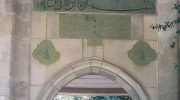
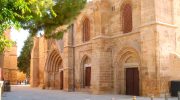
The main mosque was initiated by Cyprus governor Es-Seyyid Mehmet Emin Efendi and completed in November 1817. An Ottoman inscription above the entry gate dates to March 4, 1813. The inscription bears Sultan Mahmud II’s monogram on both sides and reads “Hala Sultan Tekke was built by God’s beloved great Ottoman Cyprus governor.”
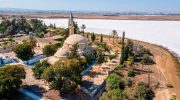
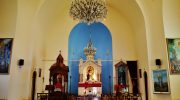
The complex includes several distinct buildings. The mosque itself is square-shaped with a central dome and a balcony, built from yellow stone blocks in classical Ottoman architectural style. Behind the mosque’s qibla wall stands the türbe (mausoleum), also square in plan with each side measuring 6.5 meters. A central dome is supported by four semi-domes. Small windows in each wall provide light. The tomb of Umm Haram sits in the very center between four miniature columns, surrounded by rows of low arches. Five separate graves are found by the eastern row of arches, including burials of two of the tekke’s shaykhs.
The Bronze Age Settlement
The area around Hala Sultan Tekke has been inhabited for thousands of years. Beneath and near the Ottoman complex lies one of the largest Bronze Age harbor cities in the Eastern Mediterranean. This ancient settlement flourished from approximately 1630 to 1150 BC and covered at least 25 hectares, possibly extending to 50 hectares according to recent radar surveys.
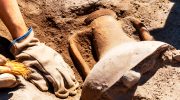
The site was first identified as archaeologically significant in the 1890s following looting of ancient tombs. The British Museum conducted excavations in 1897-1898 directed by Henry Beauchamp Walters and later John Winter Crowfoot. They excavated numerous tombs from the Late Bronze Age containing rich grave goods. Finds were divided between the British Museum and the Cyprus Museum.
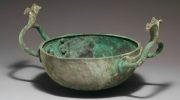
The city’s economy was based on multiple industries. More than one ton of copper slag and ore, along with furnace remains, tuyères, and crucibles, provide evidence of large-scale urban metallurgy. The city’s excellent natural harbor facilitated the export of these products in exchange for imported goods.
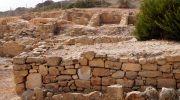
Excavations have revealed several distinct city quarters with domestic structures, industrial facilities, and public buildings. Some structures feature ashlar-faced walls, indicating high-status construction.
The Salt Lake Setting
The location beside Larnaca Salt Lake contributes to the site’s distinctive character. The lake is one of two wetlands in Cyprus with international ecological significance. The salt lake complex covers approximately 1,761 hectares and consists of four main lakes: the main Salt Lake (Alyki), Orphani, Soros, and the smaller Airport Lake.
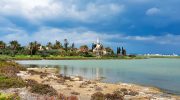
The wetland includes extensive halophytic plant communities adapted to salty conditions. The flat expanse of water and surrounding landscape creates an open, contemplative setting. During migration seasons, the lake attracts significant numbers of birds including flamingos, making it important for birdwatchers and nature enthusiasts.
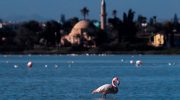
Historically, the lakes were exploited for salt production from the Roman period through the 20th century. This economic activity shaped the region’s development and provided employment for local communities. The salt extraction has now ceased, and the area serves primarily as a nature reserve and tourist attraction.
Architecture and Design
The mosque demonstrates classical Ottoman architectural principles. The square plan with central dome represents typical Ottoman mosque design from this period. The use of yellow stone blocks creates a warm appearance that contrasts with the white and blue tones of the surrounding landscape.
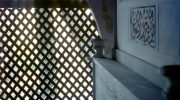
The doorway to the türbe appears to have been taken from a medieval building, showing how Ottoman builders incorporated earlier architectural elements. This practice was common and demonstrated both practical recycling of materials and symbolic continuity with previous civilizations.
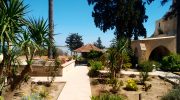
The complex is surrounded by palm and cypress trees that create a grove-like setting. This vegetation provides shade and gives the site an oasis appearance against the relatively barren salt lake shore. The garden, designed by a pasha, enhances the peaceful atmosphere.
Modern Restoration
The complex fell into disrepair during the 20th century. In the early 1900s, the mosque was used as a school and later as a storage facility. After the division of Cyprus in 1974, the site was almost forgotten and suffered from neglect.
Restoration work began in the 1980s, when the mosque was repaired and reopened as a place of worship and tourist attraction. The ancillary buildings were restored in 2004 through support from the Bi-communal Development Programme, funded by USAID and UNDP and implemented through UNOPS. The mosque and minaret are currently maintained through ongoing conservation efforts.
These restoration projects have preserved the site’s heritage and structural integrity while making it accessible to visitors. The work represents cooperation between different communities and international organizations committed to protecting Cyprus’s cultural heritage.
Visiting the Site
Hala Sultan Tekke is located approximately 3 kilometers west of Larnaca along the main road toward the salt lake. Larnaca International Airport is very close, making the site easily accessible for visitors arriving in Cyprus. The proximity to the airport means aircraft occasionally pass overhead, though this does not significantly detract from the peaceful setting.
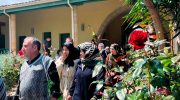
The site is open year-round except for public holidays. Operating hours vary by season. From September 16 to April 15, the complex is open from 8:30 AM to 5:00 PM. From April 16 to September 15, hours extend to 8:30 AM to 7:30 PM. Entrance is free.
Visitors must observe appropriate dress codes as this is a functioning mosque and sacred site. Shoulders and knees must be covered. Long pants and t-shirts are acceptable. Beach clothing and wrap-arounds are not permitted. Shoes must be removed before entering the prayer hall. Smoking is prohibited anywhere within the compound including the garden.
The Tekke Today
Hala Sultan Tekke functions as both an active place of worship and a cultural monument open to tourism. This dual role requires balancing religious observance with visitor access. The management has successfully maintained this balance, allowing the site to serve both purposes.
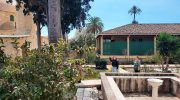
The peaceful setting beside the salt lake makes the tekke a place for quiet reflection regardless of visitors’ religious backgrounds. The historical depth of the location, with layers of human activity spanning nearly four millennia, adds meaning to the experience.
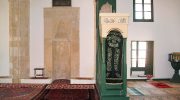
For Muslims, the site offers a connection to early Islamic history and the opportunity to pray at a place sanctified by Umm Haram’s presence. For historians and archaeologists, it provides evidence of cultural continuity and change across centuries. For general visitors, it offers beauty, tranquility, and insight into Cyprus’s diverse heritage.
The combination of Ottoman architecture, Bronze Age archaeology, and a natural wetland environment creates a unique destination. Few places offer such concentrated evidence of human history alongside protected natural ecosystems. This makes Hala Sultan Tekke valuable not just as a single monument but as a complex cultural and environmental site.
The tekke stands as evidence that sacred places can maintain their significance across changing civilizations and belief systems. The location that drew Bronze Age settlers to build their harbor city, which became the burial site of an early Muslim companion, and which Ottoman governors developed into an important pilgrimage center, continues to attract visitors today for reasons both spiritual and cultural.