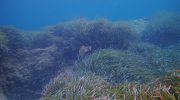
Beneath the turquoise surface of the Cypriot sea, invisible to the sunbathers on the shore above, lies one of the most extraordinary living communities on Earth. It is not a reef, not a forest of kelp, but something far more ancient and remarkable – a meadow of flowering grass, swaying gently in the current, older than most civilisations. And Cyprus, it turns out, may be home to one of the most resilient stands of this grass anywhere in the Mediterranean.
- Not an Alga – A True Flowering Plant
- From the Land to the Deep: An Ancient Migration
- A Portrait of the Plant
- Five Surprising Facts About Neptune Grass
- The Mysterious Balls on the Beach
- Cyprus and the Heat Test
- Still Here, Still Vital – But Under Pressure
- Seeing It for Yourself
- Why Neptune Grass Matters to Cyprus
Not an Alga – A True Flowering Plant
Many people who encounter Neptune grass – either as tangled brown leaves washed up on a beach or glimpsed through a snorkel mask – assume it must be a seaweed. It is not. Posidonia oceanica, known as Neptune grass or Mediterranean tapeweed, is a true flowering plant, a cousin of the grasses and lilies that grow on land.
It belongs to the family Posidoniaceae, placed within the order Alismatales in the monocot group – the same grand branch of the plant kingdom that includes reeds, palms, and orchids. Like any terrestrial plant, it has roots, stems, leaves, flowers, and fruits. It simply chose, tens of millions of years ago, to live at the bottom of the sea.
From the Land to the Deep: An Ancient Migration
The story of Neptune grass begins not in the water but on dry ground. Long before the Mediterranean existed in its current form, the ancestors of Posidonia were land plants. Over geological time, some lineages made the remarkable transition back into the sea – a journey made by only a tiny handful of flowering plants in the history of life on Earth.
The genus Posidonia is named after Poseidon, the Greek god of the seas, while oceanica refers to its former wide distribution. Carl Linnaeus gave the first botanical description of the species in Systema Naturae, though the genus was originally named Zostera.
In Cyprus, this plant has been part of the coastal seascape since long before humans arrived. The meadows around the island represent the easternmost and warmest limit of the species’ range – a living frontier, where Neptune grass clings on despite conditions that would trouble its cousins further west. This makes Cypriot populations scientifically extraordinary.
A Portrait of the Plant
Neptune grass forms dense underwater meadows, covering the sandy and rocky seabed at depths typically between one and forty metres. Its leaves can reach up to 1.5 metres in length, are about one centimetre wide, and have 13 to 17 parallel ribs. They are bright green when alive, turning brown as they age and are shed.
The plant has two kinds of underground stems, or rhizomes: horizontal ones that spread outward across the seabed, and vertical ones that grow upward to keep pace with accumulating sediment. Over centuries, these rhizomes, roots, and trapped sediments build up into a thick, dense mat known as a “matte” – a spongy terrace-like formation that can be several metres deep.
The growth rate is among the lowest of any marine plant: horizontal rhizomes grow just 1 to 6 cm per year, while vertical rhizomes grow from 0.1 to 4 cm per year. Growing a single new leaf takes about 51 days. Because of this extraordinary slowness, a meadow that has been destroyed may take centuries to recover – or may simply never come back.
The flowers of Neptune grass appear in autumn, and its fruits – small, fleshy, and buoyant – are carried by currents to new sites, known in Italy as “the olive of the sea” (l’oliva di mare).
Five Surprising Facts About Neptune Grass
- It is older than the pyramids – and then some. A single clonal colony of Posidonia oceanica can reproduce asexually, generating genetically identical copies of itself. One such organism, spanning up to 15 kilometres in width and estimated to weigh more than 6,000 metric tonnes, may well be more than 100,000 years old.
- It outbreathes the Amazon. Posidonia has a very high carbon absorption capacity, able to soak up 15 times more carbon dioxide every year than a similarly sized area of the Amazon rainforest.
- It keeps the beach in place. When the leaves die and wash ashore, they form huge protective banks called banquettes, which can be up to 2.5 metres thick. These act as a natural barrier against coastal erosion.
- It traps plastic. Recent research has shown that Neptune balls – the fibrous spheres that form from detached roots and rhizomes – trap and accumulate microplastics as they roll along the seafloor, effectively hoovering pollutants from the water before washing ashore.
- It is the oldest living thing in Cyprus. A specimen discovered in Vasiliko Bay on the southern coast of Cyprus was aged at approximately 5,500 years using lepidochronology – counting the annual leaf-scar layers on its rhizomes, much like counting tree rings. This single organism was already ancient when the Bronze Age was just beginning on the island.
The Mysterious Balls on the Beach
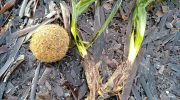
If you have ever walked a Cypriot beach in autumn or winter and found curious brown fibrous balls scattered across the sand – some as small as a pea, others as large as a tennis ball – you have met Posidonia in its strangest form.
These structures, called egagropili (singular: egagropilus), form through the mechanical action of waves and currents that tangle and roll fragments of roots, rhizomes, and leaves in submarine depressions along Mediterranean coastlines. The name derives from the ancient Greek words αἴγαγρος (wild goat) and πῖλος (felt or fur), evoking the matted, textured appearance of the balls.
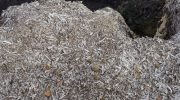
These dense fibrous balls are shaped and accumulated by wave action along the shoreline. Though widely regarded as a nuisance by beach-goers and tourism authorities – and commonly removed as waste – they actually play an important ecological role, helping to stabilise beach sediments and supporting small invertebrate communities.
These balls are, in a way, the autobiography of the meadow below the waves – the cast-off material of a living community that has persisted on the seabed for millennia. Finding one on a Cypriot beach is, quietly, a remarkable thing.
Cyprus and the Heat Test
One of the most compelling aspects of Cypriot Neptune grass is what it reveals about the future of the Mediterranean. Waters above the summer thermocline around Cyprus regularly reach 29°C, which is close the known upper thermal tolerance limit for the species. In other words, Cypriot Neptune grass is living right at the very edge of what the plant is supposed to be able to endure.
And yet it survives – and in places, it thrives. The seagrass meadows of Vasiliko Bay on the southern coast are among the densest in the world, supporting sea turtles, monk seals, and dolphins.
Research comparing eastern Mediterranean populations with those from the western Mediterranean – from Spain, France, and Italy, where summer temperatures are typically several degrees cooler – suggests that Cypriot Posidonia may have developed a degree of thermal resilience not found in its western relatives. Scientists have proposed that Cypriot populations might represent an especially important genetic strain, since sea surface temperatures in the region are rising rapidly due to climate change. Severe Posidonia habitat loss of up to 70% is projected by 2050, with potential functional extinction by 2100 across much of the Mediterranean, unless thermally resistant strains can be found.
This means that the Cypriot meadows are not merely locally important. They may hold the genetic key to the survival of Neptune grass across the entire Mediterranean basin.
Still Here, Still Vital – But Under Pressure
Today, Neptune grass remains a cornerstone of Cypriot coastal ecosystems. The meadow in Vasiliko Bay covers approximately 200 hectares across 10 kilometres of coastline, and the plant is present at numerous other sites around the island. It shelters fish nurseries, feeds sea turtles, and keeps beaches intact.
But Vasiliko Bay is also home to ports, a power station, a desalination unit, a cement factory, a major oil terminal, and gas storage facilities. Part of the meadow has already been destroyed by dredging to build a jetty.
The main threats facing Posidonia meadows more broadly include sea warming, pollution, coastal development, dredging, illegal bottom trawling, the spread of invasive species, and – particularly in tourist areas – uncontrolled anchoring of recreational boats. Anchors and chains destroy the delicate shoots, leaving behind only layers of dead rhizomes.
The plant is protected under EU and Cypriot law, and its destruction is prohibited. But awareness among the general public remains low.
Seeing It for Yourself
Neptune grass can be encountered in many ways along the Cypriot coast. Snorkelling or diving at sites such as Konnos Bay in the Famagusta district, the waters off Cape Greco, or the rocky shallows near Akrotiri allows direct observation of the meadows – a memorable experience of drifting above the long, gently swaying green ribbons, often alive with small fish, sea urchins, and octopus.
For a more contemplative encounter, a winter walk along almost any sandy Cypriot beach will reveal both the brown banquettes of shed leaves and the curious round egagropili, tumbled by storm waves onto the shore. Rather than an eyesore, these are signs of a healthy, productive meadow close offshore.
The meadow at Vasiliko Bay, though industrial pressures surround it, remains accessible to divers and researchers, and represents one of the most scientifically significant shallow marine habitats in the eastern Mediterranean.
Why Neptune Grass Matters to Cyprus
Cyprus is often celebrated for its sunshine, its archaeology, and the mythological birthplace of Aphrodite. But beneath the surface of its famously blue sea lies something equally astonishing – a living landscape of staggering age, extraordinary productivity, and growing scientific importance.
Neptune grass is not merely a plant. It is, in a very real sense, the lungs of the Cypriot sea, the cradle of its coastal fisheries, the anchor of its beaches, and a potential lifeline for the entire Mediterranean in a warming world. A 5,500-year-old plant, rooted in the sandy bay at Vasiliko since the early Bronze Age, is a testament to just how deeply the natural history of this island reaches, and how much is still worth protecting.
To know Neptune grass is to understand Cyprus a little more deeply – and to appreciate that the island’s remarkable story is told not only in stone temples and ancient harbours, but also in the quiet, swaying meadows beneath the waves.