Explore Cyprus with Our Interactive Map

Explore our top stories and discover ideas worth your time.

Trahanas Preserving In Cyprus

Trahanas Preserving In Cyprus

Trahanas is not a soup in the usual sense. It is a solution shaped by necessity. Long before refrigeration, electricity, or supermarkets, Cypriot households needed a way to preserve the abundance of summer milk and turn it into nourishment for the colder, damp months that followed. Trahanas emerged as a practical answer to this challenge, turning perishable ingredients into a stable, nourishing reserve. Tangy, filling, and deeply comforting, trahanas sits at the centre of Cyprus’s food memory not because it is impressive, but because it worked when it mattered most. To eat trahanas is to taste the logic of survival shaped by land, climate, and patience. A Food Designed to Last, Not Impress At its core, trahanas is made from sour sheep’s or goat’s milk combined with cracked wheat, often called konari in Cyprus. The mixture is fermented, cooked, shaped, and then dried under the summer sun until it becomes hard and shelf-stable. Months later, it is rehydrated with water or stock and slowly boiled into a thick, warming soup. This transformation is the point. Trahanas begins as liquid, becomes solid, and returns to liquid again, with every stage designed to extend life rather than enhance appearance. The rough texture, the sourness, and the muted colour are not flaws. They are evidence of a food designed with intention, where practicality…

Read more
Church of the Transfiguration in Palaichori

Church of the Transfiguration in Palaichori

Church of the Transfiguration in Palaichori is a 16th-century Byzantine chapel in Cyprus's Troodos Mountains, renowned for its post-Byzantine frescoes that illustrate the persistence of Orthodox artistic traditions under foreign rule. Part of the UNESCO-listed Painted Churches, it preserves vivid paintings blending theological narratives with symbolic depth, reflecting medieval devotion in a rural setting. This site captures how faith endured and adapted, offering insights into Cyprus's cultural resilience amid external influences. sobory-ru A Testament to Enduring Faith in the Mountains The Church of the Transfiguration exemplifies the resilience of Byzantine religious architecture in Cyprus's highland regions, dedicated to Christ's Transfiguration - a pivotal event symbolizing divine glory and human potential for spiritual elevation. Situated in Palaichori village at an elevation of about 700 meters, amid orchards and pine-clad slopes, the chapel's modest stone form and interior art reflect the era's fusion of local Orthodoxy with subtle Western elements. Its construction and frescoes highlight the persistence of Byzantine traditions during Venetian (1489-1571) and early Ottoman (1571-1878) periods, when Catholic or Muslim influences challenged but did not erase island faith. As one of the ten Painted Churches inscribed on UNESCO's World Heritage List in 1985, it contributes to a group that collectively showcases Cyprus's medieval religious landscape, where rural isolation fostered artistic continuity amid political shifts. httpssobory-ru The chapel's location in the…

Read more
Bellapais Abbey

Bellapais Abbey

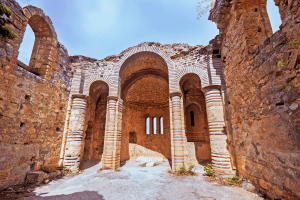
Bellapais Abbey is a 13th-century monastery ruin located in the village of Bellapais, about 5 kilometers from Kyrenia in the Turkish-occupied part of Cyprus. Built on a hillside at 220 meters above sea level, the abbey offers views across the coast to the Mediterranean Sea. This Gothic structure is considered one of the finest examples of medieval architecture in the Eastern Mediterranean and remains one of Cyprus's most visited historical sites. The site may have been known as Episcopia or Piscopia before the abbey was built, suggesting it served as a residence for the Bishop of Kyrenia and as a refuge during Arab raids in the 7th and 8th centuries. The elevated position and defensible location made it suitable for both religious and protective purposes during periods of coastal threats. Historical Background The first occupants known to settle at the site were Augustinian monks called the Canons Regular of the Holy Sepulchre, who fled Jerusalem in 1187 after the city fell to Saladin during the Crusades. These monks had previously been custodians of the Church of the Holy Sepulchre in Jerusalem, one of Christianity's holiest sites. King Aimery de Lusignan granted them land and founded the monastery between 1198 and 1205. The abbey was consecrated as the Abbey of St. Mary of the Mountain. In 1206, the Premonstratensians, also known…

Read more