Explore Cyprus with Our Interactive Map

Explore our top stories and discover ideas worth your time.

Cyprus Coastal Seafood Festivals

Cyprus Coastal Seafood Festivals

Seafood festivals in Cyprus are joyful coastal celebrations that bring together food, tradition, and community life. Held mainly in seaside towns such as Zygi, Latchi, Limassol, Larnaca, and Paphos, these events reflect the island’s long relationship with the sea and its fishing heritage. Through simple dishes, shared tables, and open harbors, they offer an easy and memorable way to experience Cyprus beyond the beach. What Are Seafood Festivals in Cyprus? Seafood festivals in Cyprus are local events that celebrate fishing culture and fresh Mediterranean seafood. They are usually organized by municipalities, community councils, or local fishing groups and take place near harbors, marinas, or coastal promenades. Some are clearly defined annual festivals, while others are part of broader cultural or religious celebrations that include seafood as a central element. At their core, these festivals focus on sharing freshly prepared fish and seafood in a relaxed, social setting. Visitors can expect grilled fish, octopus, calamari, and traditional fish meze served alongside music, conversation, and sea views. The atmosphere is informal and welcoming, designed to bring locals and visitors together rather than impress with spectacle. Roots in Coastal Life and Fishing Traditions Cyprus has always been shaped by the sea. For centuries, small coastal communities relied on fishing not only for food but for trade, identity, and survival. Harbors doubled as social…

Read more
Pentozali Cyprus Dance

Pentozali Cyprus Dance

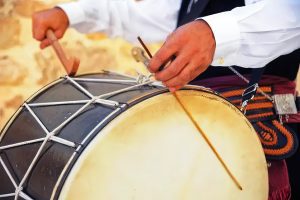
The Pentozali is one of the most powerful dances ever to cross the sea between Crete and Cyprus. Born in the mountains of western Crete as a dance of resistance and endurance, it later became part of Cyprus’s festival life, folk education, and stage tradition. When performed on Cypriot soil today, the Pentozali is not treated as a foreign import, but as a shared expression of strength, memory, and collective identity within the wider Hellenic world. This is not a dance meant to decorate an evening. It is meant to command attention. A Dance Built on Movement, Not Decoration Pentozali belongs to the family of pidichtos dances, a term that refers to leaping, high-impact movement rather than flowing steps. The body does not glide. It strikes, lifts, stamps, and suspends itself in the air. The posture is upright and direct, with little ornamentation, because the focus is on force and timing rather than elegance. The dance is usually performed in an open circle or semi-circle, with dancers linked at the shoulders. That formation creates both physical stability and a sense of collective strength. Everyone moves as one unit, but the attention belongs to the leader at the front of the line, whose improvisations set the intensity of the performance. Why Leadership Matters in Pentozali Unlike many communal dances, Pentozali places…

Read more
Saint Icon Processions in Villages

Saint Icon Processions in Villages

Icon processions, known as litanies in Greek, are among the most visible and long-standing ceremonial traditions in Cyprus villages. These events involve carrying symbolic religious images through village streets during annual festivals and designated communal celebrations. The practice temporarily transforms public spaces into structured ceremonial routes where participants move together in organized formation. These processions occur throughout the year, particularly during major seasonal festivals and village celebrations. They remain closely tied to Cyprus’s historical village culture, where collective rituals, shared events, and seasonal gatherings play an important role in maintaining community identity. Historical Origins of Processional Traditions The practice of carrying religious images in public processions developed during the Byzantine period, when ceremonial rituals became an established part of public and community life in the eastern Mediterranean. Over time, these practices were integrated into local customs across Cyprus and adapted to village-based social structures. Religious images used in these processions are traditionally regarded within their cultural context as symbolic representations connected to historical figures and narratives. Within the broader tradition, these objects are treated with reverence through formal gestures such as bowing or kissing the image, reflecting long-established ritual behavior in Orthodox-influenced regions. Processions also served practical and social functions. In historical contexts, they allowed entire communities to participate in structured public ceremonies, especially when indoor spaces were limited. They…

Read more