Explore Cyprus with Our Interactive Map

Explore our top stories and discover ideas worth your time.

Kyrenia Mountains

Kyrenia Mountains

Whether you stand on the observation deck in Troodos near the summit of Mount Olympus on a clear day, walk across the rolling fields of the Mesaoria plain, or simply drive through the streets of Nicosia, your eyes will inevitably be drawn north. There, a long, jagged ridge cuts across the horizon like a line drawn by a giant hand. In some places it rises so sharply that it feels unreal, as if the land itself has been lifted and frozen mid-motion. At sunrise it glows pale and soft. By midday it hardens into white stone. At dusk it becomes a jagged silhouette, like the ruins of a forgotten kingdom. These are the Kyrenia Mountains, also known as Pentadaktylos. Unlike Troodos, which rises gradually through valleys, plateaus and forests, the Kyrenia Mountains are abrupt, almost theatrical. They form a narrow ridge stretching for almost 200 kilometres, from Cape Kormakitis in the west to Cape Apostolos Andreas in the east. To the north they fall sharply toward the sea, separated by a narrow coastal strip rarely more than five kilometres wide. To the south they rise almost vertically above the flat Mesaoria plain. They look less like mountains and more like a stone wall, or the ruins of a forgotten city from the fantasy epic. And in many ways, they are…

Read more
Saint Barnabas Monastery

Saint Barnabas Monastery

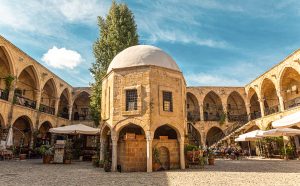
Saint Barnabas Monastery is a historical monastic complex located near the ancient city of Salamis, close to modern-day Tuzla in Cyprus. The site is associated with early Roman-era history and later Byzantine and Ottoman-period developments, and today functions primarily as a museum and archaeological landmark reflecting the island’s layered cultural heritage. The monastery stands within a landscape that includes the ruins of Salamis, one of the most important ancient urban centers of Cyprus. This proximity gives the site additional archaeological significance, as it connects monastic history with earlier Greco-Roman urban settlement patterns. Historical Background The site is traditionally linked to Barnabas, a historical figure associated with the early spread of new religious movements in the eastern Mediterranean during the 1st century AD. In historical sources, he is described as being of Cypriot origin and connected to early communities in Jerusalem and Antioch. These accounts place him within broader networks of cultural and religious exchange under Roman rule. Barnabas is also mentioned in early textual traditions as being involved in supporting emerging communities and in facilitating connections between different groups operating in cities across the Roman Empire. His name appears frequently in early historical writings that describe the formation of organized teaching networks in the eastern provinces. Historical interpretations suggest he played a mediating role in the integration of new members…

Read more
Seasonal Fishing Rituals of Cyprus

Seasonal Fishing Rituals of Cyprus

Cyprus fishing communities maintain ancient rituals that connect Orthodox faith with maritime traditions. The most significant ceremony occurs on Epiphany, January 6, when priests bless coastal waters and throw a cross into the sea for young men to retrieve. This ritual invokes protective power for fishermen and sailors throughout the coming year. The island's fishing heritage stretches back thousands of years, with fish being one of the main trade products in ancient times. Traditional fishing techniques, boat blessings, and seasonal ceremonies bind communities to the sea that sustains them. These rituals serve practical and spiritual purposes, ensuring divine protection for dangerous work while reinforcing social bonds among fishing families. The ceremonies mark the rhythm of fishing seasons and create moments when entire coastal villages gather at harbors to witness sacred traditions passed down through generations. The Epiphany cross dive tradition On January 6, coastal towns including Limassol, Larnaca, Paphos, and Ayia Napa host elaborate cross diving ceremonies. After morning liturgy, priests lead processions to harbors and beaches where thousands gather to witness the blessing of waters. The priest casts the Holy Cross into the sea while chanting the hymn When You Were Baptised in the Jordan, O Lord. Dozens of young men plunge into the cold January water, competing to retrieve the cross. The first person to grasp it receives…

Read more