Explore Cyprus with Our Interactive Map

Explore our top stories and discover ideas worth your time.

Cyprus Kleftiko Dish

Cyprus Kleftiko Dish

Kleftiko is one of the most recognisable dishes in Cyprus, yet its importance has little to do with flavour alone. This slow-cooked lamb, sealed away from air and fire, tells a story of survival, patience, and rural ingenuity. More than a recipe, Kleftiko reflects how Cypriots adapted to hardship and turned necessity into tradition. Understanding it means understanding why time, restraint, and shared meals still matter deeply on the island. A Dish Built on Secrecy and Time At its core, Kleftiko is lamb or goat cooked slowly in a sealed environment. The defining feature is not the meat itself, but the method. By trapping steam and heat, the meat softens gradually, breaking down until it can be pulled apart with little effort. This approach was developed for practical reasons. Cooking openly created smoke and scent that could travel far. Sealing the meat allowed it to cook invisibly, protected from wind, flame, and unwanted attention. Over hours, sometimes an entire day, the process transformed tough cuts into something rich and deeply aromatic. Kleftiko’s slowness is not incidental. It is the point. Time is the primary ingredient, and patience is the main technique. Why It Is Called Kleftiko The name Kleftiko comes from the Greek word kleftis, meaning “thief.” During periods of Ottoman rule, groups of mountain fighters and shepherds relied on…

Read more
Pyla-Kokkinokremos

Pyla-Kokkinokremos

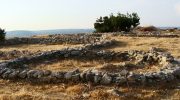
Pyla-Kokkinokremos stands as one of Cyprus's most remarkable archaeological sites, offering a rare snapshot of life during the final decades of the Bronze Age. This fortified settlement, occupied for barely 50 years around 1200 BC, preserves evidence of a multicultural community that thrived briefly before vanishing from history. The site occupies a rocky plateau rising 50 to 63 meters high, located about 10 kilometers east of ancient Kition (modern Larnaca) on Cyprus's southeast coast. The plateau covers approximately seven hectares and sits roughly 800 meters from the current coastline. This naturally defensible position overlooked Larnaka Bay and connected major Bronze Age centers like Kition and Enkomi. The settlement emerged during the Late Cypriot IIC–IIIA period, established at the end of the 13th century BC when the Late Bronze Age collapse reached its peak. Within a generation or two, by the early 12th century BC, residents abandoned the site. This brief occupation makes Pyla-Kokkinokremos invaluable to archaeologists, as it captures a precise moment in history without complications from later rebuilding. Archaeological Discovery and Excavations Porphyrios Dikaios first examined the site in 1952. Vassos Karageorghis conducted excavations in 1981–1982, then returned with Athanasia Kanta between 2010 and 2013. Since 2014, an international team from Ghent University, the Catholic University of Louvain, and the Mediterranean Archaeological Society has carried out systematic excavations under…

Read more
Cyprus’s Prehistoric and Neolithic Periods

Cyprus’s Prehistoric and Neolithic Periods

Long before the ancient Greeks built their temples or the Romans laid their mosaics, Cyprus was home to some of the Mediterranean's earliest farming communities. These prehistoric pioneers built villages, grew crops, and created a culture that would lay the foundation for thousands of years of Cypriot civilization. The Island's First Settlers Cyprus's prehistoric story begins over 11,000 years ago when the island's landscape looked dramatically different from today. The first humans to arrive found a land inhabited by pygmy hippos and dwarf elephants - miniature versions of their mainland cousins that had evolved in isolation on the island. These early settlers were hunter-gatherers who eventually gave way to organized farming communities. By around 7000 BCE, Cyprus had developed a full Neolithic (New Stone Age) culture with permanent villages, domesticated animals, and agricultural fields. These weren't primitive camps but sophisticated settlements with stone architecture, communal planning, and complex social structures. The island's prehistoric inhabitants created a distinctive way of life that would influence Cypriot culture for millennia to come. From Ice Age Hunters to Stone Age Farmers The earliest evidence of human presence on Cyprus comes from a coastal rock shelter called Aetokremnos, dating to around 9500 BCE. Here, archaeologists found thousands of burned bones from Cyprus's now-extinct dwarf hippos - 74% of all the animal remains at the site.…

Read more