Explore Cyprus with Our Interactive Map

Explore our top stories and discover ideas worth your time.

Agia Paraskevi Necropolis

Agia Paraskevi Necropolis

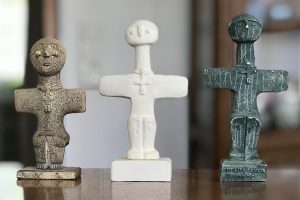
The Agia Paraskevi necropolis is an extensive Bronze Age burial ground located approximately half a mile north of the Church of Agia Paraskevi in the Nicosia district. The site occupies the edge of a plateau southwest of Cyprus's modern capital. It takes its name from the nearby Byzantine church. This cemetery was used continuously throughout the Early and Middle Bronze Age periods, roughly from 2400 BCE to 1100 BCE. The site contains hundreds of rock-cut chamber tombs where ancient communities buried their dead along with pottery, tools, jewelry, and other grave goods. These artifacts provide detailed information about how Cypriots lived, traded, and organized their societies during prehistoric times. The necropolis is particularly important because it represents the burial ground for ancient Ledra, one of the early kingdoms mentioned in Assyrian records. While the settlement itself lies buried beneath modern Nicosia, the cemetery on the plateau has survived and offers the most complete picture of life in central Cyprus during the Bronze Age. Historical Background The Agia Paraskevi necropolis came to archaeological attention in the late 19th century. In 1883 and 1884, German archaeologist Dr. Max Ohnefalsch-Richter conducted extensive excavations at the site. His work uncovered numerous tombs and established the cemetery's importance for understanding Cypriot prehistory. Ohnefalsch-Richter arrived in Cyprus in 1878 as a journalist but quickly shifted his…

Read more
Pissouri Beach

Pissouri Beach

Pissouri Beach stretches 1.5 kilometers along the southern coast of Cyprus between Limassol and Paphos, roughly 30 kilometers from each city. The beach occupies Pissouri Bay, a natural cove protected by the white limestone cliffs of Cape Aspro on both sides. The beach features fine golden sand mixed with multicolored small pebbles, creating a distinctive shoreline texture not found at purely sandy beaches. The waters here earned Blue Flag certification, marking compliance with strict European standards for cleanliness, safety, and environmental management. Pissouri divides into two distinct zones: the old village perched on a hillside three kilometers inland and Pissouri Bay, the beach resort area that developed primarily for tourism. From Pine Resin to Tourist Haven The name Pissouri most likely derives from extensive pine resin extraction in the area, as the Greek word for tar is pissa, and resin production began during the Byzantine Empire and continued through the Middle Ages and Frankish era in Cyprus. Alternative theories link the name to the Cypriot dialect word for very dark nights, connected to legends about 300 Alamani saints who arrived at this coast during a pitch-dark night in the 7th century. The ancient geographer Strabo mentioned a city called Boosoura in this region, though exact connections remain unclear. Medieval records describe Pissouri as royal property where almonds, carobs, olives, fruit,…

Read more
A Crossroads That Accumulated

A Crossroads That Accumulated

Cyprus is best understood as a layered island, where newcomers rarely erased what came before, and daily life absorbed languages, customs, and beliefs over centuries of close contact. Positioned between Europe, the Levant, and Anatolia, it became a crossroads early through trade, then accumulated Roman, Byzantine, Arab, Latin, Venetian, Ottoman, and British influences without turning into any single one of them. This article traces how those layers formed, where coexistence was practical rather than ideal, and why "Cypriot" identity still carries many histories at once. Ten Thousand Years of Settlement Human settlement in Cyprus stretches back more than ten thousand years. Long before empires arrived, early communities established farming villages and ritual spaces that tied life closely to land and seasons. These foundations mattered because when later cultures arrived, they did not start from nothing. As Cyprus entered the Bronze Age, copper transformed the island into a hub of Mediterranean trade. This was not just an economic shift. It brought constant contact with Egypt, the Levant, and the Aegean, embedding Cyprus into international networks very early in its history. From that point on, isolation was no longer possible. The island’s identity was shaped by exchange. Greeks and Phoenicians Intertwined Greek-speaking settlers arrived in large numbers during the late Bronze Age, establishing language, myths, and social structures that would endure for…

Read more