Explore Cyprus with Our Interactive Map

Explore our top stories and discover ideas worth your time.

Cyprus Forest Spirits and Fairy Tales

Cyprus Forest Spirits and Fairy Tales

Cyprus has a long-standing tradition of folklore involving supernatural beings believed to inhabit forests, springs, caves, and mountain regions. These narratives form part of the island’s oral heritage and reflect how communities historically interpreted natural landscapes and seasonal changes. Across generations, these stories have been passed down through oral storytelling, seasonal customs, and local cultural practices. They often combine elements from ancient Greek mythology with later Byzantine-era and local rural traditions, creating a layered folklore system unique to the island. Rather than representing a single unified belief system, Cypriot folklore reflects changing historical influences and regional storytelling variations that developed over centuries. Historical Background Cypriot folklore draws from multiple historical and cultural sources spanning antiquity to the medieval period. Ancient Greek settlers introduced mythological concepts linked to nature, including nymphs, which were understood in ancient literature as symbolic representations of natural features such as springs, rivers, and groves. In ancient Cypriot tradition, these nature-associated figures were often connected to specific landscapes. References in classical texts describe water-associated entities tied to rivers and springs, which were seen as important environmental resources in both symbolic and practical terms. During the Byzantine period, older mythological ideas were gradually reinterpreted through new cultural frameworks. Instead of disappearing, many earlier folk concepts were absorbed into evolving local storytelling traditions. This resulted in seasonal characters and…

Read more
Chinaberry Tree In Cyprus

Chinaberry Tree In Cyprus

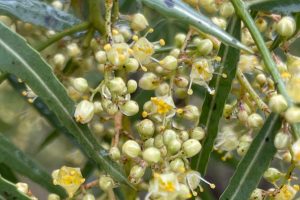
Imagine walking through a quiet Cypriot village in late April. The air carries a sweet, honey-like fragrance, and suddenly you notice a graceful tree covered in clouds of delicate lilac flowers. By autumn, the same tree hangs heavy with clusters of shiny yellow berries that glow like tiny lanterns against the green leaves. This is the chinaberry, a charming, fast-growing guest that has quietly become part of Cyprus’s everyday landscape. The Bead-Tree in the Mahogany Family Chinaberry, Melia azedarach, belongs to the Meliaceae (mahogany) family – the same noble group that gives us true mahogany timber and the famous neem tree of India. The genus Melia is small, and this species is the most widely planted. Locally it is known as Μαυρομάτα (Mavromata – “dark eyes”, referring to the darker centres of the flowers) or Αγριοπασχαλιά (Agrio Paschalia – wild Easter lilac). The name perfectly captures its springtime beauty. From Asian Forests to Cypriot Gardens Native to southern Asia (from India and China to northern Australia), the chinaberry has been valued for centuries for its shade, fragrant flowers and useful seeds. It reached the Mediterranean as an ornamental in the 19th century and arrived in Cyprus probably during the British period, planted in gardens, villages and small-holdings. Today it is fully naturalised across the island but remains non-invasive – a…

Read more
Seafood Traditions in Cyprus

Seafood Traditions in Cyprus

Seafood in Cyprus is not simply a category of food. It is a thread that runs through daily life, seasonal rhythms, and religious practice, shaped by the island’s geography and long relationship with the Mediterranean. For centuries, fish and seafood have fed families, marked fasting and feasting days, and anchored community celebrations along the coast. To understand Cypriot cuisine is to understand how the sea quietly shapes what is eaten, when it is shared, and why it matters. Living with the Sea, Not Just Beside It Cyprus has always existed in close dialogue with the sea. As an island at the crossroads of the eastern Mediterranean, its communities learned early that the water surrounding them was not a boundary, but a resource that demanded attention, knowledge, and respect. Seafood never developed as a luxury reserved for special occasions. Instead, it became part of a broader way of living shaped by seasonality and necessity. Even inland communities adapted their diets to include preserved fish brought from the coast, ensuring that the influence of the sea extended well beyond the shoreline. This practical relationship explains why Cypriot seafood traditions are grounded in restraint. The goal has rarely been to impress, but to nourish reliably and share what is available. The Historical Roots of a Maritime Diet Fishing in Cyprus developed gradually alongside…

Read more