Explore Cyprus with Our Interactive Map

Explore our top stories and discover ideas worth your time.

Cyprus Folk Dance Workshops

Cyprus Folk Dance Workshops

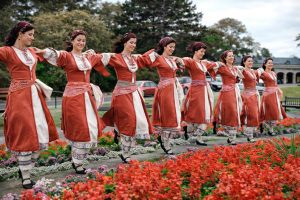
Cypriot folk dance is not something observed from a distance. It is something entered, shared, and carried by the group. Across Cyprus, workshops and demonstrations keep traditional dance alive by teaching it as a social practice rather than a staged performance. Whether held in village squares, community halls, or coastal courtyards, these gatherings connect rhythm, memory, and collective life in ways that still feel natural on the island today. politistiko-ergastiri.org Rather than preserving dance as choreography alone, Cypriot workshops focus on movement as a form of communication. Steps are learned not just as patterns, but as expressions shaped by history, environment, and social structure. Participation matters more than polish, and understanding matters more than display. Dance as a Social Language Traditional dance in Cyprus developed as a shared language rather than a spectacle. Long before formal instruction existed, dances were learned through observation and repetition during weddings, harvest celebrations, and religious festivals. Movement reflected everyday rhythms and reinforced bonds within the community. Modern workshops continue this approach. Instead of separating dancers into performers and audiences, they recreate the original logic of participation. Circles and open lines organise people spatially and socially, assigning roles, setting pace, and encouraging mutual awareness. A dance begins only when the group moves together, and its success depends on collective rhythm rather than individual expression. Foundational…

Read more

The Cyprus Cyclamen

The Cyprus Cyclamen

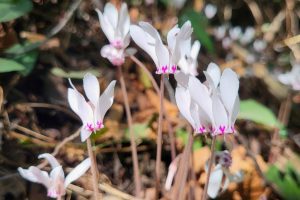
The Cyprus Cyclamen (Cyclamen cyprium) is far more than a delicate wildflower; it is a symbol of the island’s natural beauty and the resilience of its people. Formally designated as the national flower of Cyprus, this endemic treasure thrives in the cool, rocky shadows of the island's mountain ranges. seedscape.net The Mediterranean Rhythm: Growth in Winter In the unique climate of Cyprus, the seasons of life are reversed compared to northern latitudes. For the Cyprus Cyclamen, the scorching, dry summer is a period of "estivation" (summer dormancy), where it hides underground as a tuber to survive the heat. As the autumn rains arrive in September and October, the plant awakens. It uses the mild, wet winter to bloom and grow its biomass, taking advantage of the moisture before the landscape dries out again in May. Botanical Features and Identification While Cyprus is home to three cyclamen species, C. cyprium is the only one that is truly endemic—found nowhere else in the world. Key Characteristics • The Flower: Small, white to pale pink petals that sweep upward and twist at the tips. Each petal features a distinct magenta M-shaped mark at its base.• The Fragrance: It is famous for its intense, sweet lily-like scent that fills the winter air.• The Leaves: Heart-shaped with toothed edges. They are dark green with silver-grey…

Read more
Community-Based Fishing Villages of Cyprus

Community-Based Fishing Villages of Cyprus

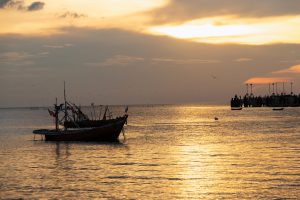
Along the Cypriot coast, fishing was never simply a job carried out at sea and forgotten once boats returned to shore. It was a shared way of life that shaped villages, relationships, and daily rhythm. In small coastal communities, fishing organised how people worked, ate, celebrated, and supported one another. Boats and nets mattered, but cooperation mattered more. Understanding Cyprus’s fishing villages means looking beyond catches and techniques to the social systems that grew around them and quietly endured. Adobe-Stock-com Villages Built Around Shared Work Community-based fishing villages developed where fishing was not an individual pursuit but a collective responsibility. Boats were small, crews were familiar, and labour depended on trust rather than contracts. Knowledge, tools, and effort were shared because survival demanded it. Cyprus’s coastline encouraged this structure. Shallow nearshore waters, sheltered bays, and predictable conditions suited small boats operated by families and neighbours. Fishing rarely rewarded isolation. Success came from working together, coordinating timing, and respecting unwritten rules shaped by experience. In these villages, fishing was not separate from life. It was life. A Way of Living Passed Down, Not Designed The roots of Cyprus’s fishing villages stretch back thousands of years. Archaeological evidence shows coastal communities relying on the sea from the Neolithic and Bronze Ages onward. Early fishers used simple vessels and local materials, learning quickly…

Read more