Explore Cyprus with Our Interactive Map

Explore our top stories and discover ideas worth your time.

Panagia Kanakaria Monastery Cyprus

Panagia Kanakaria Monastery Cyprus

Panagia Kanakaria Church is an early Byzantine-era religious structure located in the village of Lythrangomi on the Karpas Peninsula in northeastern Cyprus. The site is widely recognized as one of the most important surviving examples of early Byzantine ecclesiastical architecture and decorative art on the island. Constructed originally in the 5th or 6th century AD, the church reflects the early development of basilica-style architecture in Cyprus during the Byzantine period. It was built within a settlement that was connected to nearby ancient urban and rural communities, some of which date back to the Hellenistic and Roman eras. Historical Background The earliest phase of the structure is believed to date to the 5th century AD, when a simple wooden-roofed basilica was constructed with a single apse. Archaeological evidence suggests that materials from earlier nearby settlements were reused in its construction, a common practice in Late Antiquity across the eastern Mediterranean. During the 11th century, the building underwent major architectural expansion. The original basilica was modified into a more complex structure, including additional aisles, vaulted sections, and a dome. These changes reflect broader architectural trends in Byzantine Cyprus, where many ecclesiastical buildings were enlarged or reinforced as communities grew and resources became available. A narthex was later added during the 12th century, creating a transitional space between the exterior environment and the…

Read more
How Ancient Harbors Shaped Cyprus Cities

How Ancient Harbors Shaped Cyprus Cities

Cyprus did not become influential in the ancient Mediterranean by expanding inland or building empires on land. Its power grew from the edge of the sea. During the Bronze Age, natural harbors along the Cypriot coast evolved into gateways that connected the island to distant worlds. These maritime entry points shaped cities, concentrated wealth, and transformed Cyprus from a resource-rich island into a central player in early Mediterranean exchange. To understand Bronze Age Cyprus, it is necessary to look not at walls or palaces first, but at the waterlines where ships arrived. Where Land Met Opportunity Bronze Age harbors were not abstract ideas or convenient backdrops. They were the practical foundations of coastal life. In Cyprus, sheltered bays, shallow inlets, and calm lagoons allowed early ships to anchor safely, beach their hulls, and unload heavy cargo. These locations quickly attracted people. What began as seasonal landing points became permanent settlements built around maritime access. Harbors created opportunity. Inland communities focused on farming and mining, but coastal settlements gained something more powerful. They gained connection. Through the sea came materials, skills, and ideas that reshaped how people lived and governed. Over time, the harbor was no longer just part of the city. It became its reason for existence. A Coastline Designed for Exchange Cyprus was unusually well positioned for Bronze Age…

Read more
Makronissos Tombs

Makronissos Tombs

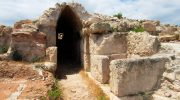
Carved into solid rock on a small peninsula west of Ayia Napa, the Makronissos Tombs are a window into ancient Cyprus. These 19 underground burial chambers date back over 2,000 years and reveal how people lived, died, and honored their dead during the Hellenistic and Roman periods. The Makronissos Tombs form an ancient necropolis, a city of the dead, where families buried their relatives between the 4th century BCE and the 4th century CE. Each tomb consists of a stepped pathway that descends into the rock, leading to a rectangular chamber sealed by stone slabs. Inside, the chambers feature three stone benches carved along the walls and a central rectangular trench slightly lower than the floor. The site also includes a small sanctuary built from large irregular stone blocks and remnants of an ancient quarry that operated nearby. The quarry unfortunately damaged some tombs, but enough survived to tell us about burial practices in ancient Cyprus. The Ancient Settlement of Thronon According to historical records, an ancient settlement called Thronon existed in the Ayia Napa area, along with several smaller communities. These settlements thrived until the Early Christian period but were abandoned around the 7th century CE during the Arab raids that swept across the Eastern Mediterranean. The tombs at Makronissos served as the final resting place for people from…

Read more