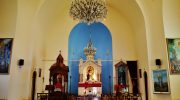
Christian Minority Traditions
Cyprus is home to several officially recognized minority communities that form part of its broader religious and cultural landscape. Alongside the Greek Orthodox majority, three long-established minority groups are traditionally identified in official records: Maronites, Armenians, and Latin Catholics. Together, these communities represent a small but historically significant portion of the population, estimated at under five percent in total. The 1960 Constitution of the Republic of Cyprus formally recognized these groups as religious minorities and provided parliamentary representation for each community. This arrangement reflects the island’s multi-layered social structure, shaped by centuries of migration, trade, and political change in the eastern Mediterranean. Each community developed its own linguistic, cultural, and institutional identity while also integrating into wider Cypriot society. Their presence illustrates how Cyprus evolved as a crossroads of civilizations, influenced by movements of people from the Levant, Anatolia, and Europe. Maronites keep ancient Arabic dialect alive The Maronite community has been present in Cyprus since at least the early medieval period, with migration waves beginning around the 8th century. These movements were linked to broader population shifts in the eastern Mediterranean during periods of political instability in the Levant. Over time, Maronite settlements became established primarily in the northern coastal regions of Cyprus. Historical records indicate that during the Lusignan period (1192–1572), the community maintained a strong rural presence…
Read more