Explore Cyprus with Our Interactive Map

Explore our top stories and discover ideas worth your time.

Agoi Saranda Cave Church

Agoi Saranda Cave Church

The Agioi Saranta Cave Church stands as a sacred monument within the rugged landscape of Protaras. This sanctuary occupies a natural limestone cavern on Fanou Hill and overlooks the Mediterranean Sea. It represents a rare fusion of geological formation and ecclesiastical architecture. The name translates to the Holy Forty and honors the Forty Martyrs of Sebaste. These Roman soldiers died in the year 320 AD because they refused to renounce their Christian faith. Local tradition links the forty stalactites on the cave ceiling to these forty individuals. Visitors find the entrance marked by a simple white wall and a distinct blue door. A stone dome sits atop the hill to provide a skylight for the interior space. This site offers a peaceful atmosphere for meditation away from the busy tourist centers of Cyprus. Historical Origins and Dedication The roots of the Agioi Saranta Cave Church date back to the early Christian period though some sources suggest more formal establishment in the sixteenth century. Christian monks likely utilized this space as a secluded retreat to avoid persecution or distraction. It serves as a testament to the endurance of the Orthodox faith throughout different eras of Cypriot history. The dedication to the Forty Martyrs of Sebaste provides a deep theological connection to the site. These martyrs belonged to the Legio XII Fulminata…

Read more
Kantou-Koufovounos

Kantou-Koufovounos

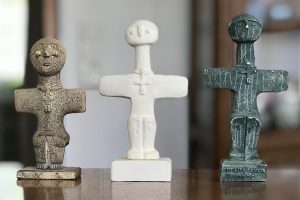
High on a hill near the Kouris River in the Limassol district of Cyprus sits Kantou Koufovounos, one of the island’s most significant Late Neolithic settlements. This archaeological site has quietly rewritten our understanding of life on Cyprus between 4,400 and 3,900 BC. Unlike the dramatic clifftop fortresses or coastal harbors that often capture imaginations, Kantou-Koufovounos was simply a community where people lived, worked, raised families, and built a society that lasted longer than many of its contemporary neighbors. The site takes its name from Koufovounos Hill, where it rests approximately 20 to 50 centimeters below the modern ground surface. This shallow depth speaks to how close we still are to these ancient inhabitants. The settlement sits on the western bank of the Kouris River, positioned in terrain that offered natural protection while remaining accessible to vital resources. Historical Background Excavations at Kantou-Koufovounos began in summer 1992 under the direction of the National and Kapodistrian University of Athens. This marked the first archaeological project the university undertook in Cyprus. The work continued through 1999, with additional periods in 1996, 1998, 2000, and 2001 dedicated to recording and studying the recovered materials. These careful excavations revealed rectangular residential units, storage pits, fire hearths, graves, and an extensive collection of stone tools. What makes this site particularly interesting is how much of…

Read more
Sacred Groves of Ancient Cyprus

Sacred Groves of Ancient Cyprus

In ancient Mediterranean belief systems, the natural world was not viewed as separate from the divine but as one of its primary expressions. Mountains, springs, caves, and especially groves of trees were often regarded as places where divine presence could be felt most directly. In Cyprus, this understanding took a distinctive form through the preservation and veneration of sacred groves. These spaces were not heavily built environments but living landscapes set apart from ordinary use. They represented an early form of ecological sacredness, where nature itself functioned as a sanctuary and the boundary between human and divine realms was marked by respect rather than construction. Sacred groves on the island reflect a worldview in which divinity resided in the rhythms of growth, fertility, and renewal. Trees symbolized endurance and life cycles, making wooded areas especially suitable for ritual activity connected to fertility, seasonal change, and divine blessing. By leaving these areas relatively untouched, communities expressed reverence not only for the gods but also for the natural environment believed to host them. This practice linked spiritual devotion with environmental awareness in a way that modern perspectives often describe as sacred ecology. The Grove as a Form of Sanctuary Unlike monumental temples that defined sacred space through architecture, groves created sacredness through preservation. A boundary—sometimes marked by stones, walls, or natural features—separated…

Read more