Explore Cyprus with Our Interactive Map

Explore our top stories and discover ideas worth your time.

Temple of Zeus Salaminios

Temple of Zeus Salaminios

The Temple of Zeus Salaminios was one of the most important religious monuments of ancient Salamis. Dedicated to Zeus as the supreme god of the Olympian pantheon, it symbolised the city’s Greek identity, political authority, and connection to divine protection. Through this temple, Salamis expressed its place within the wider Greek world while affirming its own power and prestige. A Temple at the Heart of Salamis The Temple of Zeus Salaminios stood within the great city of Salamis on the eastern coast of Cyprus. As one of the island’s largest and wealthiest cities, Salamis required a religious centre that matched its status. The choice of Zeus was deliberate. As ruler of gods and men, Zeus represented order, authority, and legitimacy. Worshipping him in monumental form reinforced Salamis’s role as a leading city with strong ties to Greek tradition and values. Zeus as Guardian of the City Zeus Salaminios was not a distant or abstract god. He was believed to actively protect the city, its people, and its rulers. His cult emphasised stability, justice, and continuity, qualities essential for a powerful urban centre. Rulers and elites used the sanctuary to demonstrate their devotion and to associate their authority with divine approval. Public ceremonies held at the temple reinforced the idea that Salamis thrived under Zeus’s watchful presence. From Early Cult to…

Read more
Trooditissa Monastery

Trooditissa Monastery

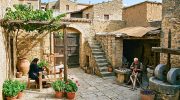
Trooditissa Monastery is a historic monastic site located on the southern slopes of the Troodos Mountains at an altitude of around 1,300 meters. It lies near the village of Platres and is surrounded by dense pine forests. The monastery is officially known as Panagia Trooditissa, a name that reflects its geographical setting within the Troodos mountain range. Historical references place the origins of the monastery around the late 10th century, shortly after the Byzantine iconoclasm period. While the present buildings are later reconstructions, the site is recognized for its long-standing monastic presence and its role in the religious and cultural landscape of Cyprus. Historical Background During the 8th and 9th centuries, the Byzantine Empire experienced a period in which religious imagery was officially restricted and many icons were removed or destroyed. In this broader historical context, some monks and religious communities migrated to remote regions such as Cyprus, where local monastic life continued with less direct imperial enforcement. According to traditional accounts, a monk associated with this period brought a religious icon from Constantinople and initially settled at a monastic site near Limassol, later associated with the Monastery of Saint Nicholas. After spending many years there, he is described in local tradition as moving toward a more isolated monastic lifestyle in the Troodos Mountains, eventually establishing a hermitage in a…

Read more
Buffavento Castle Cyprus

Buffavento Castle Cyprus

Buffavento Castle stands at 960 meters above sea level in the Kyrenia mountain range of Cyprus. This medieval fortress is the highest and least preserved of three Byzantine strongholds built along the mountains. The name comes from Italian and means "Defier of the Winds," a fitting description for a castle constantly exposed to mountain winds at this elevation. The castle sits between St. Hilarion Castle to the west and Kantara Castle to the east, forming a defensive line across the Kyrenia Mountains. All three castles are visible from each other, allowing them to pass signals and warnings. Buffavento guarded the mountain passage from Kythrea to the north coast, controlling movement between the coastal plain and the interior. The location provides views in every direction. Looking north across the Mediterranean Sea, visitors can see the Turkish coast approximately 65 kilometers away on clear days. To the south, the Mesaoria Plain stretches toward Nicosia. On exceptionally clear days, Famagusta to the east and the Troodos Mountains to the south are visible. The castle overlooks nearly half the island from its rocky peak. The steep cliffs surrounding the fortress made it naturally defensible. The north, east, and west sides are protected by sheer drops, with only the southern approach allowing access. Historical Background The exact construction date remains unknown, though most historians believe…

Read more