Explore Cyprus with Our Interactive Map

Explore our top stories and discover ideas worth your time.

Lilac Clouds and Golden Berries

Lilac Clouds and Golden Berries

Imagine walking through a quiet Cypriot village in late April. The air carries a sweet, honey-like fragrance, and suddenly you notice a graceful tree covered in clouds of delicate lilac flowers. By autumn, the same tree hangs heavy with clusters of shiny yellow berries that glow like tiny lanterns against the green leaves. This is the chinaberry – a charming, fast-growing guest that has quietly become part of Cyprus’s everyday landscape. www.inaturalist.org The Bead-Tree in the Mahogany Family Chinaberry, Melia azedarach, belongs to the Meliaceae (mahogany) family – the same noble group that gives us true mahogany timber and the famous neem tree of India. The genus Melia is small, and this species is the most widely planted. Locally it is known as Μαυρομάτα (Mavromata – “dark eyes”, referring to the darker centres of the flowers) or Αγριοπασχαλιά (Agrio Paschalia – wild Easter lilac). The name perfectly captures its springtime beauty. From Asian Forests to Cypriot Gardens Native to southern Asia (from India and China to northern Australia), the chinaberry has been valued for centuries for its shade, fragrant flowers and useful seeds. It reached the Mediterranean as an ornamental in the 19th century and arrived in Cyprus probably during the British period, planted in gardens, villages and small-holdings. Today it is fully naturalised across the island but remains non-invasive…

Read more
Byzantine Chant in Cypriot Style

Byzantine Chant in Cypriot Style

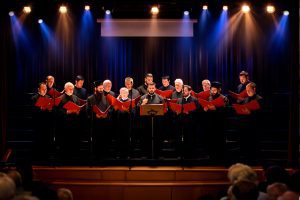
Byzantine Chant in Cypriot Style is a localized variant of Orthodox liturgical music, characterized by unique melodic phrasing and vocal delivery that distinguish it from mainland traditions. Preserved in monasteries and village churches across the island, it incorporates ancient modes with Cypriot inflections, blending spiritual depth with cultural expression. This form of chant reflects Cyprus's role as a guardian of Byzantine heritage, evoking how sacred sound has shaped devotion for centuries. A Distinct Voice in Orthodox Liturgy Byzantine chant in Cypriot style represents a regional adaptation of the Eastern Orthodox musical tradition, where melodies and rhythms carry theological meaning through voice alone. Developed over centuries in Cyprus's isolated monasteries and rural churches, it features elongated notes, subtle ornamentation, and a nasal timbre that evoke emotion and reverence. This style not only accompanies services but also serves as a cultural anchor, preserving ancient hymnody while incorporating local dialects and rhythms. Its survival highlights Cyprus's position as a crossroads of influences, where Byzantine purity met Mediterranean flavors, creating a chant that feels both timeless and intimately island-bound. Historical Origins and Evolution The roots of Cypriot Byzantine chant trace to the early Christian era, when the island adopted liturgical music from Constantinople around the 4th century AD. Apostles Barnabas and Paul introduced Christianity in the 1st century, as recorded in the Acts of…

Read more
Traditional Cypriot Dances Spoke Without Words

Traditional Cypriot Dances Spoke Without Words

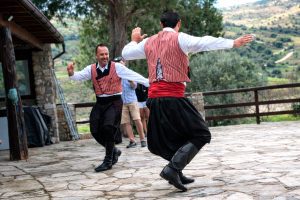
Long before dating, private meetings, or casual conversation between young men and women were socially acceptable, Cyprus had another system. It happened in village squares, at weddings, and during festivals. It used rhythm instead of language and movement instead of promises. Through paired dances such as the Sousta and Antikristos, Cypriot communities created a public, structured way for courtship to unfold, allowing interest, character, and respect to be displayed openly while remaining within strict social boundaries. These dances were never casual entertainment. They were carefully coded social encounters, understood by everyone watching. Face to Face, but Never Too Close At the heart of Cypriot courtship dancing is a simple idea: two people facing one another. The Antikristos, whose name literally means “opposite” or “face to face,” places dancers across from each other rather than in a circle or line. This positioning mattered. It allowed eye contact, acknowledgement, and interaction, but always at a controlled distance. pinterest.com2 In traditional village life, direct interaction between unmarried men and women was limited. The dance floor became one of the few socially accepted spaces where such interaction could occur in public, under the gaze of the community. Nothing was hidden. Everything was observed. The Sousta follows a similar logic but adds energy. Its springing, hopping steps introduce vitality and momentum, turning the encounter into…

Read more