Explore Cyprus with Our Interactive Map

Explore our top stories and discover ideas worth your time.

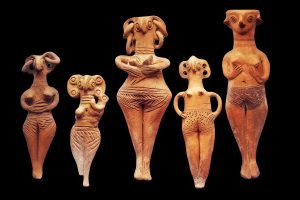
Fertility and Mother Goddess Cults in Ancient Cyprus

Fertility and Mother Goddess Cults in Ancient Cyprus

Fertility and Mother Goddess cults in ancient Cyprus were the island's earliest spiritual heartbeat, centered on a powerful female divine force that oversaw birth, growth, and the rhythms of nature. These beliefs weren't about distant deities but a hands-on reverence for life's cycles, helping early communities thrive amid uncertainty. Digging into them reveals how Cypriots turned everyday survival into something sacred, leaving us wondering just how much of that ancient wisdom still echoes today. The Roots of Cyprus's Earliest Beliefs Imagine a time when religion wasn't found in grand temples or holy books, but in the soil under your feet and the changing seasons overhead. That's where Fertility and Mother Goddess cults began in Cyprus - as a practical way for prehistoric people to make sense of a world full of risks like failed crops or harsh winters. These weren't fancy philosophies; they were born from the need to ensure life kept going. The Mother Goddess, often depicted as a nurturing female figure, symbolized the force behind everything that grew or multiplied. She wasn't a queen on a throne but more like the earth's own pulse, connecting humans to the land's bounty. For early Cypriots, from the Chalcolithic period around 4000 BC onward, this wasn't superstition - it was survival wrapped in awe, a way to feel in control of…

Read more
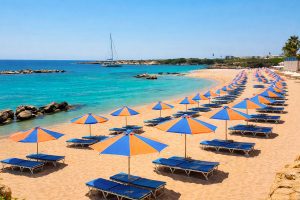
Coral Bay Beach, Paphos, Cyprus

Coral Bay Beach, Paphos, Cyprus

The beach stretches approximately 500 meters along a horseshoe-shaped bay. Two limestone headlands flank the shoreline and create natural protection from strong winds and waves. This geographical formation keeps the waters remarkably calm even when other beaches experience rough conditions. cyprusbylocals-com The sand at Coral Bay is fine and golden, considered among the best examples of sandy beach terrain in Cyprus. Unlike many Mediterranean beaches that feature pebbles or coarse sand, Coral Bay offers soft sand that remains comfortable for barefoot walks and beach activities. The waters are shallow and clear enough to see the seabed, which makes the beach particularly suitable for children and less confident swimmers. Cyprus recognized Coral Bay as its ninth plastic-free beach, part of a broader environmental initiative to reduce plastic waste along the island's coastlines. This designation reflects ongoing efforts to maintain the beach's natural beauty and protect marine ecosystems. Historical Background At the northern end of Coral Bay sits the Maa-Paleokastro archaeological site, where the first Mycenaean Greeks settled in 1200 BC. These settlers arrived on Cyprus after the fall of the Mycenaean kingdoms in mainland Greece. The site marks the beginning of the Hellenization of Cyprus, the process through which Greek language and culture spread across the island. The settlement takes its name from its imposing defensive walls, which were always visible…

Read more
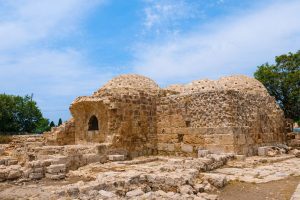
Basilica of Chrysopolitissa Paphos History Facts

Basilica of Chrysopolitissa Paphos History Facts

In the heart of Paphos stands a remarkable archaeological site where more than 1,600 years of Christian history remain visible. The Basilica of Chrysopolitissa, once the largest church in Cyprus, now reveals its ancient mosaics, towering columns, and a legendary pillar that connects this place to one of Christianity's most influential figures. tripadvisor-com The Basilica of Chrysopolitissa, also known as Panagia Chrysopolitissa, is an archaeological complex in Kato Paphos that contains the ruins of what was once the largest early Christian basilica on the island of Cyprus. Built in the late 4th century AD, this massive church served as the cathedral of Paphos and the seat of its bishop. Today, the site includes not only the basilica ruins but also a working church called Agia Kyriaki, a medieval Franciscan church, and the famous St. Paul's Pillar. Historical Background The basilica was constructed in the second half of the 4th century AD, at a time when Christianity was becoming the official religion of the Roman Empire. Cyprus had already embraced Christianity thanks to the visit of Apostles Paul and Barnabas in 45 AD, when they converted the Roman proconsul Sergius Paulus, making Cyprus one of the first regions to have a Christian leader. The basilica was built on the site of an earlier Roman structure, possibly near where a synagogue once…

Read more