Explore Cyprus with Our Interactive Map

Explore our top stories and discover ideas worth your time.

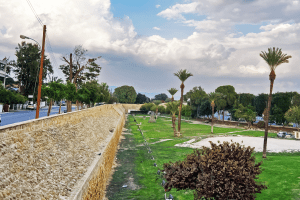
Venetian Walls of Nicosia, Cyprus

Venetian Walls of Nicosia, Cyprus

The Venetian Walls of Nicosia form a circular defense system around the capital city of Cyprus. Built between 1567 and 1570 by the Republic of Venice, these Renaissance fortifications remain largely intact and represent one of the best-preserved examples of 16th-century military architecture in the Eastern Mediterranean. voicemap-me The walls create an almost perfect circle around the old city with a circumference of approximately 5 kilometers. This circular shape was innovative for its time and reflected the latest military engineering principles from Renaissance Italy. The design eliminated the weaknesses of medieval fortifications and created a more efficient defensive perimeter that required fewer soldiers to defend. The walls were built primarily from mud brick with the lower sections reinforced with stone. A wide moat 80 meters across surrounded the entire fortification, providing an additional obstacle for attackers. The moat was designed to be filled with water from the Pedieos River, which was diverted outside the city walls during construction. Historical Background Before the Venetian walls existed, earlier fortifications protected Nicosia. The first defensive structure was a castle built in 1211 during the Lusignan period. King Peter I constructed the Margarita Tower in 1368, a large defensive tower that stood as a major landmark. His successor, Peter II built the first walls surrounding the entire city, though he demolished the Margarita Tower…

Read more
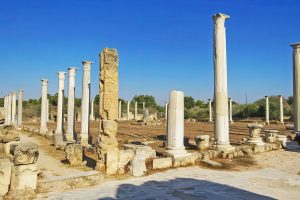
Temple of Zeus Salaminios

Temple of Zeus Salaminios

The Temple of Zeus Salaminios was one of the most important religious monuments of ancient Salamis. Dedicated to Zeus as the supreme god of the Olympian pantheon, it symbolised the city’s Greek identity, political authority, and connection to divine protection. dreamstime-com Through this temple, Salamis expressed its place within the wider Greek world while affirming its own power and prestige. A Temple at the Heart of Salamis The Temple of Zeus Salaminios stood within the great city of Salamis on the eastern coast of Cyprus. As one of the island’s largest and wealthiest cities, Salamis required a religious centre that matched its status. vici-org The choice of Zeus was deliberate. As ruler of gods and men, Zeus represented order, authority, and legitimacy. Worshipping him in monumental form reinforced Salamis’s role as a leading city with strong ties to Greek tradition and values. Zeus as Guardian of the City Zeus Salaminios was not a distant or abstract god. He was believed to actively protect the city, its people, and its rulers. His cult emphasised stability, justice, and continuity, qualities essential for a powerful urban centre. wikipedia-org Rulers and elites used the sanctuary to demonstrate their devotion and to associate their authority with divine approval. Public ceremonies held at the temple reinforced the idea that Salamis thrived under Zeus’s watchful presence. From…

Read more

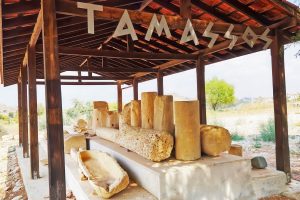
Tamassos Sacred Valley

Tamassos Sacred Valley

Tamassos was an inland city-kingdom that thrived from the Late Bronze Age to the Roman period, from around 1200 BC to the 10th century AD. The city appears in an Assyrian inscription from about 673 BC as Tamesi, a city-state that paid tribute to the Neo-Assyrian Empire. Homer may have mentioned it in the Odyssey as Temese, described as the main copper market on the island. culturespot-cy The archaeological site is next to the modern village of Politiko. Much of the ancient city center has not been excavated because it lies under the village and the nearby Monastery of Saint Herakleidios. Archaeologists have uncovered two large royal tombs from the 6th century BC, the foundations of a temple to Aphrodite, parts of city walls, and signs of extensive copper-processing workshops. Historical Background The region was inhabited since the Chalcolithic Age, and villages in the area were densely populated from the Early Bronze Age. Small farming settlements existed long before Tamassos became a unified city. The discovery and use of copper deposits transformed the farmland into an industrial center. The population grew significantly after the copper mines were exploited. Tombs and copper-processing workshops from the Late Bronze Age show this growth. Tamassos controlled major mines near its capital, like Mavrovouni and Kokkinopezoula, which made it a center of copper production. Classical…

Read more