Explore Cyprus with Our Interactive Map

Explore our top stories and discover ideas worth your time.

Panigyria Cyprus Villages

Panigyria Cyprus Villages

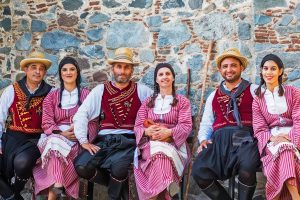
Across Cyprus, every village has at least one night each year when the roads feel a little busier, the air smells faintly of smoke and grilled meat, and familiar voices reappear as if they never left. The panigyri, the traditional village festival, is that moment: a lived ritual shaped by faith, agriculture, and the island’s instinct for togetherness, turning quiet communities into crowded, luminous meeting places where memory and belonging become tangible again. A Gathering of Everyone The word panigyri carries its meaning in its roots. It comes from the ancient Greek panēguris, built from pan (“all”) and agora (“gathering” or “marketplace”), and it points to an older world where people came together for religious, political, and cultural life in the same shared space. In Cyprus, that idea endured through centuries of change and settled into the calendar as the central annual pulse of village life. cyprus-mail-com Today, a panigyri usually marks a patron saint’s feast day or aligns with a seasonal moment tied to harvest and local rhythm, which is why it often feels both sacred and grounded, elevated and practical at the same time. It blends devotion with celebration, turning the village square into a social arena where residents, visitors, and returning diaspora find each other again, sometimes after years, sometimes after a single season away. What makes…

Read more

Traditional Percussion and Rhythm of Cyprus

Traditional Percussion and Rhythm of Cyprus

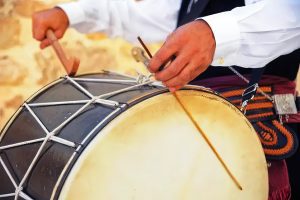
Traditional percussion in Cyprus is not decoration. It is structured. Long before written music or formal performance spaces, rhythm organised ritual, movement, and social life on the island. From village squares to wedding processions, the drum provided a shared pulse that told people when to gather, how to move, and when a moment mattered. Cypriot percussion did not evolve to impress an audience. It evolved to hold a community together. teriremproject-org Why Rhythm Comes First in Cypriot Music Cyprus sits at a cultural crossroads between the Eastern Mediterranean, Anatolia, and the Levant. Melodies travelled easily across these regions, but rhythm was what anchored them locally. Percussion gave Cypriot music its internal order, allowing dances, songs, and rituals to remain recognisable even as influences shifted over centuries. Unlike modern ensembles where rhythm supports melody, traditional Cypriot music often works the other way around. The drum sets the framework. Everything else responds. The Daouli: A Drum Built for the Open Air The most recognisable percussion instrument in Cyprus is the daouli, a large double-headed drum designed to be heard across open spaces. Its size and volume were practical. Village celebrations, processions, and agricultural festivals needed sound that could travel without amplification. The daouli is worn over the shoulder and played with two different sticks. One produces deep, grounding beats. The other delivers…

Read more
Paphos – Western Kingdom

Paphos – Western Kingdom

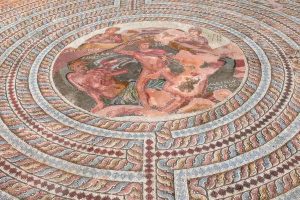
www.sovereign.com Paphos refers to two distinct but connected ancient cities in southwestern Cyprus. Palaipaphos (Old Paphos), located at modern Kouklia village, was the original seat of the kingdom and the center of Aphrodite worship from the 12th century BC. Nea Paphos (New Paphos), founded around 320-310 BC at the modern coastal city of Paphos, served as the administrative and commercial capital during Hellenistic and Roman periods. The archaeological complex encompasses both sites and was inscribed on the UNESCO World Heritage List in 1980. The Sanctuary of Aphrodite at Palaipaphos dates to Mycenaean times and functioned as one of the most important pilgrimage destinations in the ancient Greek world. The Archaeological Park at Kato Paphos preserves Roman villas with elaborate mosaic floors, a Hellenistic theater, fortifications, public buildings, and the Tombs of the Kings necropolis. Together, these sites document over 2,500 years of continuous religious and political significance. Historical Background According to Greek stories, the hero Agapenor from Arcadia founded Paphos after the Trojan War and built a temple to Aphrodite around 1200 BC. Archaeology confirms Mycenaean people lived there, supporting this date. This makes it one of the earliest Greek religious sites in Cyprus. The sanctuary was unusual because it did not have a human statue of the goddess. Instead, people worshipped a conical stone, possibly a meteorite, as a…

Read more