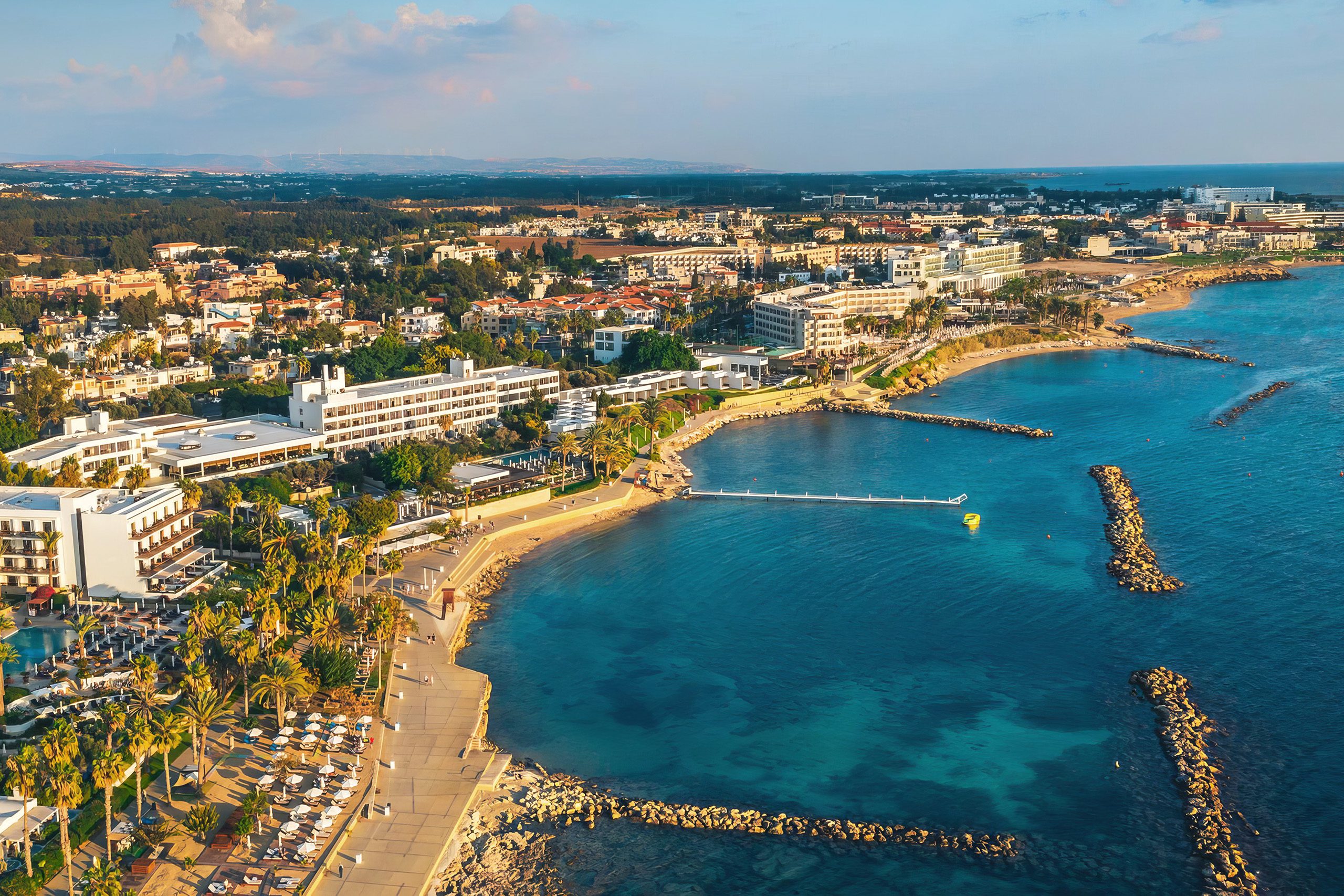
Paphos refers to two distinct but connected ancient cities in southwestern Cyprus. Palaipaphos (Old Paphos), located at modern Kouklia village, was the original seat of the kingdom and the center of Aphrodite worship from the 12th century BC. Nea Paphos (New Paphos), founded around 320-310 BC at the modern coastal city of Paphos, served as the administrative and commercial capital during Hellenistic and Roman periods.
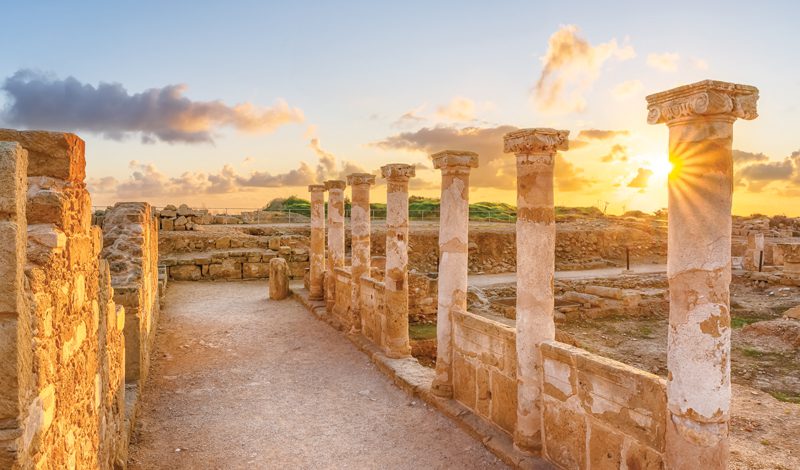
The archaeological complex encompasses both sites and was inscribed on the UNESCO World Heritage List in 1980. The Sanctuary of Aphrodite at Palaipaphos dates to Mycenaean times and functioned as one of the most important pilgrimage destinations in the ancient Greek world. The Archaeological Park at Kato Paphos preserves Roman villas with elaborate mosaic floors, a Hellenistic theater, fortifications, public buildings, and the Tombs of the Kings necropolis. Together, these sites document over 2,500 years of continuous religious and political significance.
Historical Background
According to Greek stories, the hero Agapenor from Arcadia founded Paphos after the Trojan War and built a temple to Aphrodite around 1200 BC. Archaeology confirms Mycenaean people lived there, supporting this date. This makes it one of the earliest Greek religious sites in Cyprus.
The sanctuary was unusual because it did not have a human statue of the goddess. Instead, people worshipped a conical stone, possibly a meteorite, as a symbol of Aphrodite. This way of worship, called aniconic, was influenced by Near Eastern religious traditions and made Palaipaphos different from other Greek temples. Ancient texts describe annual festivals with processions from New Paphos to the sanctuary, attended by many pilgrims.
The Aphrodite cult at Paphos actually began before the Greeks arrived. It likely started from local Cypriot worship of a fertility goddess during the Chalcolithic period (3900–2500 BC). When Greeks came in the Late Bronze Age, they identified the local goddess with their Aphrodite and kept the temple important. This created a unique mix of Near Eastern and Greek religious traditions that attracted visitors from across the Mediterranean.
The kings of Paphos also acted as high priests of the temple, combining political and religious power. Inscriptions from the 5th and 4th centuries BC show kings were called both “basileis of Paphos” (king) and “hiereis of the wanassa” (priest of the Queen Goddess). This made the monarchy stronger by connecting royal authority directly to the gods.
Foundation of New Paphos
At the end of the 4th century BC, Nikokles, the last king of Paphos, founded a new coastal city about 14 kilometers northwest of the old capital. He moved the city because the old harbor could no longer handle the growing maritime trade of the Hellenistic period. A better port was needed to keep the kingdom’s economy strong.
Nikokles planned the new city using a grid layout, typical of Hellenistic cities, and built a temple to Artemis Agrotera. Archaeologists have found early Hellenistic walls, floors, and pottery under later Roman buildings, confirming the city was founded around 321–310 BC. The city had blocks of houses, public buildings, and streets organized in a clear, logical way.
Soon after, Ptolemy I Soter conquered Cyprus and added it to his Egyptian kingdom. Historical sources say Ptolemy had Nikokles and his family killed, ending Paphos’s independence. In 312 BC, Ptolemy destroyed the nearby city of Marion and moved its people to New Paphos, making the city larger and more economically important.
The Ptolemies valued New Paphos as a strategic city and made it the administrative capital of Cyprus. From around 200 BC until the 4th century AD, the city was the seat of government, first for Ptolemaic rulers and later for Roman officials. During this 500-year period, the city grew with public buildings, fortifications, and civic infrastructure.
Archaeological Excavations
Modern archaeological investigation of Paphos began in the early 20th century with brief surveys and test excavations. Systematic work commenced in 1962 when a local farmer accidentally discovered Roman mosaics while plowing his field. This chance find led to decades of excavation that gradually revealed the extent and quality of Paphos’s archaeological remains.
The Cyprus Department of Antiquities conducted major excavations at various locations within Kato Paphos between the 1960s and 1990s. Foreign archaeological missions, particularly from Poland, have made substantial contributions since the 1960s. The Polish Centre of Mediterranean Archaeology of Warsaw University has worked at the Maloutena site since 1965 and uncovered the House of Aion along with important evidence about the city’s topography and development.
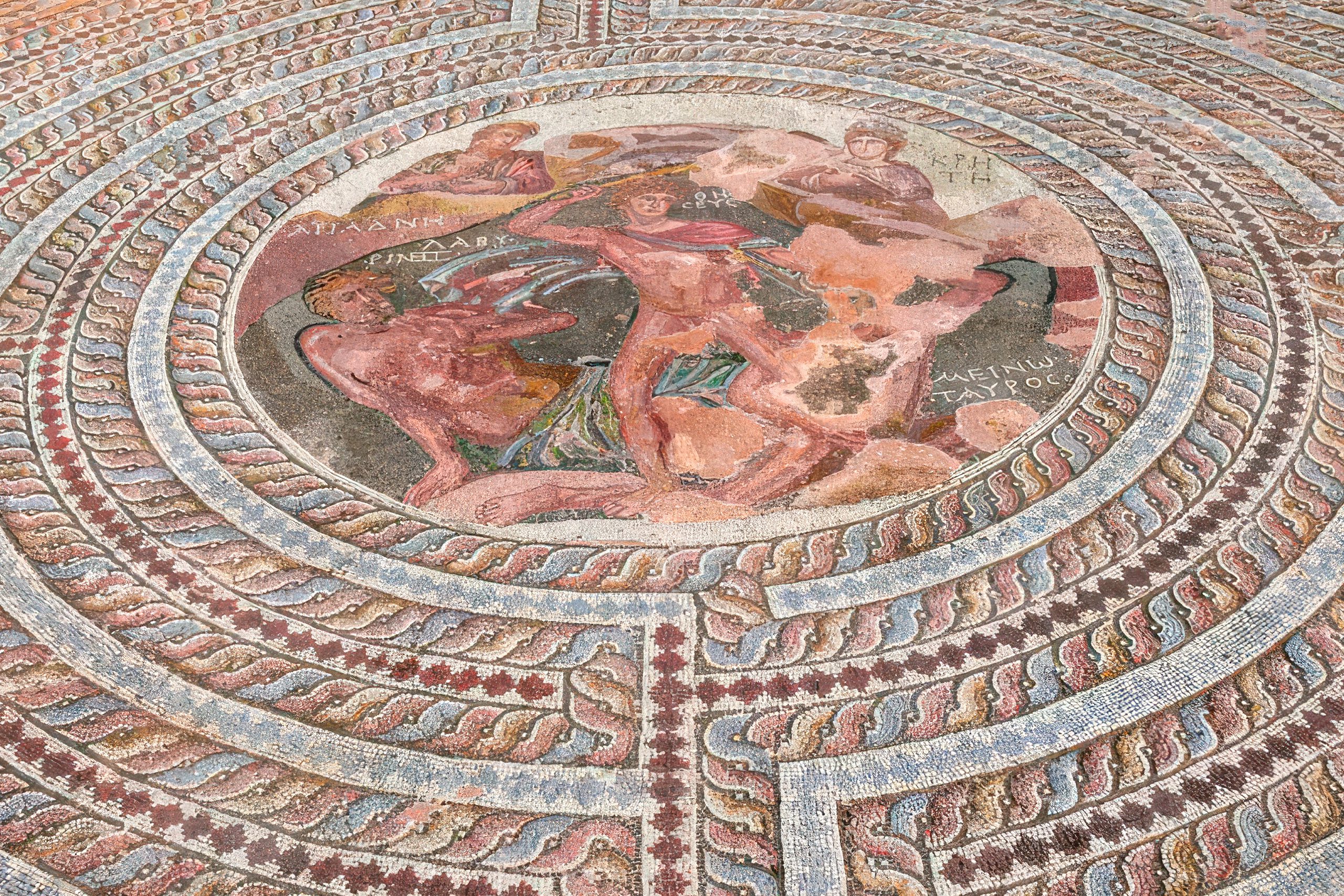
Polish teams under successive directors Wiktor Daszewski (1971-2007) and Henryk Meyza (2008-2019) gradually exposed the Villa of Theseus and numerous other structures. Since 2020, a consortium including Jagiellonian University, Polish Centre of Mediterranean Archaeology, and Warsaw University of Technology has studied the agora and urban layout using advanced digital modeling and documentation techniques.
Excavations continue to reveal new structures and refine understanding of how Paphos developed from its late 4th century BC foundation through medieval times. Recent work has focused on the city’s fortifications, harbors, and public spaces rather than solely on elite residences. This broader approach provides a more complete picture of urban life at all social levels.
Why Paphos Matters
Paphos represents the longest continuous religious tradition documented anywhere in Cyprus. The Sanctuary of Aphrodite functioned from the 12th century BC until the 4th century AD, spanning over 1,500 years. This unbroken cult activity demonstrates remarkable cultural continuity through Mycenaean, Phoenician, Persian, Hellenistic, and Roman periods.
The city also exemplifies successful urban relocation in the ancient world. Nikokles’s decision to move his capital from inland Palaipaphos to coastal New Paphos succeeded beyond his expectations. Though he did not live to see it, his new city became Cyprus’s capital for half a millennium and attracted investment from Ptolemaic and Roman rulers who recognized its strategic and economic value.
The villa mosaics at Paphos rank among the finest examples of Roman provincial art anywhere in the empire. The quality of design, execution, and preservation allows detailed study of mythological iconography, artistic techniques, and elite domestic architecture. These mosaics provide evidence of cultural sophistication and wealth comparable to what existed in major imperial centers like Rome and Alexandria.
Visiting Paphos Archaeological Park
The main archaeological site at Kato Paphos is located near the harbor in modern Paphos city. The park is open daily with seasonal hours: 8:00-17:00 (November-March), 8:00-18:00 (April-May), 8:00-19:30 (June-August), and 8:00-18:00 (September-October). Single admission of €4.50 provides access to all structures within the park including the four villa mosaics, the odeon, the agora, and other remains.
Raised wooden walkways allow visitors to view the mosaic floors from above without damaging the fragile surfaces. Information plaques in English and Greek explain the mythological scenes and provide architectural context.
The Tombs of the Kings necropolis is located about 2 kilometers north of the main archaeological park and requires separate admission of €2.50. Palaipaphos at Kouklia village is accessible by car approximately 15 kilometers southeast of Paphos.
The site includes the Sanctuary of Aphrodite ruins and a small museum housed in the medieval Lusignan Manor. Admission is separate from the main archaeological park. Petra tou Romiou (Aphrodite’s Rock), the legendary birthplace of the goddess, is located along the coastal road between Paphos and Limassol and is free to visit.
A Legacy of Beauty and Power
Paphos matters because it demonstrates how religious authority and political power intertwined in the ancient Mediterranean world. The kings of Paphos ruled as priest-kings, deriving legitimacy from their role as intermediaries between the goddess and the people. This theocratic model continued even after the kingdom’s independence ended, with Ptolemaic and Roman officials maintaining and expanding the Aphrodite cult for political purposes.
The city also shows how ancient societies managed urban development and capital relocation. The successful transfer from Old to New Paphos required careful planning, substantial investment, and political will. The new city’s grid plan, harbor facilities, and public buildings demonstrate sophisticated urban design that anticipated centuries of growth and adaptation.