Explore Cyprus with Our Interactive Map

Explore our top stories and discover ideas worth your time.

Music in Cyprus Weddings And Festivals

Music in Cyprus Weddings And Festivals

Cyprus uses music as a social "signal system" that marks life transitions and pulls communities into the same emotional rhythm, from weddings and baptisms to village saint festivals. facebook-com Across many Greek Cypriot celebrations, the violin (violi) and laouto form the classic duo, while Turkish Cypriot traditions often foreground the oud and, in outdoor festivities, the powerful davul and zurna pairing. Religious settings shift the sound world. Orthodox ceremonies are shaped by Byzantine chant, while Turkish Cypriot gatherings may include Mevlit recitations that bring blessings to the home. Modern Cyprus is increasingly hybrid: live musicians for key rituals, then DJs for late-night receptions, especially in urban venues. When music is not the background, but permission In Cyprus, music is rarely a decorative extra. It is how a moment becomes official. paphosweddingcompany-co A wedding is not just a couple signing papers or walking into a church. It becomes socially “real” when the instruments arrive, the first dance line forms, and the right songs tell everyone what stage of the ritual they are in. Baptisms, too, move from sacred chant to family feast once the community shifts from reverence to celebration. Even the biggest religious festivals carry this same logic: prayer first, then the village square opens into food, dancing, and sound. That is why Cypriot celebration music feels so purposeful. It…

Read more

Salamis City, Cyprus – History & Facts

Salamis City, Cyprus – History & Facts

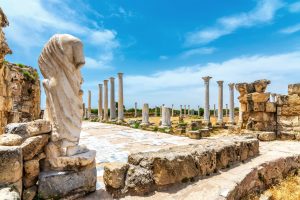
Salamis stands as one of the most important archaeological sites on the island of Cyprus. Located on the eastern coast near modern Famagusta, this ancient city flourished for over 1,800 years before nature forced its abandonment. The ruins spread across one square mile along the coast, offering visitors a remarkable glimpse into ancient Mediterranean civilization. cyprusparadise.com According to Greek legend, Salamis was founded by Teucer, son of King Telamon. After the Trojan War ended, Teucer could not return home because he failed to avenge his brother Ajax. Banished by his father, Teucer sailed to Cyprus and established a new city named after his birthplace, the island of Salamis near Athens. Archaeological evidence dates the earliest settlement to the 11th century BC during the Late Bronze Age. The city likely emerged as a replacement for nearby Enkomi, which was abandoned when its harbor silted up. Cyprus held immense strategic value due to its rich copper deposits, and Salamis became a crucial hub in Mediterranean trade networks. From Kingdom to Capital By the 6th century BC, Salamis had grown into the most powerful city on Cyprus. King Euelthon, who ruled from 560 to 525 BC, claimed authority over the entire island and became the first Cypriot king to mint coins. The city came under Persian control in 525 BC but maintained considerable…

Read more
Cyprus Police Museum (Nicosia)

Cyprus Police Museum (Nicosia)

The Cyprus Police Museum chronicles law enforcement history in Cyprus from British colonial times through independence to the present day. The British Chief of Police, W.C.C. King, founded the museum in 1933 during the colonial period. cyprusbutterfly-com The museum documented criminal methods and police responses during a period when Cyprus was transitioning from traditional village life to a more modern urban society. The facility displays uniforms, weapons, equipment, police vehicles, and documents that trace the development of policing on the island. The museum also houses important materials from World War II and the 1955 to 1959 National Liberation Struggle against British rule. Evolution to a Historical Institution Over decades, the museum's scope expanded beyond purely criminal matters. While crime-related exhibits remain important, the collection now covers the broader history of the Cyprus Police Force. The institution documents how policing changed through different political periods, from British colonial administration through the establishment of the Republic of Cyprus in 1960 to modern law enforcement practices. cyprusbutterfly-com The Police Museum is owned by the Cyprus Police and managed by Department A of the Police Headquarters. It operates as a public institution with free admission, making police history accessible to all visitors. The museum serves both educational purposes and institutional memory, preserving the legacy of police work in Cyprus. Police History Collections A substantial…

Read more