Explore Cyprus with Our Interactive Map

Explore our top stories and discover ideas worth your time.

Spikes and Towers in the Cypriot Sun

Spikes and Towers in the Cypriot Sun

Stand on a rocky hillside in southern Cyprus at the end of a long, dry summer and you may suddenly notice a giant green starburst on the slope. Then, one day, a towering stalk shoots skyward like a living flagpole, topped with a candelabra of creamy-yellow flowers. This is the agave of Cyprus a dramatic New-World succulent that has quietly become one of the island’s most eye-catching landscape characters. www.inaturalist.org Meet the Agaves Agaves belong to the asparagus family (Asparagaceae), in the subfamily Agavoideae. These are tough, rosette-forming succulents perfectly built for arid life. The genus Agave contains around 200 species, nearly all native to the deserts and dry hills of Mexico, the southern United States and Central America. In Cyprus the two most common are Agave americana (the century plant or American aloe) and Agave sisalana (sisal agave). Gardeners also grow several other attractive species, including the graceful, almost spineless Agave attenuata (foxtail agave) with its soft, arching leaves and the compact, fiercely spiny Agave stricta. Locally they are known as Αγαύη (Agávi), a direct borrowing of the scientific name, which comes from the ancient Greek agauós “admirable” or “noble” a perfect description for their striking, architectural form. Some older Cypriots in Greek-speaking areas still call the spikiest ones Αλάς (Alás), perhaps a folk name evoking the sharp, sword-like…

Read more
Colonial Road and Infrastructure Networks

Colonial Road and Infrastructure Networks

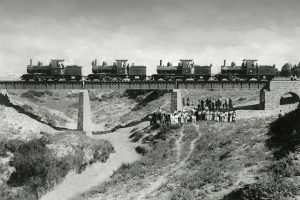
British-built roads, bridges, and public works that transformed mobility, trade, and communication across the island. Colonial Road and Infrastructure Networks in Cyprus mark a pivotal era of transformation under British rule from 1878 to 1960, where engineered roads, bridges, and public works revolutionized the island's connectivity, boosting trade, communication, and economic integration. These projects, spearheaded by the colonial administration, shifted Cyprus from Ottoman-era isolation to a modernized network, linking remote villages to urban centers like Nicosia, Limassol, and Famagusta. Key features included macadamized roads, stone bridges over seasonal rivers, and irrigation dams that supported agriculture, reflecting imperial strategies to exploit resources while imposing control. As symbols of progress and domination, they facilitated troop movements and commerce but also sparked local resistance, highlighting tensions between development and exploitation. Today, many endure as vital arteries, preserved for heritage while adapting to contemporary needs, underscoring Cyprus's journey from colony to independent nation amid ongoing debates on legacy and sustainability. A Transformative Colonial Network Colonial road and infrastructure networks reshaped Cyprus's landscape, creating a web of paved routes, sturdy bridges, and essential public works that connected its rugged terrain, from the Troodos Mountains to coastal plains. Spanning thousands of kilometers by independence, the system included major arteries like the Nicosia-Limassol road and rural links to villages, built to withstand the island's semi-arid climate with…

Read more

Akamas Peninsula National Park

Akamas Peninsula National Park

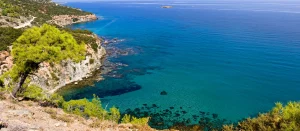
Akamas Peninsula National Park occupies the northwestern tip of Cyprus, beginning just north of Paphos and extending to Cape Arnaoutis. The landscape ranges from golden beaches and dramatic coastal cliffs to arid plains covered in Mediterranean scrub and mountain forests of pine and juniper. Deep gorges carved by seasonal rivers cut through the limestone terrain. No paved roads cross most of the interior, and large parts of the peninsula remain uninhabited. The area takes its name from Akamas, a son of the mythological hero Theseus, who is said to have founded the ancient city of Soli after fighting in the Trojan War. Shutterstock-com Historical Background Until the year 2000, the British military used Akamas for training exercises and as a firing range. Under the 1960 Treaty of Establishment, the British Army was permitted to use the peninsula for up to 70 days each year. This military presence indirectly helped preserve the region by preventing major development. After the British withdrawal, conservation groups and the Cyprus government began working toward formal protected status. visitcyprus-com In preparation for Cyprus joining the European Union, most of Akamas was included in the Natura 2000 network between 2003 and 2009. Two turtle nesting beaches were designated as Sites of Community Importance. The Polis–Gialia area received Special Area of Conservation status, and the entire peninsula became…

Read more