Explore Cyprus with Our Interactive Map

Explore our top stories and discover ideas worth your time.

Troodos Ophiolite Cyprus

Troodos Ophiolite Cyprus

If you ever want to surprise someone in Cyprus, do not take them to a museum. Take them to Troodos. As you drive up from any direction you will first pass citrus groves, almond orchards and vineyards. Then pine appears. The air cools. The road winds higher. Somewhere above the clouds you stop, step out of the car and pick up a stone. Michal Klajban And you are holding a piece of the Earth that once lay kilometres beneath a vanished ocean. This is not a poetic exaggeration. Troodos is one of the very few places on the planet where a complete section of oceanic crust and upper mantle stands above sea level. What scientists normally reach only with deep-sea drilling ships, submarines and expensive research programmes lies here beside hiking paths, picnic sites and village roads. Within roughly fifty kilometres you can travel from rocks that formed deep inside the mantle to rocks that erupted on the seafloor, then into sediments that later surrounded the rising island. You are not simply climbing or going down a mountain. You are walking through the internal anatomy of the Earth itself. In the 1960s geologists were still debating whether continents actually moved. The theory of plate tectonics existed but needed proof. Troodos provided it. Here, predictions matched reality: magma chambers, feeder dykes…

Read more
Ayia Napa Thalassa Museum

Ayia Napa Thalassa Museum

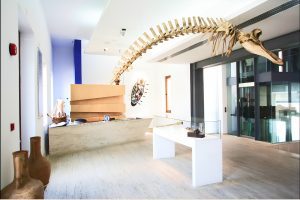
The Thalassa Municipal Museum stands in the center of Ayia Napa as the first museum dedicated entirely to maritime heritage in the Mediterranean region. Named after the Greek word for 'sea,' it opened in August 2005 to showcase the relationship between Cyprus and the surrounding waters. tripplanet.ru The museum operates under the direction of the Pierides Foundation, the Hellenic Institute for the Preservation of Nautical Tradition, and the Tornaritis-Pierides Marine Life Foundation. The building itself, constructed from marble, onyx, wood, and metal, features six levels where exhibits can be viewed from multiple angles, including underground display cases that visitors walk over. Maritime History Through the Ages The museum presents 7,000 years of Cypriot history, from the Neolithic period to Venetian rule (5000 B.C. to 1600 A.D.) Archaeological treasures include a composite vase with vertical handle from the Early Bronze Age III period (2100-1900 B.C.), a clay model of a ship with sailors and captain from the Cypro-Archaic II period (600-480 B.C.), and four red figured plates decorated with fish from the Classical and Hellenistic periods (475-30 B.C.). commons.wikimedia.org These artifacts demonstrate how ancient Cypriots lived, traded, and traveled across the Mediterranean. The museum also displays a replica of a Mesolithic papyrus vessel from 9200 B.C., which archaeologists believe was used to transport obsidian across the Aegean Sea. The Kyrenia Ship…

Read more

Nea Paphos Archaeological Park Roman Mosaics

Nea Paphos Archaeological Park Roman Mosaics

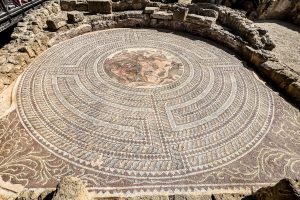
Nea Paphos Archaeological Park preserves the heart of an ancient city that served as the capital of Cyprus for over 600 years. Located on the southwestern coast near modern Paphos, this UNESCO World Heritage Site contains some of the finest Roman mosaics in the eastern Mediterranean, alongside temples, fortresses, and the remains of a once-thriving urban center. Adobe-Stock-com Historical Background Nea Paphos was founded in the late 4th century BC by Nikokles, the last king of Palaipaphos (Old Paphos), about 10 kilometers inland. The new coastal location offered better harbor access and strategic advantages for trade across the Mediterranean. When Ptolemy I of Egypt took control of Cyprus in 294 BC, he made Nea Paphos the island's administrative capital, a status it maintained through the Ptolemaic, Roman, and early Byzantine periods. Adobe-Stock-com The city reached its peak during Roman rule, from 58 BC onward. As the seat of the Roman proconsul, Nea Paphos became a wealthy urban center with impressive public works and luxurious private homes. According to the Acts of the Apostles, Paul the Apostle visited the city in 45 AD and converted the Roman proconsul Sergius Paulus to Christianity. It makes Cyprus one of the first Roman territories to have a Christian governor. The city suffered severe damage from earthquakes in the 4th century AD, particularly the devastating…

Read more