Explore Cyprus with Our Interactive Map

Explore our top stories and discover ideas worth your time.

Cyprus Meze Tradition Social Dining Ritual

Cyprus Meze Tradition Social Dining Ritual

Meze in Cyprus is not a starter, a tasting menu, or a casual sharing plate. It is a complete dining ritual built around time, abundance, and company. When Cypriots sit down for meze, they are committing to an experience that unfolds slowly, dish by dish, over several hours. This article explains what makes Cypriot meze different from its Mediterranean cousins, how it is structured, why it matters socially, and how it continues to shape everyday life on the island. The goal is not to list dishes, but to show how food, pacing, and hospitality come together in one of Cyprus’s most enduring traditions. Meze as a Meal, Not a Prelude In much of the eastern Mediterranean, meze refers to small plates served before a main course or alongside drinks. In Cyprus, meze replaces the entire concept of courses. Ordering meze means you will not choose individual dishes, and you will not rush. The kitchen decides the sequence, and the table follows its rhythm. cyprusen.wiz-guide-com This distinction is essential. Cypriot meze is designed as a narrative rather than a collection. Each plate prepares the way for the next, building flavour and fullness gradually. What matters is not quantity alone, but progression and the shared pace that develops around the table. Why Meze Exists in Cypriot Life While the tradition grew from…

Read more

Marki Alonia Early Bronze Age Settlement

Marki Alonia Early Bronze Age Settlement

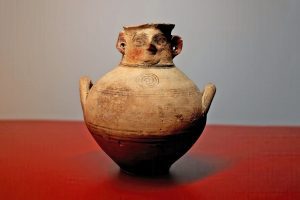
Nestled in central Cyprus, Marki-Alonia stands as one of the most revealing prehistoric settlements from the Early and Middle Bronze Age. Between 1990 and 2000, archaeologists David Frankel and Jennifer Webb from La Trobe University uncovered approximately 1,500 square meters of this ancient village. sciencedirect-com Their excavations revealed a remarkable window into how people lived, built their homes, and organized their communities from about 2400 BCE to around 1900 BCE. Unlike many archaeological sites where researchers can only piece together fragments of the past, Marki-Alonia offers an unusually complete picture of Bronze Age life in Cyprus. Historical Background The story of Marki-Alonia begins with a small group of settlers who arrived around 2400 BCE. The founding population numbered just 40 to 50 people. Over the course of 500 years, the settlement experienced steady growth. By the Middle Cypriot I period, roughly 400 years after its founding, the population had swelled to about 400 inhabitants. This growth reflects the settlement's success in establishing a stable agricultural economy and developing social systems that could support larger groups of people. cambridge-org What makes Marki-Alonia particularly important to archaeologists is its unbroken occupation sequence. Many ancient sites show signs of sudden abandonment or catastrophic destruction, but Marki-Alonia evolved gradually. Buildings were renovated, rooms were reorganized, and structures were rebuilt or demolished as needs changed.…

Read more
Makronissos Tombs

Makronissos Tombs

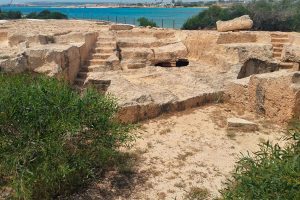
Carved into solid rock on a small peninsula west of Ayia Napa, the Makronissos Tombs are a window into ancient Cyprus. These 19 underground burial chambers date back over 2,000 years and reveal how people lived, died, and honored their dead during the Hellenistic and Roman periods. kiprguru-com The Makronissos Tombs form an ancient necropolis, a city of the dead, where families buried their relatives between the 4th century BCE and the 4th century CE. Each tomb consists of a stepped pathway that descends into the rock, leading to a rectangular chamber sealed by stone slabs. Inside, the chambers feature three stone benches carved along the walls and a central rectangular trench slightly lower than the floor. The site also includes a small sanctuary built from large irregular stone blocks and remnants of an ancient quarry that operated nearby. The quarry unfortunately damaged some tombs, but enough survived to tell us about burial practices in ancient Cyprus. The Ancient Settlement of Thronon According to historical records, an ancient settlement called Thronon existed in the Ayia Napa area, along with several smaller communities. These settlements thrived until the Early Christian period but were abandoned around the 7th century CE during the Arab raids that swept across the Eastern Mediterranean. The tombs at Makronissos served as the final resting place for people…

Read more