Explore Cyprus with Our Interactive Map

Explore our top stories and discover ideas worth your time.

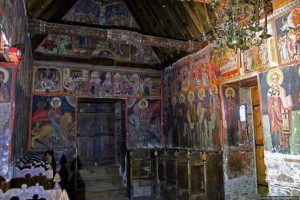
Church of Stavros tou Agiasmati Wall Painting

Church of Stavros tou Agiasmati Wall Painting

Historical Background and Regional Context The Church of Stavros tou Agiasmati, situated in the Troodos Mountains near the village of Platanistasa, is one of the monuments included in the UNESCO World Heritage group known as the Painted Churches of the Troodos Region. Dating to the late 15th century, the church represents a mature phase of Cypriot ecclesiastical art during a period of political change and cultural interaction. Its decoration is attributed to the painter Philip Goul, a master whose work reflects the continued vitality of Orthodox artistic traditions under Venetian rule. The church’s importance lies in the completeness and narrative richness of its fresco cycle, which preserves a vivid visual expression of late medieval theology and devotion. ayda-ru During the 15th century, Cyprus stood at a crossroads between Byzantine heritage and Western influence. Although the island was under Venetian administration, Orthodox communities maintained their religious and artistic traditions. Stavros tou Agiasmati embodies this continuity, demonstrating that rural mountain churches remained centers of creative expression and theological instruction. Its remote location contributed to the preservation of its paintings, allowing modern viewers to experience a nearly intact example of late medieval Cypriot religious art. Architectural Form and Environmental Adaptation Architecturally, the church follows the characteristic Troodos mountain type: a small, single-aisled structure built of local stone and covered by a steeply pitched…

Read more
Black Locust Of Cyprus

Black Locust Of Cyprus

Imagine walking through an older Cypriot village or along a rural roadside in late May, when the air suddenly fills with a sweet, heavy perfume reminiscent of orange blossom. Looking up, you see long, drooping clusters of creamy-white flowers hanging like fragrant tassels from the branches of a graceful, thorny tree. This is the black locust of Cyprus – a fast-growing, nitrogen-fixing beauty that has quietly become part of the island’s living heritage. www.inaturalist.org The False Acacia of the Legume Family Black locust, Robinia pseudoacacia, belongs to the vast Fabaceae (legume) family – the same group as carob, peas and beans. It is a deciduous tree famous for its ability to enrich poor soils by fixing nitrogen from the air. Locally it is known as Ροπίνια η ψευδοακακία (Ropínia i pseudoakakía), literally “false acacia Robinia”, because its pinnate leaves and pea-like flowers resemble true acacias even though it is not closely related. From American Forests to Cypriot Roadsides Native to the Appalachian Mountains and Ozarks of the eastern United States, black locust was one of the first North-American trees brought to Europe in the early 17th century. It reached Cyprus during the British period (late 19th–early 20th century) and was widely planted for durable timber, excellent honey production, erosion control on degraded land, and quick shade in villages and towns.…

Read more

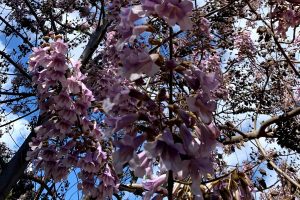
Purple Trumpets in the Cypriot Spring

Purple Trumpets in the Cypriot Spring

Imagine driving through the gentle hills near Paphos or Limassol in early April, when the air is still cool and the light turns golden. Suddenly, tall, bare-branched trees burst into clouds of soft lavender-purple bells that look like giant foxgloves hanging in the breeze. These are the Paulownia trees of Cyprus – fast-growing newcomers from the Far East that bring a touch of royal elegance to the island’s modern landscape. The Empress Tree Family Paulownia belongs to its own small family, Paulowniaceae, closely related to the foxgloves and snapdragons you might see in a cottage garden. These are deciduous trees that grow with astonishing speed. The main species planted in Cyprus are Paulownia tomentosa (the classic princess or empress tree) together with the even faster-growing P. elongata and P. fortunei. Locally they are known as Παυλώνια (Pavlónia), a direct transliteration of the scientific name. The genus honours Princess Anna Pavlovna of Russia (1795–1865), whose beauty and grace the flowers were said to resemble when the tree was first introduced to Europe. From Asian Forests to Cypriot Plantations Native to central and eastern China and parts of Korea, Paulownia has been treasured for centuries in its homeland for its lightweight, strong timber and beautiful timber used in everything from furniture to musical instruments. It reached Europe in the 19th century as…

Read more