Explore Cyprus with Our Interactive Map

Explore our top stories and discover ideas worth your time.

Spikes and Towers in the Cypriot Sun

Spikes and Towers in the Cypriot Sun

Stand on a rocky hillside in southern Cyprus at the end of a long, dry summer and you may suddenly notice a giant green starburst on the slope. Then, one day, a towering stalk shoots skyward like a living flagpole, topped with a candelabra of creamy-yellow flowers. This is the agave of Cyprus a dramatic New-World succulent that has quietly become one of the island’s most eye-catching landscape characters. www.inaturalist.org Meet the Agaves Agaves belong to the asparagus family (Asparagaceae), in the subfamily Agavoideae. These are tough, rosette-forming succulents perfectly built for arid life. The genus Agave contains around 200 species, nearly all native to the deserts and dry hills of Mexico, the southern United States and Central America. In Cyprus the two most common are Agave americana (the century plant or American aloe) and Agave sisalana (sisal agave). Gardeners also grow several other attractive species, including the graceful, almost spineless Agave attenuata (foxtail agave) with its soft, arching leaves and the compact, fiercely spiny Agave stricta. Locally they are known as Αγαύη (Agávi), a direct borrowing of the scientific name, which comes from the ancient Greek agauós “admirable” or “noble” a perfect description for their striking, architectural form. Some older Cypriots in Greek-speaking areas still call the spikiest ones Αλάς (Alás), perhaps a folk name evoking the sharp, sword-like…

Read more

Kyrenia (Pentadaktylos) Mountains

Kyrenia (Pentadaktylos) Mountains

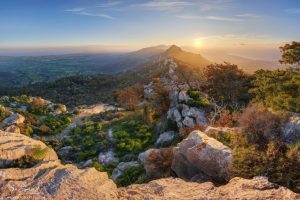
Whether you stand on the observation deck in Troodos near the summit of Mount Olympus on a clear day, walk across the rolling fields of the Mesaoria plain, or simply drive through the streets of Nicosia, your eyes will inevitably be drawn north. Expedia There, a long, jagged ridge cuts across the horizon like a line drawn by a giant hand. In some places it rises so sharply that it feels unreal, as if the land itself has been lifted and frozen mid-motion. At sunrise it glows pale and soft. By midday it hardens into white stone. At dusk it becomes a jagged silhouette, like the ruins of a forgotten kingdom. These are the Kyrenia Mountains, also known as Pentadaktylos. Unlike Troodos, which rises gradually through valleys, plateaus and forests, the Kyrenia Mountains are abrupt, almost theatrical. They form a narrow ridge stretching for almost 200 kilometres, from Cape Kormakitis in the west to Cape Apostolos Andreas in the east. To the north they fall sharply toward the sea, separated by a narrow coastal strip rarely more than five kilometres wide. To the south they rise almost vertically above the flat Mesaoria plain. They look less like mountains and more like a stone wall, or the ruins of a forgotten city from the fantasy epic. And in many ways, they…

Read more
Ottoman Sebils – Public Water Fountains of Cyprus

Ottoman Sebils – Public Water Fountains of Cyprus

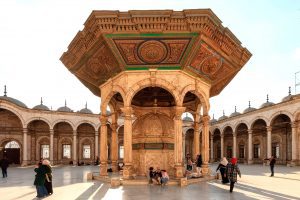
photohound.co When the Ottoman Empire took control of Cyprus in 1571, the island experienced major changes in its architecture and daily life. Among the most practical contributions the Ottomans brought were sebils, public water fountains that became essential features of Cypriot cities. These structures served both religious and civic purposes, providing free drinking water to travelers and locals while allowing Muslims to perform ritual ablutions before prayer. The word sabil comes from the Arabic root meaning to make available or to provide a way. In Islamic tradition, building a sabil was considered an act of charity, a way to earn religious merit by serving the community. The Ottoman authorities valued these fountains so highly that they granted tax exemptions to anyone who built a public sabil, provided they kept water available for travelers at all times. Historical Background wikimedia.org Ottoman sebils were not just simple fountains. They were carefully designed structures that combined function with beauty. The typical sabil featured a small kiosk where an attendant stood behind a grilled window, handing out cups of water to passersby. Some sebils were standalone buildings at busy street corners, while others were attached to mosques or caravanserais. The architectural style of Sebils varied across the empire. In Istanbul, elaborate sebils appeared during the Tulip Period in the early 18th century, decorated with…

Read more