Explore Cyprus with Our Interactive Map

Explore our top stories and discover ideas worth your time.

Basilica of Kampanopetra Salamis Christian Architecture

Basilica of Kampanopetra Salamis Christian Architecture

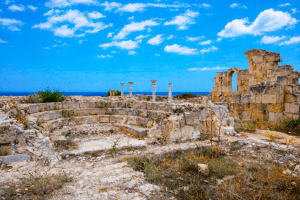
The Basilica of Kampanopetra is a large Early Christian church complex located at the archaeological site of ancient Salamis, near modern Famagusta in the Turkish-occupied part of Cyprus. Built during the late 5th or early 6th century CE, the basilica served the city of Constantia, the name given to Salamis after it was rebuilt following devastating earthquakes in 332 and 342 CE. The complex consists of four major sections arranged in a linear sequence. From west to east, these include a large western courtyard, a second western atrium connected to a narthex (entrance hall), the main three-aisled basilica, and an eastern atrium. The entire structure measures approximately 152 meters in length and reaches nearly 38 meters at its widest point. This makes it one of the largest Early Christian basilicas in Cyprus. The name "Kampanopetra" has been interpreted in different ways. Some sources translate it as "stone by the monks' cells," while others suggest it means "stone bell." The name likely refers to features or traditions associated with the site during medieval times when a small monastic community continued to use portions of the ruined basilica. Historical Background Salamis was one of Cyprus's most important cities throughout antiquity. According to legend, it was founded around the 11th century BCE by Teucer, a hero from the Trojan War who was exiled…

Read more
Panigyria in Cyprus: Village Saint Celebration

Panigyria in Cyprus: Village Saint Celebration

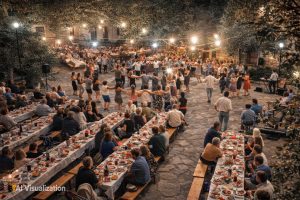
In Cyprus, a panigyri is not simply a festival marked on a calendar. It is a moment when a village gathers itself fully, reconnecting faith, memory, and everyday life into a shared experience. Held in honor of a patron saint, panigyria transforms religious observance into a living social ritual, where prayer flows naturally into food, music, dance, and reunion. These evenings are not for spectacle or tourism. They exist because the community expects them to exist, and because participation itself keeps them alive. heartlandoflegends.com To arrive at a panigyri is to step into a rhythm that has been repeated for generations. The setting may vary from village to village, shaped by geography and custom, but the feeling remains familiar. It is welcoming without formality, celebratory without excess, and deeply rooted in a sense of belonging that does not need explanation. What a Panigyri Really Is At its most basic level, a panigyri is a communal celebration held on the feast day of a village’s patron saint. It begins with a religious service, often followed by a procession of the saint’s icon, and gradually expands outward into the shared spaces of the village. Church courtyards, village squares, and nearby streets become places where people gather to eat, talk, dance, and remain together long into the night. What distinguishes this transition is…

Read more
Sheftalia Cypriot Sausage Tradition

Sheftalia Cypriot Sausage Tradition

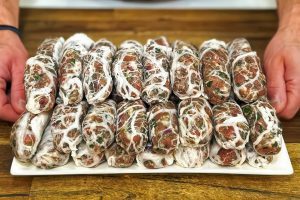
Sheftalia looks like a sausage, but it behaves very differently. There is no casing to snap, no neat uniformity, and no attempt to imitate anything else in the Mediterranean. Instead, minced meat, herbs, and onion are wrapped loosely in caul fat and cooked slowly over charcoal, producing something softer, juicier, and unmistakably Cypriot. facebook-com This is a dish shaped by village logic rather than factory precision. Its endurance comes from how well it fits the island’s rhythms of cooking, gathering, and shared meals. To understand sheftalia is to understand how Cyprus turns necessity into identity. Built Around Fire, Not Convenience Sheftalia is inseparable from the grill. It is not cured, dried, or stored. It is mixed, wrapped, and cooked fresh, usually over charcoal rather than gas. This choice matters. As the caul fat melts, it bastes the meat from the outside, dripping onto the coals and sending smoke back into the sausage. The cooking process is interactive and attentive, requiring turning, patience, and an understanding of heat. Unlike conventional sausages, which rely on tight casings and internal pressure, sheftalia remains deliberately loose. The meat steams gently inside its fatty wrap while the exterior browns. The result is not crispness, but succulence, a texture designed for slow eating rather than fast handling. Why Caul Fat Changes Everything The defining feature of…

Read more