Explore Cyprus with Our Interactive Map

Explore our top stories and discover ideas worth your time.

Sacred Landscape Representation

Sacred Landscape Representation

Sacred Landscape Representation in Cypriot art involved the use of motifs such as mountains, seas, fertility symbols, and celestial elements to express the island's profound spiritual connection to nature. These designs went beyond mere decoration, reflecting a worldview where the environment was infused with divine energy, from turbulent waves to bountiful fields. This artistic approach evokes the island's mystical essence, highlighting ancient perceptions of the natural world as a realm of sacred significance. reddit-com A World Expressed Through Art Cypriot art portrayed the landscape as a narrative medium, where natural features conveyed deeper spiritual layers. Mountains symbolized strength and divine oversight, seas evoked origins and transformation, fertility motifs celebrated renewal, and celestial patterns linked earthly existence to cosmic forces. This method remained uncomplicated, emphasizing reverence for nature's power and the island's hallowed character. ancientcyprus-com Origins and Evolution These motifs trace back to the Neolithic and Chalcolithic periods, from approximately 8000 to 2500 BC. Early inhabitants, reliant on farming and herding, incorporated elements reflecting survival and natural cycles into their works. Clay figurines emphasized fertility through wide hips, associating human life with the earth's productivity. metmuseum-org The Bronze Age, beginning around 2500 BC, introduced trade influences from Egypt and Greece. Pottery designs featured wavy lines for seas, symbolizing Aphrodite's emergence, while seals depicted mountains as guardians. Subsequent Greek and Roman periods…

Read more

Sanctuary of Apollo Hylates at a Glance

Sanctuary of Apollo Hylates at a Glance

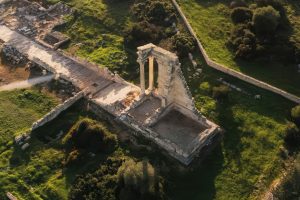
The Sanctuary of Apollo Hylates was one of the most important religious centres in ancient Cyprus, set within the wooded landscape near Kourion. Dedicated to Apollo in his role as protector of forests and nature, it combined Greek religious traditions with older local beliefs and attracted pilgrims for centuries. The sanctuary reveals how religion, nature, and daily life were closely connected in the ancient world. cyprusalive-com A Sacred Place in the Forest The Sanctuary of Apollo Hylates lies west of ancient Kourion, surrounded by gentle hills and woodland. Unlike urban temples built into city centres, this sanctuary was deliberately placed in nature, reflecting the character of the god worshipped there. limassoltourism-com Apollo Hylates was not the sun god or musician known from classical myths, but a guardian of forests, wild landscapes, and natural balance. The setting itself was part of the sacred experience, where worshippers felt close to both the god and the land. Roots Older Than the Greeks The origins of the sanctuary reach back to the Late Bronze Age. Before Greek settlers arrived, local communities already worshipped a nature deity connected to trees and the wilderness. When Greek culture spread to Cyprus, this local god was identified with Apollo. chatgpt-com Rather than replacing older beliefs, Greek religion absorbed them. The result was Apollo Hylates, a uniquely Cypriot form…

Read more
Environmental Awareness and Eco Trails

Environmental Awareness and Eco Trails

Cyprus has transformed itself into a model for environmental education and sustainable tourism across the Mediterranean region. The island maintains a network of 52 designated nature trails covering 319.6 kilometers through national forests, complemented by 47 additional trails outside protected areas, for a total of 99 marked routes accessible to visitors. These paths connect to specialized environmental education centers, green certification programs, and conservation initiatives that demonstrate how tourism and environmental protection can support each other. nicetrip.com The Department of Forests developed the initial network of nature trails to offer direct contact with Cypriot nature while serving environmental education, general information, and physical exercise. These trails span three major regions: the Akamas Peninsula, Troodos Mountains, and Cape Greco National Forest Park. Each area presents distinct landscapes, from coastal cliffs to pine covered peaks reaching 1,951 meters elevation at Mount Olympus. Routes vary from easy one kilometer walks to challenging 17 kilometer treks, with the European E4 Long Distance Path extending more than 500 kilometers across the island. The trails fall into three difficulty categories: Category 1 features gentle gradients suitable for most visitors, Category 2 includes some uphill sections, and Category 3 presents steep or difficult terrain for experienced hikers only. At Cape Greco National Forest Park, the Agioi Anargyroi trail network showcases dramatic coastal features. The 2.3 kilometer circular…

Read more