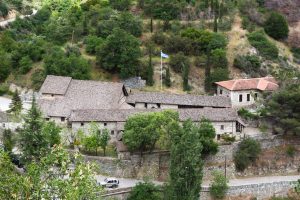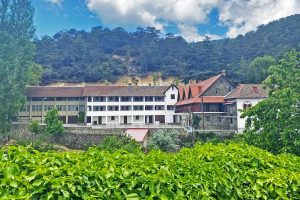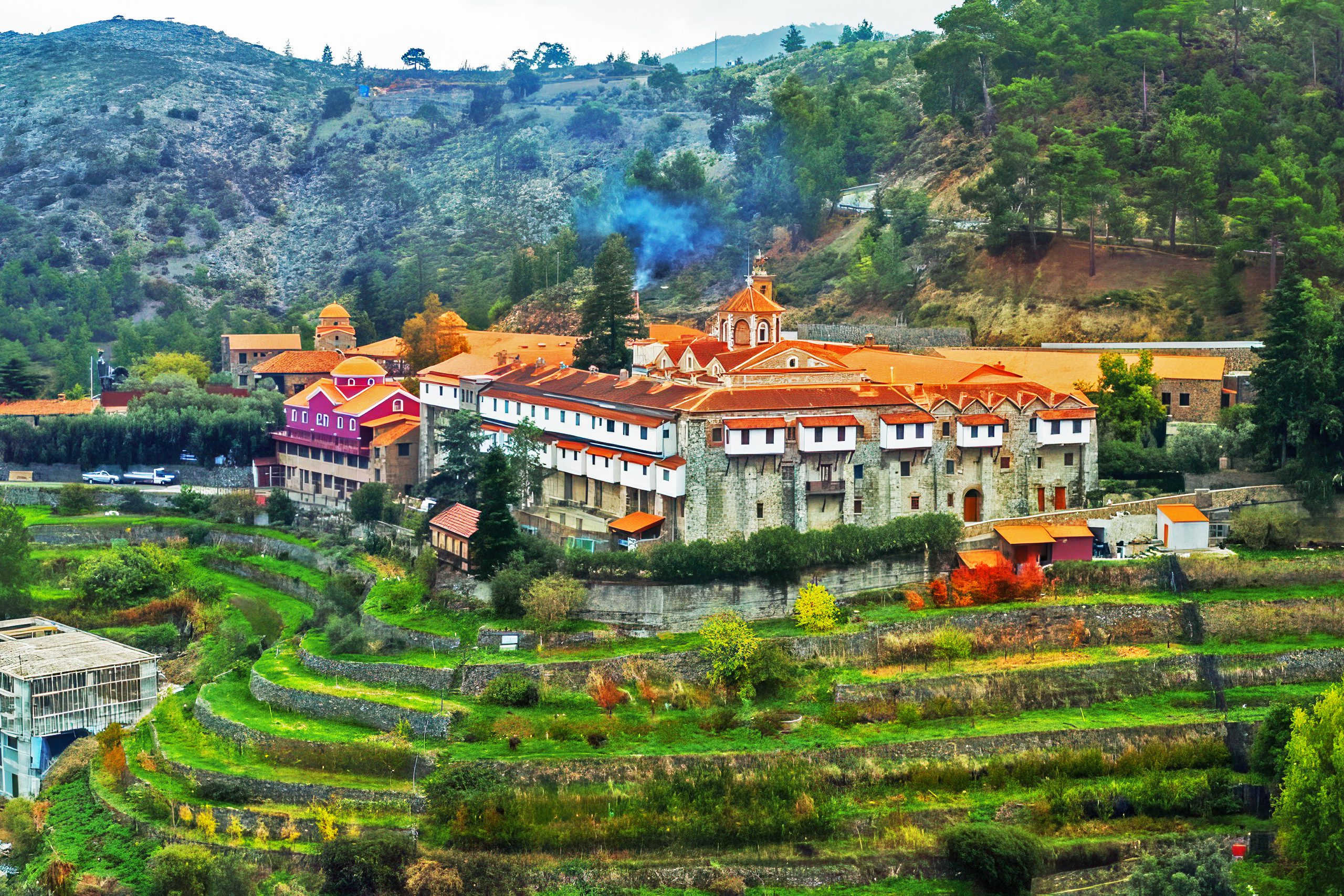
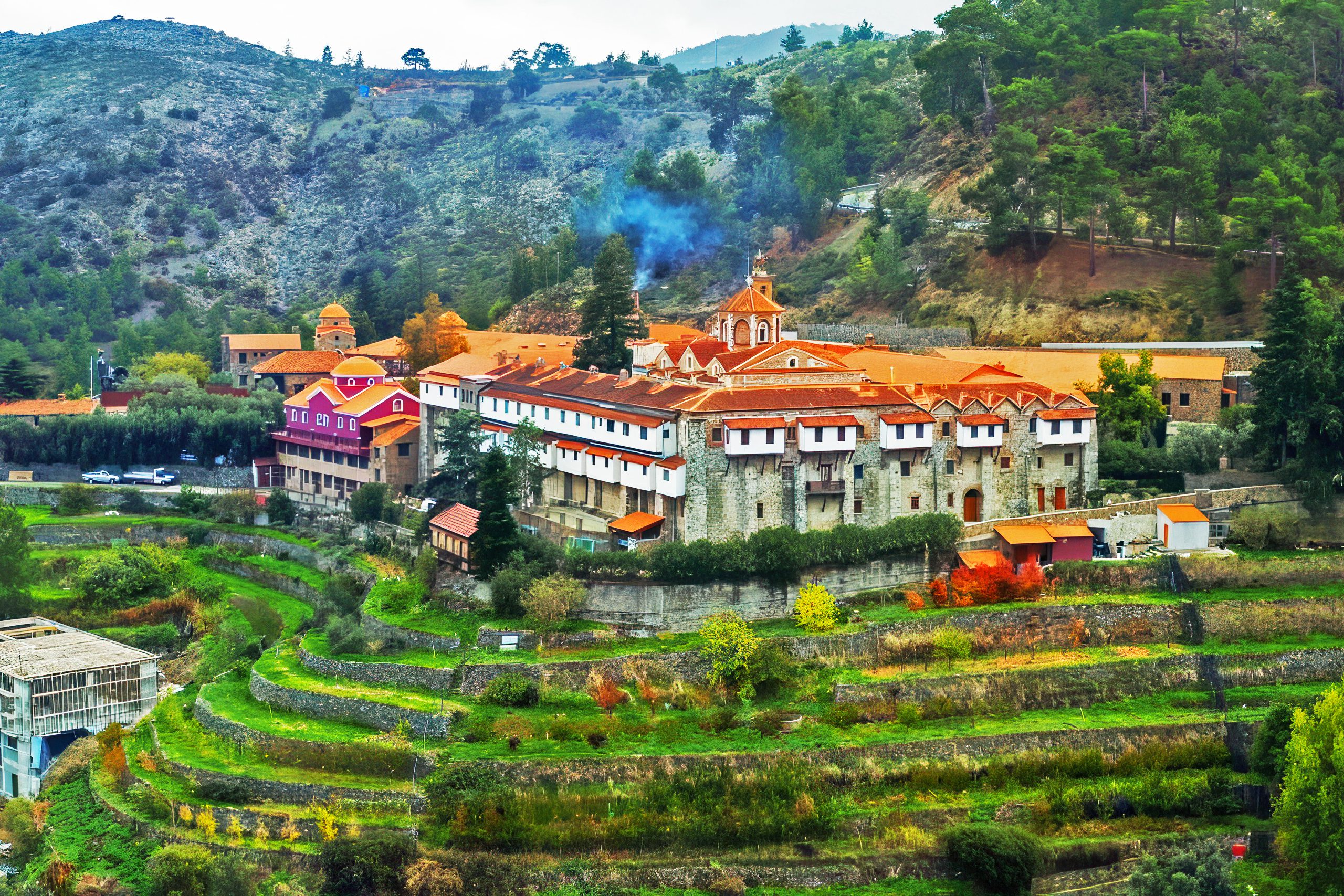
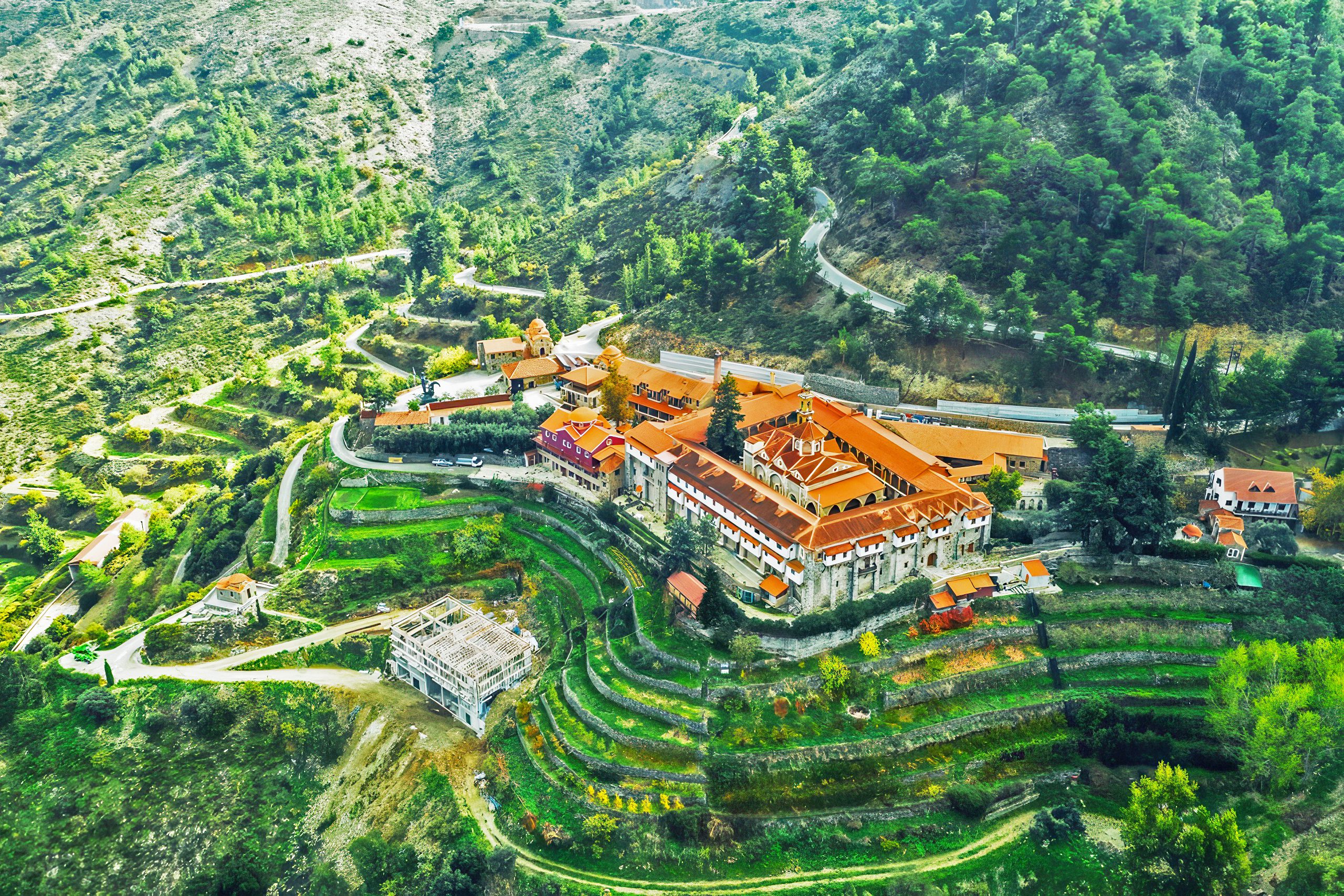
Holy Monastery of Panagia Machaira is a historic monastery dedicated to the Virgin Mary located about 40 km from the capital of Cyprus, Nicosia. The monastery is built near Mount Kionia, at an elevation of 870 meters, and surrounded by dense pine forests. The monastery towers like a fortress on a steep hillside above the Pediaios River, Cyprus’s longest waterway.
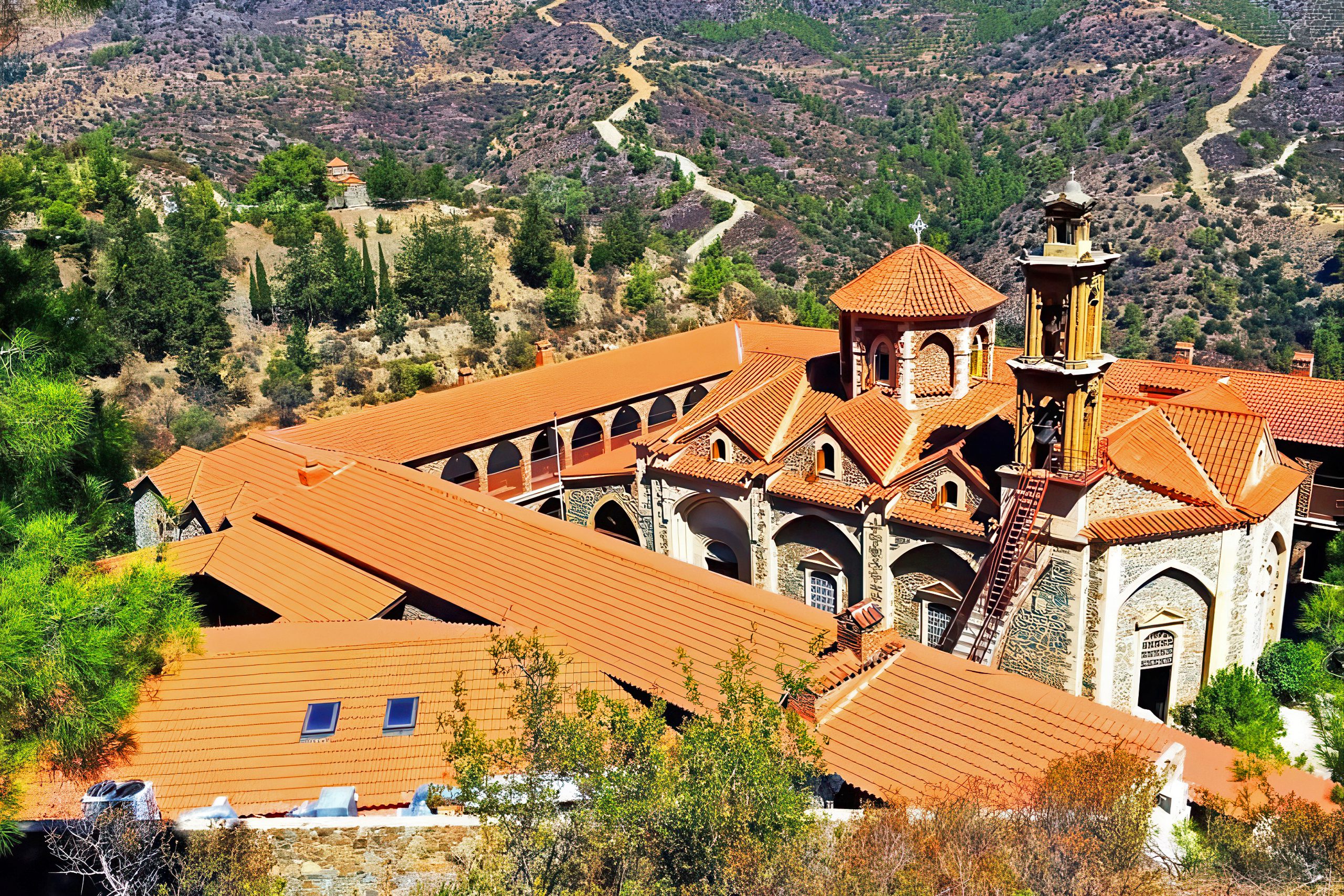
The Sacred, Royal and Stavropegic Monastery of the Virgin of Machairas ranks as one of the island’s three most important monasteries alongside Kykkos and Agios Neophytos, holding special privileges that grant independence from the Archbishop of Cyprus.
The Discovery of a Sacred Icon
According to tradition, the icon is one of the seventy icons painted by the Apostle Luke. The icon had been placed above the Holy Soros, or reliquary, of the Virgin Mary in the Church of Blachernae in Constantinople. During the eighth century iconoclasm period when religious images faced destruction, a devout monk rescued the icon and brought it to Cyprus, hiding it in a cave where it remained forgotten for centuries.
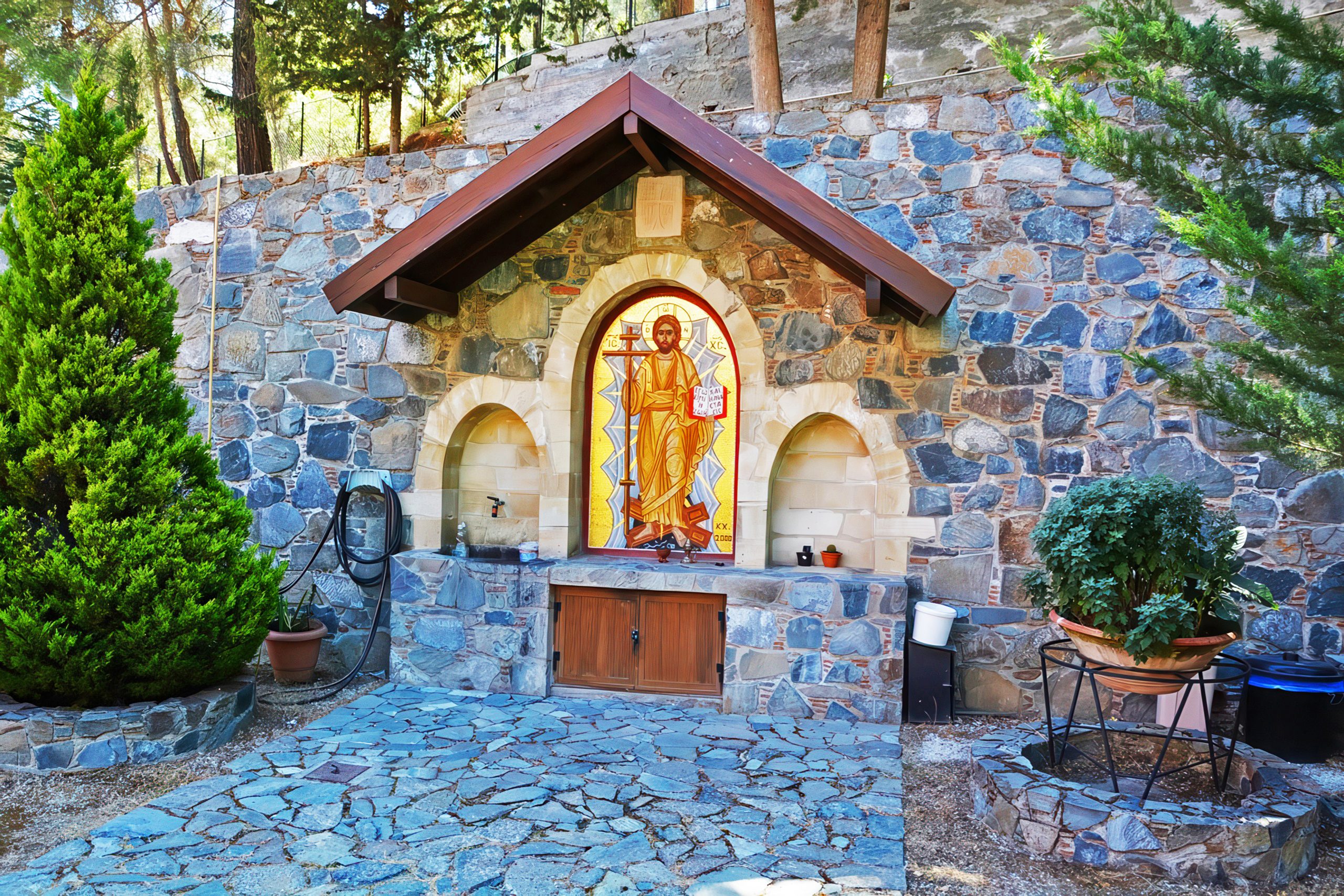
Around 1145, the hermits Ignatios and Neophytos, blessed with divine grace, discovered the cave which was obscured by bushes. To reach the cave where the icon was, a knife was given to them by a divine hand with which they used to cut the bushes. The Greek word for knife, machairi, inspired both the icon’s new name Machairiotissa and the monastery’s name. Machairas Monastery was founded in 1148 by two monks, Neophytos and Ignatius, on the eastern foothills of the Troodos Mountains of Cyprus.
Following the death of Neophytos, Ignatios travelled with Prokopios to Constantinople in the year 1172 where they succeeded in obtaining financial assistance from the Byzantine emperor Manuel I Komnenos. The monastery was also granted ownership of the entire mountain on which it is now situated and the status of stavropegion. The monk Neilos enlarged the initial monastery in the early 13th century and became its first abbot. Two additional Byzantine emperors provided support: Isaac II Angelos granted cash and land in Nicosia while Alexios III Angelos donated 24 serfs.
Destruction and Resilience Through History
The monastery was destroyed in a fire in 1530 and rebuilt. The monastery sustained great damage within the fire in 1892. Archimandrite Chariton travelled to Russian Empire to gain donations for the reconstruction of the monastery and managed to collect 6,483 rubles. The current buildings date from the early 20th century reconstruction following the 1892 disaster.
After the Latin conquest of Cyprus and expulsion of the Orthodox bishops in 1222, the monastery lost most of its property and was reduced to destitution. Ottoman conquest in 1571 brought no immediate improvement, though fortunes gradually recovered under the monk Parthenios in the 18th century. During the Greek War for independence, the Turks seized and sold a large part of the monastery property after the mass executions of Cypriots on July 9, 1821. Archbishop Kyprianos, a monk from Machairas, was martyred during these executions.
The Monastery’s Architecture and Sacred Treasures
The monastery has a rectangular layout and a red-tiled timber roof. The main entrance faces towards the east, a second faces due west. The supporting buildings and monks’ cells are built around a centrally located church designed in Byzantine style. The main aisle of the church is lined with a row of columns and is covered by a dome.
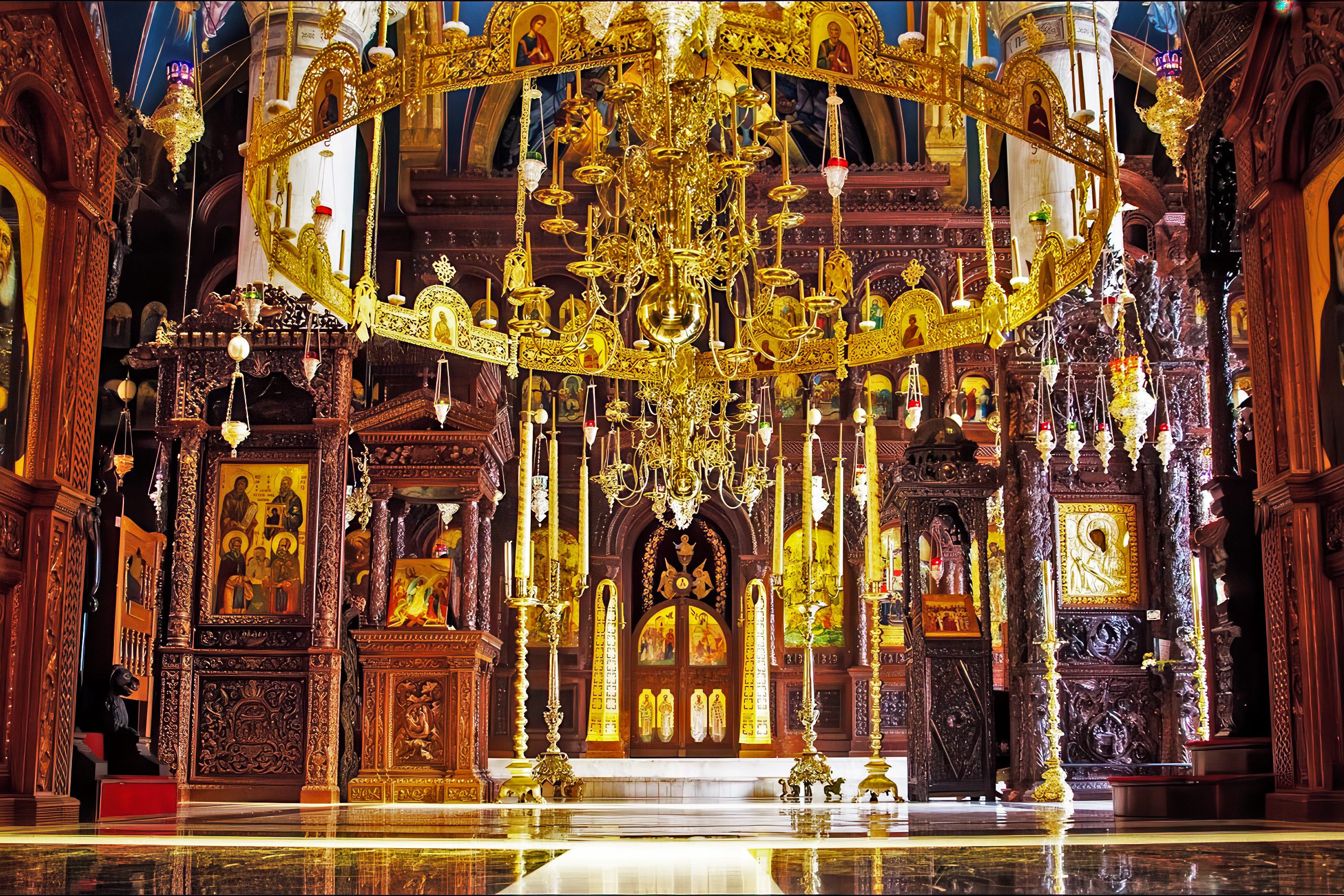
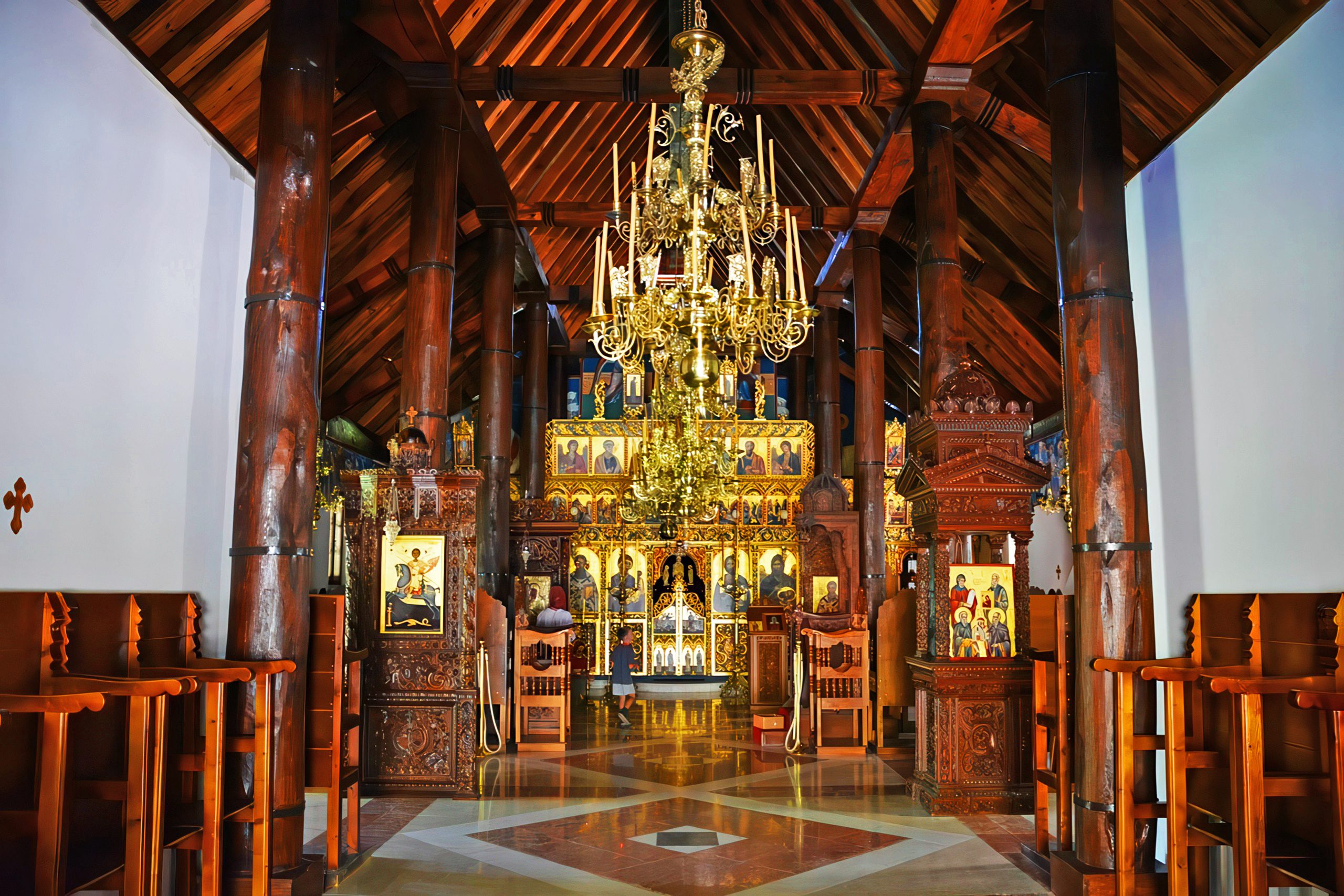
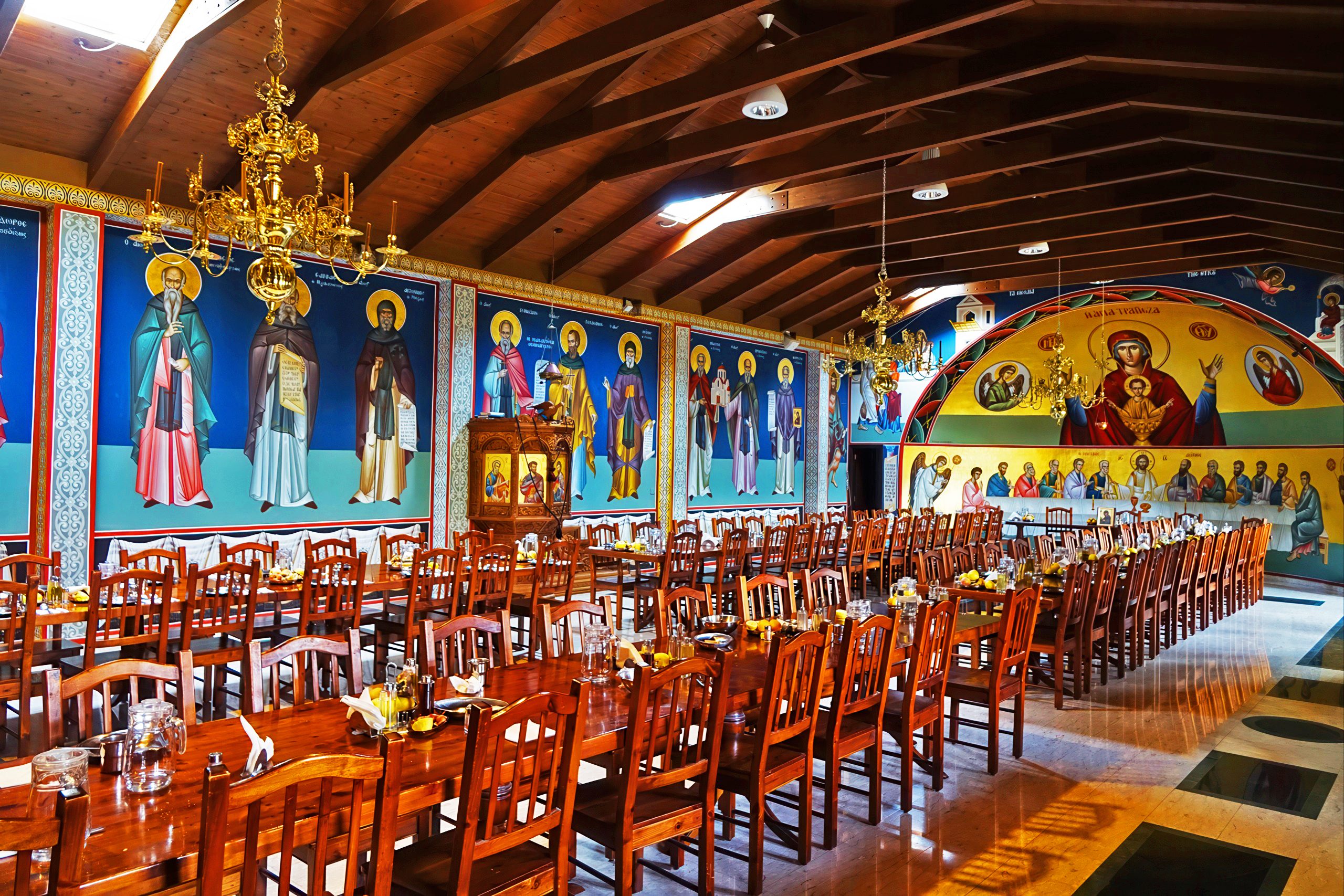
The interior of the church is decorated with religious icons, chandeliers, stone floors and wall frescoes. The icon of the Virgin Mary takes a prominent position. The renovated vestry basement houses the monks’ original cells, stables, and storage areas, along with collections of old books, manuscripts, icons, and religious artifacts. The monastery library contains thousands of volumes including Greek and Ottoman documents preserved in the archive.
The monastery celebrates its main feast day on November 21, the Presentation of the Blessed Virgin Mary. This annual celebration draws pilgrims from across Cyprus and beyond. Today approximately 25 to 30 Orthodox monks maintain the monastic community, sustaining themselves through agricultural activities and donations from believers.
Connection to Cyprus’s Independence Struggle
In March 1957, Afxentiou found himself holed up near Machairas Monastery. On 3 March 1957, after a Cypriot informant had betrayed his location, British Army troops surrounded Afxentiou outside his secret hideout near the Machairas Monastery near Lazanias. Grigoris Afxentiou served as second-in-command of EOKA, the organization fighting British colonial rule from 1955 to 1959.
Afxentiou ordered his comrades to surrender but stayed behind to fight to the death. The British asked Afxentiou to surrender his weapons, to which he replied “molon labe” (“come and take them”), quoting Leonidas I of Sparta. After Afxentiou put up a resistance that lasted 10 hours, and all conventional methods had failed, the British poured petrol into the hideout to burn out the EOKA men.
Next to Afxentiou’s burned body was a sub-machine gun, revolvers, grenades and a copy of Nikos Kazantzakis’ “Christ Recrucified” that had been given to Afxentiou by the Abbot of Machairas. The monastery has a small museum dedicated to Grigoris Afxentiou. A large bronze statue memorial to Afxentiou stands below the monastery, honoring his sacrifice at age 29.
Why Machairas Remains Important Today
The monastery represents continuity of Orthodox Christian tradition across nearly nine centuries despite repeated destructions and political upheavals. Its status as a Royal and Stavropegic monastery reflects both historical imperial patronage and continuing autonomy within the Church of Cyprus. The monastery owns significant land holdings and property throughout Cyprus, resources accumulated through centuries of donations and careful management.
Machairas served educational and cultural functions throughout history. During Ottoman rule, it operated as a covert school preserving Greek language and Christian teachings. The monastery library preserves religious manuscripts, rare books, and historical documents that provide insights into Cyprus’s spiritual and cultural heritage. This scholarly tradition continues today with monks maintaining archives and welcoming researchers.
The monastery’s connection to the independence struggle adds another layer of significance. The story of Grigoris Afxentiou resonates with Greek Cypriots as a symbol of resistance and sacrifice. The museum and memorial transform Machairas into a pilgrimage site for those honoring both religious devotion and national struggle. Annual commemorations on March 3 bring together religious services and patriotic remembrance.
For Orthodox believers, the miraculous icon of the Machairiotissa remains the monastery’s spiritual center. Pilgrims seek blessings, healing, and spiritual renewal before this sacred image painted, according to tradition, by Apostle Luke himself. The icon survived iconoclasm, fires, and political turmoil, embodying resilience that mirrors the monastery’s own history.
Visiting This Mountain Sanctuary
The monastery sits approximately 40 kilometers from Nicosia and can be reached by car via mountain roads through villages like Lazanias. The drive takes roughly one hour from the capital. The surrounding Machairas forest offers hiking trails and picnic areas for visitors wanting to explore the natural setting. Parking is available near the monastery entrance at no charge.
The monastery welcomes visitors daily though specific hours may vary. Entry to the monastery grounds is free, though donations are appreciated. Modest dress is required with shoulders and knees covered for both men and women. Photography is prohibited inside the main church to preserve the sacred atmosphere and protect artwork. A small shop sells religious items, books, and traditional products.
The monastery is accessible to people in wheelchairs with designated parking and toilet facilities. Group visits are welcome but require advance telephone consultation with the monastery. Information leaflets about the monastery’s history are available in Greek at the church entrance. The monks maintain the monastery as an active religious community, so visitors should respect the contemplative atmosphere.
The Afxentiou museum and memorial statue lie a short distance from the main monastery complex. The museum displays artifacts related to the EOKA struggle and Afxentiou’s final battle. The viewing area around the statue offers panoramic views across the Troodos Mountains and Mesaoria plain. March 3 sees large memorial gatherings at this site honoring Afxentiou’s sacrifice.
The Meaning of Sacred Endurance
Machairas Monastery demonstrates how religious institutions preserve faith, culture, and memory across generations. The monastery survived iconoclasm, fires, foreign conquests, and political upheavals while maintaining its spiritual mission. This endurance reflects both the dedication of monastic communities and the support of believers who view Machairas as central to their religious and cultural identity.
The combination of sacred icon, mountain setting, architectural beauty, and historical significance creates an experience that transcends simple tourism. Visitors encounter Orthodox tradition maintained continuously since medieval times. They see evidence of Cyprus’s complex history written in the monastery’s architecture and collections. They stand where monks prayed for centuries and where a national hero made his final stand.