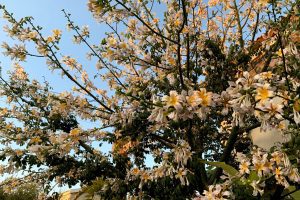
Imagine walking through an older Cypriot village or along a rural roadside in late May, when the air suddenly fills with a sweet, heavy perfume reminiscent of orange blossom. Looking up, you see long, drooping clusters of creamy-white flowers hanging like fragrant tassels from the branches of a graceful, thorny tree. This is the black locust of Cyprus – a fast-growing, nitrogen-fixing beauty that has quietly become part of the island’s living heritage.

The False Acacia of the Legume Family
Black locust, Robinia pseudoacacia, belongs to the vast Fabaceae (legume) family – the same group as carob, peas and beans. It is a deciduous tree famous for its ability to enrich poor soils by fixing nitrogen from the air. Locally it is known as Ροπίνια η ψευδοακακία (Ropínia i pseudoakakía), literally “false acacia Robinia”, because its pinnate leaves and pea-like flowers resemble true acacias even though it is not closely related.
From American Forests to Cypriot Roadsides
Native to the Appalachian Mountains and Ozarks of the eastern United States, black locust was one of the first North-American trees brought to Europe in the early 17th century. It reached Cyprus during the British period (late 19th–early 20th century) and was widely planted for durable timber, excellent honey production, erosion control on degraded land, and quick shade in villages and towns. Like many useful introductions of that era, it naturalised readily and now grows wild in disturbed areas, forest edges, maquis and roadsides across the island – though it spreads more modestly here than the more aggressive wattles or acacias.
Distinctive Form and Fragrant Blooms
Black locust grows into a medium-sized deciduous tree, usually 12–25 m tall, with a straight trunk and open, somewhat irregular crown. The bark on mature trees is dark grey-brown, deeply furrowed and shaggy. Young twigs and suckers carry sharp, paired stipular spines. The leaves are alternate and pinnate, with 7–19 oval leaflets that turn bright yellow in autumn. In late spring the tree produces long, pendulous racemes of highly fragrant, white pea-like flowers that are a magnet for bees. Later come flat, smooth seed pods 5–10 cm long that turn brown and persist on the tree through winter.
Fun Facts
- The flowers produce one of the finest and most abundant honeys in the world – light, fragrant and slow to crystallise; Cypriot beekeepers have long valued black locust groves for this reason.
- The wood is exceptionally durable and rot-resistant, traditionally used for fence posts, vineyard stakes and shipbuilding – it can last decades in the ground.
- Like other legumes, it improves soil fertility through nitrogen fixation, making it useful for reclaiming poor or eroded land.
- The seeds and bark contain toxic compounds (robinine), so the tree is never grazed by livestock, but the flowers are edible and sometimes used in fritters or teas in its homeland.
- It is one of the fastest-growing hardwoods, often reaching 2–3 m in its first few years.

A Little More Depth
In Cyprus Robinia pseudoacacia is fully naturalised and can form dense thickets via root suckers, especially on disturbed ground. It spreads less aggressively than australian Acacia saligna but is still monitored in sensitive habitats. It thrives in full sun on almost any well-drained soil and tolerates the island’s dry summers once established. It is assessed as Least Concern globally on the IUCN Red List, though it is regarded as invasive or potentially problematic in parts of Europe and the Mediterranean, including Cyprus, where control measures are sometimes applied in protected areas.
Living with Black Locust Today
In our warming climate and drive for sustainable land use, black locust offers practical benefits: quick shade, excellent honey, soil improvement and durable wood. You will see mature specimens lining rural roads, shading village squares and growing in older gardens. While reforestation projects rightly prioritise native drought-tolerant species for resilient hedgerows and restoration, the black locust remains a useful, low-maintenance tree in urban edges and agricultural settings – a living example of how introduced plants can support both people and pollinators when thoughtfully managed.
Finding and Experiencing Them
Black locust is easy to spot across Cyprus from May to June when the fragrant white flower cascades appear. Excellent places include older villages in the Troodos foothills, roadsides around Nicosia, Limassol and Paphos, and many public parks and school grounds. Stand beneath a flowering tree on a warm spring day, breathe in the sweet scent and listen to the constant hum of bees it is one of the island’s most generous nectar sources. In autumn the dangling brown pods and golden leaves create a different but equally lovely picture. All specimens are safe to admire from a distance; just enjoy the fragrance without tasting any part of the tree.
A Fragrant Chapter in Cyprus’s Green Story
Though it crossed oceans centuries ago, the black locust has become a true Cypriot character offering shade, perfume, honey and resilient timber with remarkably little fuss. Its story reminds us that thoughtful plant introductions can enrich our landscape with beauty and utility while fitting gently into the island’s natural rhythm. Next time you walk beneath a flowering black locust, pause to appreciate this graceful “false acacia” – a living link between distant American forests and the sunny villages of Cyprus, quietly adding sweetness and strength to our shared green heritage.