Ancient cities and settlements

Articles: Ancient cities and settlements

Stories in this category and its subcategories.

Ancient Amathus

Ancient Amathus

Amathus projected authority through stone: colossal vessels and carved reliefs that required skill, labour coordination, and long-term planning on a civic scale. wikimedia-org These monuments turned ritual spaces into political statements, using weight, repetition, and hybrid symbols to make royal legitimacy feel permanent and divinely protected. This article traces how vessels, reliefs, and funerary sculpture worked together to communicate power at Amathus without relying on lengthy inscriptions. Monumental Scale, Local Identity Located on Cyprus’s southern coast, Amathus developed as one of the island’s most distinctive city-kingdoms during the early first millennium BCE. Unlike other centres that aligned themselves quickly with Greek traditions, Amathus retained a strong indigenous identity, often described as Eteocypriot. This sense of cultural independence was not passive.…

Read more
Stone Columns Above Cyprus Blue Waters

Stone Columns Above Cyprus Blue Waters

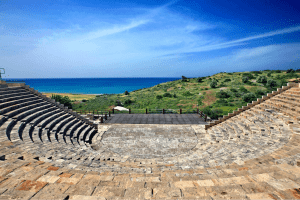
Cyprus coastal monuments showcase classical architecture where ancient stone columns rise against Mediterranean horizons, creating dramatic vistas that combine archaeological significance with natural beauty. The most impressive examples include the Greco-Roman theatre at Kourion perched on coastal cliffs 70 meters above sea level, the Sanctuary of Apollo Hylates with its partially restored temple columns, and the Tombs of the Kings in Paphos featuring underground burial chambers decorated with Doric pillars. Shutterstock-com These structures date primarily from Hellenistic and Roman periods between the 4th century BC and 4th century AD, when Cyprus prospered under successive empires. The architectural elements follow classical Greek orders with refinements from Roman building techniques, creating monuments that have withstood earthquakes, invasions, and two millennia of Mediterranean…

Read more
Morphou Plain

Morphou Plain

The Morphou Plain spreads across northwestern Cyprus as the island's most fertile agricultural region. The plain covers several hundred square kilometres of exceptionally productive farmland watered by underground aquifers and seasonal streams. The town of Morphou serves as the region's commercial centre with a current population of approximately 18,000 to 24,000 people. shutterstock-com The area produces over half of Cyprus's citrus fruits, primarily oranges, lemons, and grapefruits, along with substantial quantities of apples, vegetables, melons, and strawberries. The distinctive red soil, rich in minerals and organic matter, creates ideal conditions for intensive agriculture. Unlike much of Cyprus, which struggles with water scarcity, the Morphou Plain benefits from abundant groundwater that allows year-round cultivation and supports the island's most productive farming…

Read more
Khirokitia UNESCO Chalcolithic Village Cyprus

Khirokitia UNESCO Chalcolithic Village Cyprus

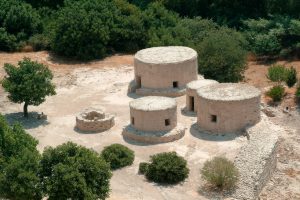
nashaplaneta.net Khirokitia (also spelled Choirokoitia) represents the peak of Cyprus's Aceramic Neolithic period, when communities built permanent settlements without any knowledge of pottery production. The site covers approximately 3 hectares at its maximum extent and consists of circular stone and mudbrick houses clustered together on a hillside. These structures were protected by massive stone walls that enclosed the settlement on multiple sides. The archaeological remains document a sophisticated farming society that thrived for over 1,500 years. Residents cultivated wheat and barley, raised domesticated sheep, goats, and pigs, and supplemented their diet through hunting and gathering wild foods. The settlement's name likely derives from the Greek words for pig (χοίρος) and cradle (κοιτίς), suggesting an area where pigs were raised, though…

Read more
Salamis City, Cyprus – History & Facts

Salamis City, Cyprus – History & Facts

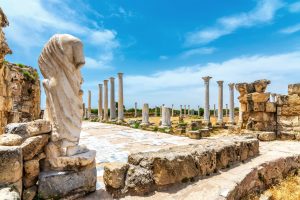
Salamis stands as one of the most important archaeological sites on the island of Cyprus. Located on the eastern coast near modern Famagusta, this ancient city flourished for over 1,800 years before nature forced its abandonment. The ruins spread across one square mile along the coast, offering visitors a remarkable glimpse into ancient Mediterranean civilization. cyprusparadise.com According to Greek legend, Salamis was founded by Teucer, son of King Telamon. After the Trojan War ended, Teucer could not return home because he failed to avenge his brother Ajax. Banished by his father, Teucer sailed to Cyprus and established a new city named after his birthplace, the island of Salamis near Athens. Archaeological evidence dates the earliest settlement to the 11th century…

Read more
Cyclopean Walls and Temples of Kition

Cyclopean Walls and Temples of Kition

A sacred complex in Kition constructed with massive stone blocks, housing temples dedicated to Astarte and Melqart, serving the Phoenician community. larnakaregion-com The Cyclopean Walls and Temples of Kition represent a cornerstone of Cyprus's ancient heritage, where monumental architecture and religious devotion intertwined to form a vibrant sacred precinct in the heart of the island's earliest urban center. Located in modern Larnaca, ancient Kition was one of Cyprus's ten city-kingdoms, thriving as a hub of trade, culture, and spirituality from the Late Bronze Age onward. This complex, characterized by its imposing walls built from enormous limestone blocks, enclosed a series of temples primarily dedicated to the Phoenician deities Astarte, goddess of fertility and war, and Melqart, a protector figure akin…

Read more
Ancient Ledra Early History of Nicosia

Ancient Ledra Early History of Nicosia

Ancient Ledra was a city-kingdom in the center of Cyprus where modern Nicosia stands today. It was established around 1050 BC and it became one of ten Cypriot kingdoms by the 7th century BC. Unlike coastal kingdoms that thrived on maritime trade, Ledra developed as an agricultural settlement in the fertile Mesaoria Plain. By Hellenistic times, it had dwindled to a small village before transforming into the capital city that continues to this day. oxfordre-com Archaeological remains from ancient Ledra have been found in several areas around modern Nicosia. The Bronze Age settlement was located on Leontari hill, approximately 6.5 kilometers southeast of the historical city center. This platform measures about 200 by 300 meters and includes a small cemetery.…

Read more
Ancient Soli, Cyprus – Hellenistic Coastal City

Ancient Soli, Cyprus – Hellenistic Coastal City

Soli was one of the ten ancient city kingdoms that ruled Cyprus from the 6th century BC until the Roman conquest. The city occupied an ideal location beside the Kambos River on Morphou Bay, with an acropolis on high ground and a lower town next to the harbor. visitncy-com Rich copper deposits lay just south of the city, good water flowed from nearby sources, and fertile soil stretched across the plains. These advantages made Soli prosperous for over a thousand years until Arab raiders destroyed it in the 7th century AD. Historical Background Several legends explain how Soli got its name. One Greek story claims the mythical Athenian hero Acamas founded the city after the Trojan War, accompanied by Phalerus.…

Read more
Ancient Tamassos, Cyprus

Ancient Tamassos, Cyprus

About 21 kilometres southwest of Nicosia, near the village of Politiko, lies one of ancient Cyprus's most significant city-kingdoms: Tamassos. It was not a coastal city with a grand harbour or a sprawling palace complex. It was something different. airial.travel Tamassos was an inland powerhouse, built almost entirely around one thing: copper. For centuries, this city sat on some of the richest copper deposits in the eastern Mediterranean, and that single resource shaped everything about it, from its economy to its politics, from its wealth to its eventual decline. Historical Background The land around Tamassos has been occupied since the Chalcolithic period, thousands of years before the city itself took shape. Small farming villages dotted the area well into the…

Read more