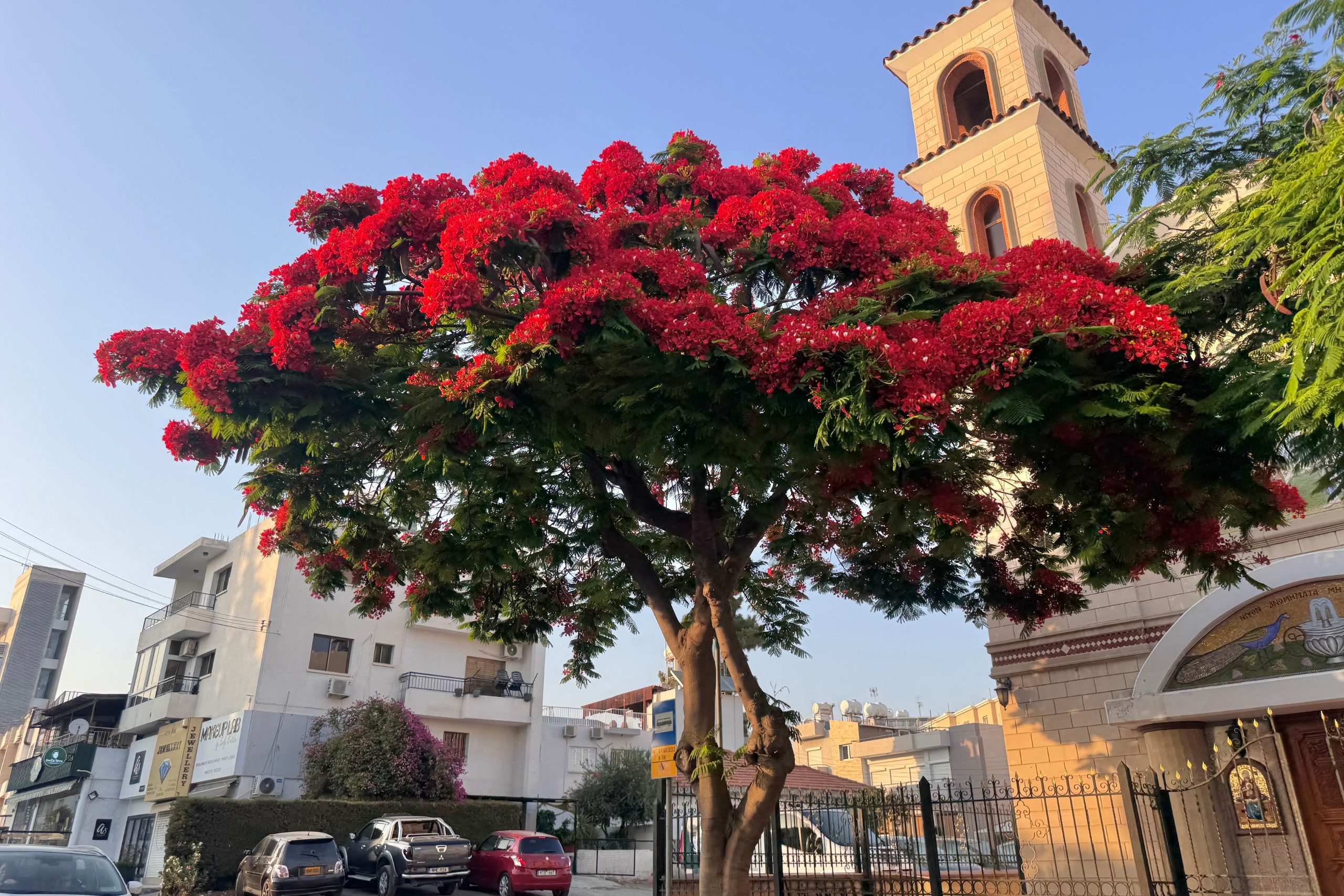
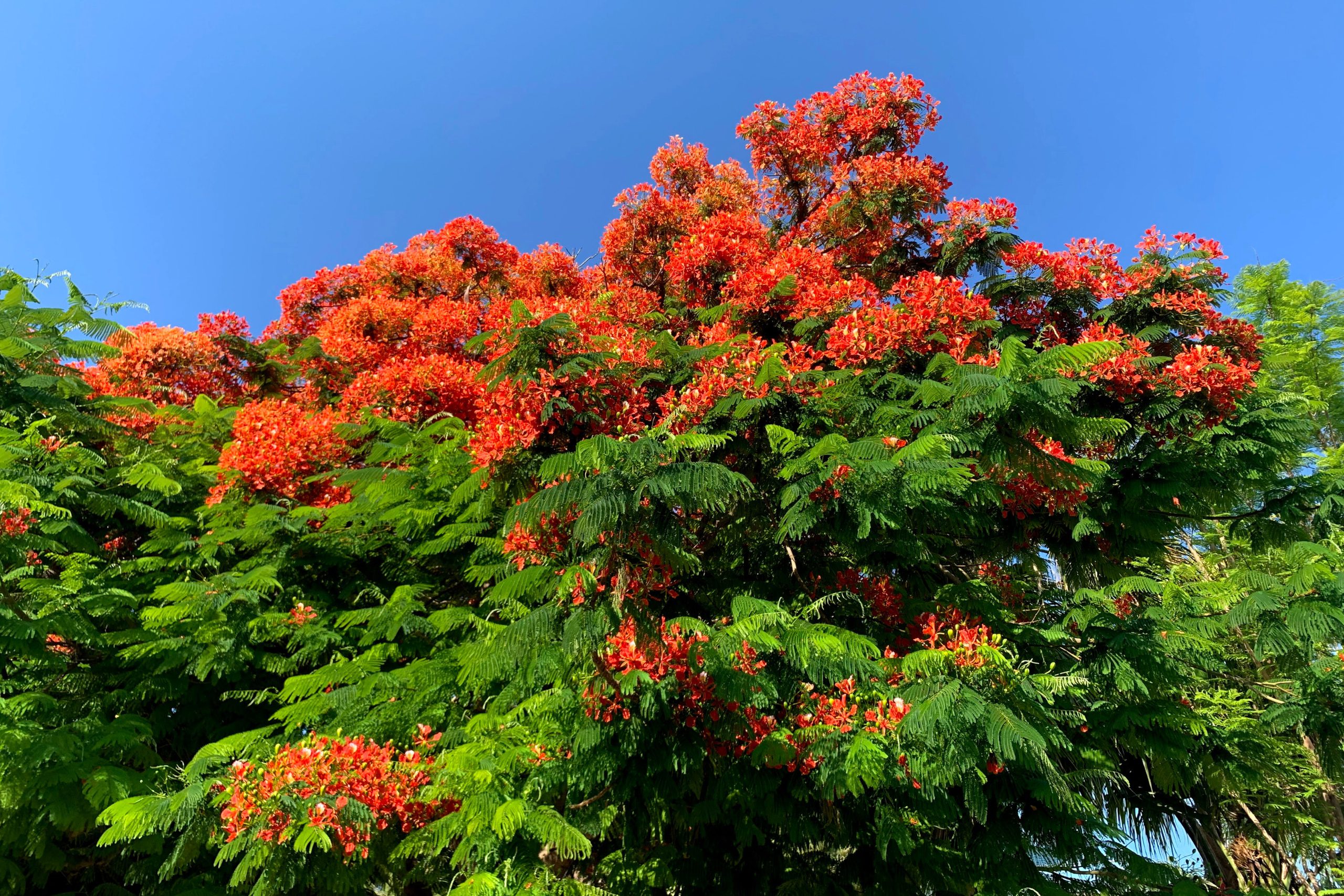
Picture a quiet street in Ayia Napa or Limassol in early June, when the heat has already settled in. Suddenly the whole canopy ignites in a blaze of scarlet and orange, as if someone has draped living flames across the branches. This is the royal poinciana of Cyprus – a tree so spectacular that locals and visitors alike stop to stare every summer.
The Royal Flame in the Legume Family
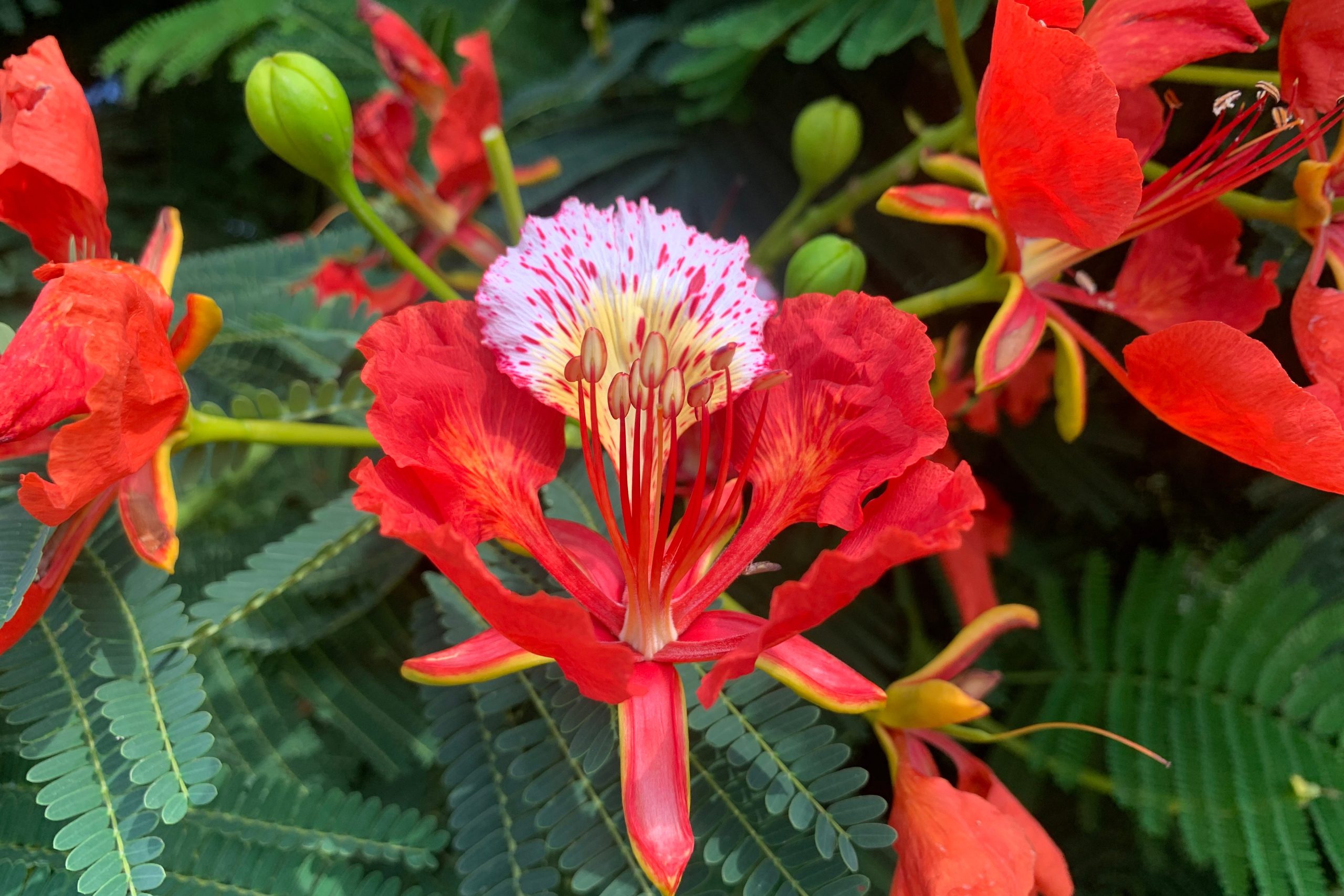
Delonix regia belongs to the vast Fabaceae (legume) family, specifically the Caesalpinioideae subfamily – the same group that includes carob, senna and many beautiful tropical trees. The genus Delonix is small, with just a handful of species, nearly all native to Madagascar and nearby islands. Locally it is known as Φλαμπουγιάν (Flambouyian) or Βασιλική Ποιντσιάνα (Vasiliki Pointsiána), names that echo its French nickname “flamboyant” (showy or flaming) and its older scientific synonym Poinciana regia. The genus name itself comes from ancient Greek: delos (visible or conspicuous) + onyx (claw), perfectly describing the long, claw-like petals that make each flower look like a tiny exotic bird.
From Madagascar to Cypriot Shores
Native to the dry deciduous forests of Madagascar, the royal poinciana was unknown to science in the wild until the 1930s, though it had already been carried around the tropics by traders and gardeners for centuries. It reached the Mediterranean in the 19th century as a prized ornamental, and in Cyprus it became popular from the mid-20th century onward. Gardeners and municipalities planted it for its unmatched colour and generous shade in coastal towns where winters stay mild. Unlike the eucalypts or wattles introduced for practical reasons, the flamboyant arrived purely to delight the eye – and it has succeeded brilliantly.
Dramatic Beauty and Grace
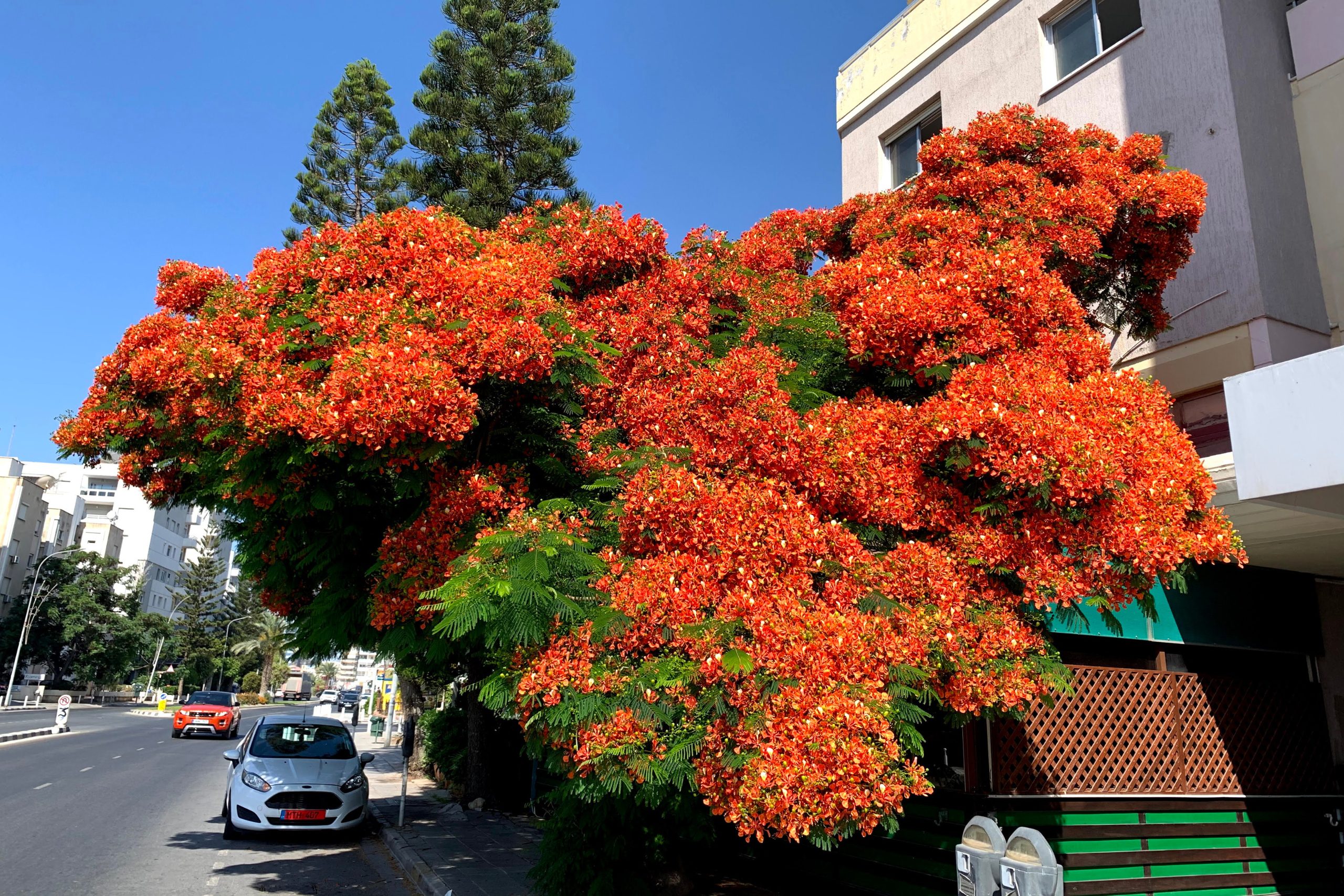
Delonix regia grows into a broad, umbrella-shaped tree 10–15 metres tall (sometimes more) with a smooth, grey trunk and spreading branches. Its leaves are wonderfully fern-like – doubly pinnate, up to 50 cm long, with hundreds of tiny oblong leaflets that fold slightly at night. In summer the tree sheds most of its leaves just before flowering, so the branches appear covered in pure fire: large clusters of 8–12 cm flowers in vivid scarlet-orange, each with five spreading petals (four bright red, one larger and often streaked with yellow or white) and long, protruding stamens. Later come flat, woody pods up to 60 cm long that hang like giant beans and rattle in the breeze. In Cyprus the trees thrive on well-drained soils and full sun, flowering most spectacularly after a dry spring.
Fiery Surprises
• The name “royal poinciana” honours the 18th-century governor of the Caribbean island of St Kitts, who loved the tree.
• Each flower lasts only a day or two, but the tree produces thousands, creating a continuous “flame” effect for weeks.
• The fallen petals carpet the ground in red – Cypriots sometimes call it “the red rain”.
• Bees and sunbirds adore the nectar; in Cyprus the flowers are a favourite late-spring food source for honeybees.
• The hard seeds were once used as beads, and the wood, though soft, makes beautiful lightweight carvings.
More Than Meets the Eye
The flamboyant is almost evergreen in Cyprus’s mild coastal climate but drops its leaves briefly in the driest months. It tolerates salt spray and drought once established, making it ideal for seaside gardens. It is not considered invasive here and stays neatly within planted areas. Like the jacaranda we met earlier, it is grown purely for beauty and shade rather than timber or fruit. The species is listed as Least Concern on the IUCN Red List, thanks to its huge popularity in cultivation worldwide.
Brightening Cyprus Today
In our hot, sunny summers the royal poinciana adds a tropical splash of colour that lifts everyone’s spirits. You will see mature specimens lining streets in Ayia Napa, Paphos and Limassol, shading parks and private gardens. While conservation focuses on native plants for wild areas, this flamboyant beauty continues to earn its place in urban and coastal landscaping – a low-maintenance, high-impact tree that helps make Cyprus feel even more vibrant and welcoming.
Witnessing the Flame
The best time to experience Cyprus’s royal poincianas is June and July. Take a relaxed drive or walk through the coastal avenues of Limassol, the streets of Ayia Napa, or the gardens around Paphos. Look for the broad, spreading crowns that turn completely scarlet-orange. Park safely, stand beneath the branches and listen to the soft hum of bees while bright petals drift down like confetti. Many public spaces and hotel gardens feature fine examples, and the display is so vivid that once you recognise the feathery leaves and claw-like petals you will spot them everywhere – turning everyday routes into unforgettable fiery parades.
A Blaze of Colour Worth Celebrating
Though it travelled far from its Madagascan home, the royal poinciana has become a beloved summer icon of Cyprus. Its blazing flowers remind us that beauty from distant lands can enrich our landscape without harm, bringing joy, shade and colour to the places we live and visit. Next time you see one glowing against the deep blue sky, pause and smile – this magnificent “flamboyant” is quietly celebrating Cyprus’s long tradition of welcoming striking green (and red!) travellers and making them part of the island’s colourful story.