Explore Cyprus with Our Interactive Map

Explore our top stories and discover ideas worth your time.

Finikoudes Beach Larnaca

Finikoudes Beach Larnaca

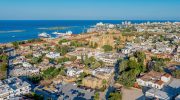
Finikoudes Beach stretches 600 meters along Larnaca's central seafront, backed by a palm-lined promenade that serves as the city's main social gathering space. The beach takes its name from the Greek word for small palm trees, referring to the baby palms planted along the promenade in 1922. Those original trees have now reached full height and stand as defining features of Larnaca's coastal identity. This urban beach offers direct access to the Mediterranean from the heart of Cyprus's third-largest city, with shallow waters that extend 25 to 30 meters from shore before reaching deeper zones. From Fishing Village to Tourist Destination Larnaca sits on the site of ancient Kition, established in the 13th century BC as a Mycenaean settlement. The city served as a copper trading hub and maintained continuous habitation for over 3,000 years. The modern Finikoudes area developed much later as Larnaca transformed from a modest coastal town into an international gateway. Historical records from the 16th and 17th centuries describe Larnaca as containing only around 300 houses, most built from stone and mud brick. The promenade's development fundamentally changed the relationship between Larnaca's old town and its waterfront. The reconstruction and improvement of Piale Pasha Avenue, which connects Finikoudes with the Mackenzie tourist area, was completed on July 29, 2014. This project unified Larnaca's entire seafront through…

Read more
Cyprus Metal Crafts Through Ages

Cyprus Metal Crafts Through Ages

Cyprus holds a unique position in metalworking history. The island gave its name to copper itself, with the Latin term "cuprum" deriving from "Cyprus." For over 6,000 years, Cypriot artisans have shaped metals into tools, weapons, jewelry, and decorative objects. The tradition spans from simple Chalcolithic copper tools around 4000 BCE to Byzantine gold treasures and modern handcrafted silver jewelry. This heritage connects ancient mining operations in the Troodos Mountains with contemporary workshops where craftspeople maintain techniques passed down through generations. Historical Background The metal story in Cyprus begins during the Chalcolithic period when early settlers discovered native copper deposits. By 3000 BCE, Cypriots were already working copper to create artifacts of high quality that circulated throughout the Mediterranean. Archaeological evidence shows that copper smelting started during the third millennium BCE, transforming the island into a major production center. The Bronze Age brought massive expansion. Cyprus became the largest copper supplier around the Mediterranean, with the island's strategic location between three continents making it a vital trading hub. Ancient texts from Babylon, Mari, and Alalakh dating to the 19th through 17th centuries BCE mention copper from Alashiya, the Bronze Age name for Cyprus. The Ulu Burun shipwreck discovered off Turkey's southwestern coast carried over 10 tons of Cypriot copper ingots when it sank in the late 14th century BCE, demonstrating…

Read more
Pentozali Cyprus Dance

Pentozali Cyprus Dance

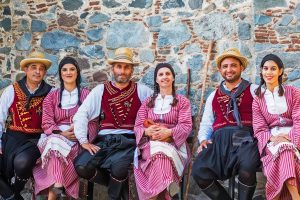
The Pentozali is one of the most powerful dances ever to cross the sea between Crete and Cyprus. Born in the mountains of western Crete as a dance of resistance and endurance, it later became part of Cyprus’s festival life, folk education, and stage tradition. When performed on Cypriot soil today, the Pentozali is not treated as a foreign import, but as a shared expression of strength, memory, and collective identity within the wider Hellenic world. This is not a dance meant to decorate an evening. It is meant to command attention. A Dance Built on Movement, Not Decoration Pentozali belongs to the family of pidichtos dances, a term that refers to leaping, high-impact movement rather than flowing steps. The body does not glide. It strikes, lifts, stamps, and suspends itself in the air. The posture is upright and direct, with little ornamentation, because the focus is on force and timing rather than elegance. The dance is usually performed in an open circle or semi-circle, with dancers linked at the shoulders. That formation creates both physical stability and a sense of collective strength. Everyone moves as one unit, but the attention belongs to the leader at the front of the line, whose improvisations set the intensity of the performance. Why Leadership Matters in Pentozali Unlike many communal dances, Pentozali places…

Read more