Explore Cyprus with Our Interactive Map

Explore our top stories and discover ideas worth your time.

Cyprus Folk Dances And Weddings Festivals

Cyprus Folk Dances And Weddings Festivals

Cyprus folk dances represent living traditions that connect modern Cypriots to Byzantine heritage through choreographed movements, traditional costumes, and communal participation. These dances appear at weddings, religious festivals, harvest celebrations, and family gatherings, serving social functions beyond entertainment by reinforcing community bonds, facilitating courtship under supervision, and displaying cultural identity.  The basic repertoire includes syrtos and kartzilaumas, performed as paired confrontational dances or circle formations, alongside specialty performances like tatsia where dancers balance wine-filled glasses on sieves, and drepani, the sickle dance demonstrating agricultural skills.  Men and women traditionally danced separately, with social conventions restricting female dancing primarily to weddings while men performed at coffee shops, threshing floors, and festivals. The movements emphasize improvisation within communal constraints, with dancers competing to display skill while adhering to strict local standards that discourage excess or showiness that would violate collective norms. The Kartzilaumas Confrontational Tradition Kartzilaumas, the fundamental Cypriot dance from approximately 1910 through the 1970s, consists of six parts performed by confronted pairs of dancers, either two men or two women. The name derives from the Turkish word karşılama meaning greeting, reflecting the face-to-face positioning where dancers mirror and respond to each other's movements. The suite progresses through first, second, third, fourth, fifth or balos stages, with each part featuring slight variations in steps, tempo, and intensity. Between the third and…

Read more
Cyprus Omens Divination Traditions

Cyprus Omens Divination Traditions

Cyprus maintains vibrant divination and superstition traditions that blend ancient Greek practices with Christian Orthodox beliefs and Ottoman influences. The most iconic practice remains kafemanteia or coffee fortune telling, where patterns left by Cyprus coffee grounds reveal past and future events. These traditions persist across both Greek and Turkish Cypriot communities, demonstrating how folklore unites the divided island. Both young and old Cypriots observe omens and follow superstitious rituals, some from habit taught since childhood, others with genuine belief. The practices serve social and psychological functions, providing comfort during uncertainty while creating bonds through shared cultural knowledge passed between generations, typically from grandmother to granddaughter. The ancient art of reading coffee cups After drinking thick Cyprus coffee, the drinker places the saucer over the cup, makes a wish, and flips the entire assembly upside down. The cup rests on the saucer for several minutes while grounds settle and create patterns on the cup's interior. A designated reader, often an older woman called kafetzou, interprets shapes formed by the residue. The top half of the cup typically shows the future while the bottom half reveals the past. Some readers claim the left side indicates bad news while the right side brings good tidings. White designs formed by empty spaces represent positive developments, while dark patterns created by concentrated grounds signal challenges.…

Read more
Enkomi Bronze Figurines: Gods of Copper

Enkomi Bronze Figurines: Gods of Copper

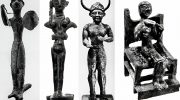
Enkomi’s bronze figurines show how Late Bronze Age Cyprus fused religion with copper production, turning its key resource into divine protection and political legitimacy. The Horned God and the Ingot God were not decorative art but intentional symbols, linking sanctuaries, workshops, and administrative control inside one civic system. This article explains Enkomi’s trade position as Alashiya, what each figure was designed to communicate, and why their burial and survival still shape how we understand “sacred industry” on Cyprus. A City Between Mine and Sea Enkomi rose on a rocky plateau near a sheltered inlet that once opened to the sea. This position allowed it to function as both a port and a processing centre, linking the copper-rich Troodos Mountains to international trade routes that reached Egypt, the Levant, and the Aegean. Ancient texts refer to the kingdom of Alashiya as a copper supplier powerful enough to address pharaohs as equals. That status came directly from Enkomi's control of metal production. The city expanded dramatically during the Late Bronze Age, especially in the 14th and 13th centuries BCE. Its layout reveals planning rather than improvisation. Straight streets, large ashlar buildings, and massive fortifications point to centralised authority and long-term investment. This was not a marginal settlement. It was an industrial capital whose wealth depended on metal and whose religion reflected that…

Read more