Explore Cyprus with Our Interactive Map

Explore our top stories and discover ideas worth your time.

The Story Behind Cyprus Kleftiko

The Story Behind Cyprus Kleftiko

Kleftiko is a traditional lamb dish cooked in a sealed oven for many hours until the meat becomes tender enough to fall off the bone. The name comes from the Greek word "kleftis," which means thief. The dish uses lamb or goat, cut into large portions and kept on the bone. Seasoning remains minimal: salt, oregano, bay leaves, lemon juice, and garlic. The meat cooks alongside potatoes in a sealed clay pot or wrapped tightly in parchment paper. The cooking process traps all moisture and aroma inside, creating meat that pulls apart with a fork. Traditional versions cook for at least eight hours, though modern recipes often reduce this to three or four hours in conventional ovens. Origins of a Rebel Dish The history of kleftiko traces back to the 15th through 19th centuries during Ottoman rule over Greece and Cyprus. A group called the Klephts operated as mountain rebels who resisted Ottoman authority. These fighters lived in remote mountain regions and survived partly by stealing livestock from flocks. To avoid detection while cooking their stolen meat, the Klephts developed a method that left no visible smoke or scent. They dug pits into hillsides or underground, placed the meat inside with hot stones or coals, then sealed everything with clay or mud. The meat slow-cooked for many hours while the…

Read more
Royal Tombs of Tamassos In Cyprus

Royal Tombs of Tamassos In Cyprus

Southwest of Nicosia, near the modern village of Politiko, stand two monumental burial chambers that tell the story of ancient Cyprus's wealthiest inland kingdom. The Royal Tombs of Tamassos represent the height of 6th century BCE Cypriot architecture and demonstrate the immense prosperity that copper mining brought to this ancient city-kingdom. These tombs, carved from limestone blocks and built to resemble wooden houses, remain among the most impressive examples of pre-Hellenistic burial architecture on the island. The Royal Tombs of Tamassos are two monumental burial chambers constructed in the mid-6th century BCE. They belonged to the local rulers or elite aristocrats of the ancient city-kingdom of Tamassos, one of the ten major kingdoms of ancient Cyprus. The tombs were built using massive ashlar blocks of limestone and feature architectural details that imitate wooden construction techniques, including carved representations of roof beams and door locks. Historical Background Tamassos was strategically positioned near rich copper deposits in the northeastern foothills of the Troodos Mountains. The area had been inhabited since the Chalcolithic Age (around 3900 BCE), but population growth accelerated dramatically during the Late Bronze Age when copper mining intensified. By the 8th century BCE, Tamassos had developed into a major city-kingdom. The kingdom is mentioned in the Assyrian Prism of Esarhaddon from around 673-672 BCE, where it appears as "Tamesi." The…

Read more
Modern Naval Heritage

Modern Naval Heritage

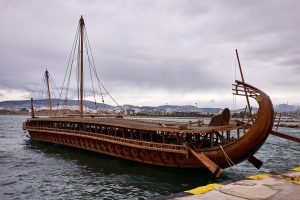
Cyprus has never treated the sea as a boundary. For centuries, its coastline functioned as a working edge where trade, defense, administration, and daily life met. In the modern period, this relationship was shaped most clearly by two naval powers: the Ottoman Empire and the British Empire. Their presence did not simply leave behind forts and harbors. It reshaped how the island was governed, how its ports functioned, and how Cypriots understood their place within the wider Mediterranean world. This article explores how Ottoman and British naval priorities transformed Cyprus from a regional outpost into a strategic maritime asset, and why that legacy still defines the island’s identity today. An Island Positioned to Be Watched Cyprus sits at a crossroads of the eastern Mediterranean, close enough to Anatolia, the Levant, and Egypt to matter to every power operating in the region. This geography made neutrality impossible. Control of Cyprus meant visibility over key sea lanes, access to sheltered anchorages, and influence across multiple trading and military routes. Rather than isolating the island, the sea connected it outward. Cyprus became valuable not for its interior alone, but for how its coastline could support movement, surveillance, and supply. This strategic reality explains why naval priorities repeatedly shaped the island’s administration. What “Modern Naval Heritage” Really Means When discussing naval heritage in Cyprus,…

Read more