Explore Cyprus with Our Interactive Map

Explore our top stories and discover ideas worth your time.

Cyprus Grazing Lands and Stone Houses

Cyprus Grazing Lands and Stone Houses

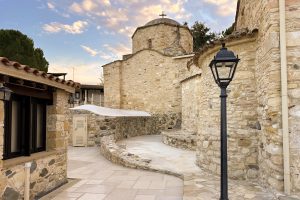
Cyprus agricultural landscape combines traditional shepherding practices with distinctive stone architecture that has defined rural life for centuries. Grazing land occupies approximately 16,369 hectares, representing 4.95% of the total land area in the Turkish-occupied part of Cyprus. These pastures support sheep and goat herding that dates back to the Neolithic period around 8000 BC, making Cyprus one of the earliest locations for domesticated livestock management. Stone houses built from locally quarried limestone stand as physical monuments to village life and family continuity. The thick walls, small windows, and vaulted ceilings reflect adaptations to Mediterranean climate while using materials readily available from surrounding terrain. These structures remain intimately connected to the agricultural economy they supported for generations. Shepherding Methods Adapted to Island Terrain Traditional Cypriot sheep and goat herding operates on small to medium scales with short-range mobility. From October through June during rainy seasons, herds relied on wild plants in scrublands, hilly areas, and fallow land. In predominantly mountainous regions, especially around Lemesos and Pafos districts, goats continued year-round grazing. This pattern demonstrated remarkable adaptation to landscape variations and climate cycles. British colonial law in 1913 excluded goats from extensive upland forest areas to protect tree regeneration. Only tethered goats received permission in those zones. This restriction fundamentally altered traditional grazing patterns and concentrated herds in lowland areas. The law…

Read more
Salt Flats Coastal Wetlands

Salt Flats Coastal Wetlands

Salt Flats and Coastal Wetlands (Larnaca, Limassol, Akrotiri) are crucial ecosystems in Cyprus, serving as vital stopovers for migratory birds, habitats for flamingos, and homes to brine-adapted flora, holding international significance for biodiversity. These areas, including Larnaca Salt Lake, Limassol's Akrotiri Wetlands, and related sites, form interconnected zones where saltwater and freshwater mix, creating unique conditions that support thousands of species. They highlight the island's role as a Mediterranean biodiversity hotspot, where natural processes and human history intersect to foster life in challenging environments. A Vital Ecosystem in the Mediterranean Salt flats and coastal wetlands in Cyprus represent dynamic landscapes where land meets sea, characterized by shallow saline lakes, marshes, and mudflats that fluctuate with seasons. Larnaca Salt Lake, the largest inland wetland at 2.2 square kilometers, dries to a white crust in summer but fills with winter rains, hosting algae that tint waters pink. Limassol's Akrotiri Peninsula, covering 150 square kilometers, includes brackish lagoons and reed beds, while smaller sites like Oroklini add diversity. These zones support migratory birds numbering over 10,000 annually, flamingos that winter in flocks of 20,000, and brine-adapted plants like halophytes that thrive in salty soils. Their international significance stems from Ramsar Convention protection since 1997, recognizing them as wetlands of global importance for conservation and sustainable use. Formation Through Geology and Climate These wetlands…

Read more
Artos Cultural and Research Foundation (Nicosia)

Artos Cultural and Research Foundation (Nicosia)

The Artos Cultural and Research Foundation is a contemporary arts and science center located in the Acropolis neighborhood of Nicosia. Established as both a cultural venue and research platform, it operates where creativity and scientific inquiry meet. The foundation occupies a restored building that once served as the parish bakery for the Agii Omologites area. Its name translates from Greek as "bread," which acknowledges the building's former purpose while symbolizing the nourishment of ideas and cultural growth. Historical Background The foundation's history begins with artists Achilleas Kentonis and Maria Papacharalambous, who legally established the organization on October 26, 2000. Kentonis studied electronic engineering and physics at the University of South Alabama and later worked on NASA research programs before shifting to fine arts.  He pursued postgraduate studies in multimedia aesthetics and new technologies at the Museo Internacional de Electrografia in Cuenca, Spain. Papacharalambous trained in visual arts and developed a practice that combines traditional media with conceptual approaches. The couple collaborated throughout the 1990s on architectural projects, including the restoration of traditional houses in Nicosia. One renovation uncovered four ancient tombs from 450 BC, which led to international cultural events in 1995 during the European Cultural Month. This project earned them a Europa Nostra award in 1998 for their contribution to European cultural heritage conservation and representation at the 1997…

Read more