Explore Cyprus with Our Interactive Map

Explore our top stories and discover ideas worth your time.

Machairas Forest Reserve Mountain Biodiversity

Machairas Forest Reserve Mountain Biodiversity

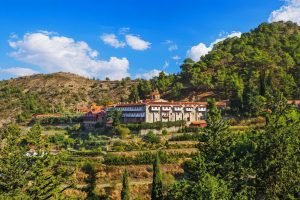
Machairas Forest Reserve represents one of Cyprus's most ecologically valuable protected areas. The forest has an extent of 6,057 hectares or 60.6 square kilometers, making it a significant natural asset for the island. visitcyprus-org Located in the central mountain range between the Nicosia and Larnaca districts, the forest extends from an altitude of 300 meters at its lowest point to 1,423 meters at Kionia peak. The reserve was designated as a national forest to protect its exceptional biodiversity and watershed functions. More than 600 plant species have been recorded in the park, with 27 indigenous to Cyprus. The terrain consists of dense pine forests, golden oak groves, and Mediterranean scrubland that shelters numerous endemic species found nowhere else on Earth. Two of Cyprus's most important rivers, the Pediaios and Yialias, originate within the forest boundaries, providing critical water resources to surrounding regions. Historical Context The Machairas region holds deep historical significance, stretching back centuries. The area takes its name from the Machairas Monastery, founded in 1148 by two monks who reportedly discovered a miraculous icon of the Virgin Mary in a nearby cave. wikipedia-org The monastery became an important spiritual center and landowner in medieval Cyprus. Throughout the Byzantine, Lusignan, and Ottoman periods, the surrounding forest provided timber, game, and grazing land for local communities. By the early 20th century,…

Read more
Cyprus Kourkoutas Lizard

Cyprus Kourkoutas Lizard

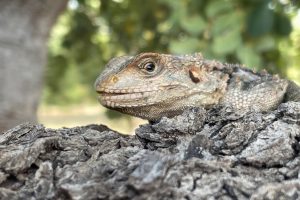
Imagine a creature that looks like a miniature dragon, basking on sun-warmed rocks with starry patterns twinkling on its back. This is the kourkoutas, Cyprus' very own rock agama a nimble lizard that's as much a part of the island's rugged landscapes as olive trees and ancient ruins. But what makes this endemic resident so special, and why does it deserve a spotlight in Cyprus' wildlife tales? www.inaturalist.org Getting to Know the Starred Survivor The kourkoutas, or Cyprus rock agama, is a biggest of lizards in Cyprus that's perfectly adapted to island life. It's not a giant though – growing up to about 35 centimeters from nose to tail tip – but it's a tough little explorer of Cyprus' diverse terrains. Think of it as a scaled sun-lover that's at home anywhere from sandy beaches to mountain peaks, always ready to dart away from curious eyes. A Journey from Ancient Lands The kourkoutas belongs to the agama family, a group of lizards with roots stretching back to ancient times across Asia, Africa, and Europe. Its scientific name, Stellagama stellio cypriaca (or more correctly Laudakia cypriaca), highlights its starry appearance and Cypriot origins. Fossil records and genetic studies suggest its ancestors arrived on Cyprus during the late Pleistocene, evolving in isolation to become a unique subspecies. Unlike its mainland cousins in…

Read more
Kourion Mosaics Apollo To Basilicas Guide

Kourion Mosaics Apollo To Basilicas Guide

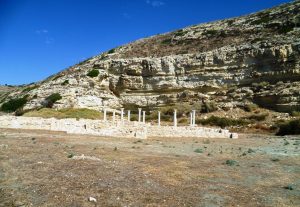
Kourion’s mosaics record Cyprus’s shift from a classical city organised around temples and civic life to an early Christian centre rebuilt under episcopal authority after mid-fourth-century earthquakes. In villas and basilicas, floors and inscriptions became a visual language that guided movement, reinforced belief, and redefined what power looked like in public space. wikimedia-org This article explains how disaster opened the ground for change, how the Episcopal Complex reshaped the city’s core, and how mosaic imagery at sites like the House of Eustolios shows a community rebuilding identity as well as architecture. Apollo Hylates and Old Order For centuries, Kourion thrived as a Greco-Roman city, complete with temples, baths, theatres, and elite villas. Public life revolved around civic institutions and traditional religious cults, most notably the Sanctuary of Apollo Hylates. Christianity was present early, introduced to Cyprus in the first century, but in Kourion it remained largely private and unobtrusive. Everything changed in the mid-fourth century. A catastrophic earthquake, most notably the one in 365 CE, devastated the city. Entire neighbourhoods collapsed, public monuments were abandoned, and the old religious landscape effectively ended. The destruction was not symbolic. It was physical, sudden, and comprehensive. When rebuilding began, it followed a new logic. wikimedia-org Instead of restoring pagan sanctuaries, Kourion was reorganised around Christian authority. The centre of gravity shifted from temples…

Read more