Explore Cyprus with Our Interactive Map

Explore our top stories and discover ideas worth your time.

Cyprus Birthplace Mediterranean Copper Trade

Cyprus Birthplace Mediterranean Copper Trade

Long before Cyprus became known for beaches or crossroads of empires, it was known for something far more fundamental. Copper. Drawn from its mountains and carried across open water, this metal placed the island at the center of the ancient Mediterranean world. Cyprus did not merely export a resource. It supplied the material that powered the Bronze Age and, in doing so, helped shape the earliest long-distance trade networks ever formed at sea. wikipedia-com This is not a story of passive geography or accidental wealth. It is the story of how an island learned to move its resources outward, turning stone into influence and distance into connection. An Island Defined by What Lay Beneath Copper was the first metal to change how societies lived. It allowed stronger tools, more effective weapons, and eventually the creation of bronze, the alloy that defined an entire era. Control of copper meant control of technology, agriculture, and military power. Cyprus stood apart because of scale. Its copper deposits, concentrated in the Troodos Mountains, were among the richest and most accessible in the ancient world. Mining was not scattered or marginal. It was continuous, extensive, and organized. The island’s association with copper became so strong that the Latin word cuprum ultimately derived from Cyprus. While the name of the island itself likely predates the metal…

Read more

Cyprus Volcanic Rocks

Cyprus Volcanic Rocks

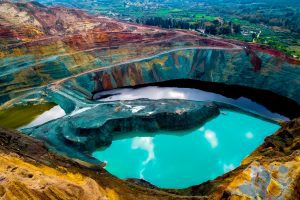
Cyprus holds a unique position in geological science. The island contains Earth's best preserved ophiolite complex, a rare slice of ancient oceanic crust and upper mantle thrust upward onto land. This exceptional geological heritage shaped both the island's dramatic landscapes and its human history, particularly through copper deposits that gave Cyprus its very name. sandatlas.org The Troodos Massif formed 90 million years ago during the Upper Cretaceous period at the bottom of the ancient Tethys Ocean. The rocks visible today once existed 8,000 meters below sea level at a mid-ocean ridge spreading center, where new oceanic crust continuously forms as tectonic plates pull apart. Geologists call this complete sequence an ophiolite complex. sandatlas.org Troodos was not metamorphosed during uplift, allowing scientists to study pristine oceanic rocks without submarines. This makes Cyprus an on-land analogue for modern mid-ocean ridges. The collision of African and Eurasian tectonic plates pushed the oceanic lithosphere upward rather than downward into a trench. Troodos first rose above sea level about 20 million years ago, with uplift centered around Mount Olympus at 1,952 meters. Erosion exposed deeper layers, allowing visitors to walk from rocks that once existed in Earth's mantle to rocks that formed at the ancient seafloor. Complete Rock Sequence from Mantle to Seafloor The ophiolite exposes a perfect vertical sequence. At the deepest level lie…

Read more
Cyprus Police Museum (Nicosia)

Cyprus Police Museum (Nicosia)

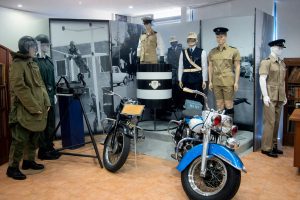
The Cyprus Police Museum chronicles law enforcement history in Cyprus from British colonial times through independence to the present day. The British Chief of Police, W.C.C. King, founded the museum in 1933 during the colonial period. cyprusbutterfly-com The museum documented criminal methods and police responses during a period when Cyprus was transitioning from traditional village life to a more modern urban society. The facility displays uniforms, weapons, equipment, police vehicles, and documents that trace the development of policing on the island. The museum also houses important materials from World War II and the 1955 to 1959 National Liberation Struggle against British rule. Evolution to a Historical Institution Over decades, the museum's scope expanded beyond purely criminal matters. While crime-related exhibits remain important, the collection now covers the broader history of the Cyprus Police Force. The institution documents how policing changed through different political periods, from British colonial administration through the establishment of the Republic of Cyprus in 1960 to modern law enforcement practices. cyprusbutterfly-com The Police Museum is owned by the Cyprus Police and managed by Department A of the Police Headquarters. It operates as a public institution with free admission, making police history accessible to all visitors. The museum serves both educational purposes and institutional memory, preserving the legacy of police work in Cyprus. Police History Collections A substantial…

Read more