Explore Cyprus with Our Interactive Map

Explore our top stories and discover ideas worth your time.

Wattles of Cyprus

Wattles of Cyprus

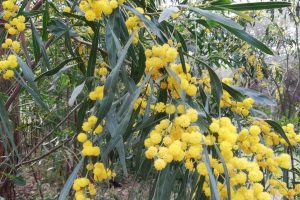
Picture a roadside verge or coastal slope in late February, when the Mediterranean light turns sharp and warm. Suddenly, whole thickets explode into vivid, butter-yellow spheres that light up the landscape like thousands of tiny suns. These are the wattles of Cyprus Australian guests that arrived with good intentions but have written their own lively, sometimes challenging chapter in the island’s green story. www.inaturalist.org Wattles in the World of Legumes Wattles belong to the enormous Acacia genus within the Fabaceae (legume) family – the same botanical clan as peas, beans, carobs and acacias of the ancient world. Most of the 1,000-plus Acacia species are native to Australia, where they are proudly called “wattles”. In Cyprus the star of the show is Acacia saligna, the golden wreath wattle or orange wattle, though a handful of other species (A. farnesiana, A. ligulata, A. karroo) appear in small numbers. Locally they are simply known as Ακακία (Akakia) – a name that echoes the ancient Greek “akakia”, used two thousand years ago by Dioscorides for the gum of Egyptian acacias. From Australian Shores to Cypriot Soil When British foresters took charge in 1878 they faced an island stripped of much of its woodland by centuries of grazing and fuelwood cutting. Following earlier recommendations by French arborist P.G. Madon (1881), they turned to fast-growing exotics.…

Read more
Cyprus E4 Trail – Europe Long Distance Route

Cyprus E4 Trail – Europe Long Distance Route

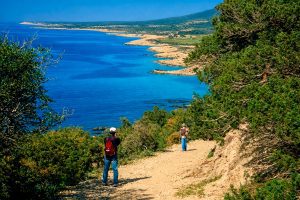
The E4 European Long Distance Path stretches over 10,450 kilometers from Tarifa in southern Spain to Cyprus, making it one of the most ambitious hiking routes in the world. The Cyprus section was added to the route in 2005 following a proposal by the Greek Ramblers Association to the European Ramblers Association. travel-com The trail connects Larnaca and Paphos international airports across approximately 540 to 660 kilometers depending on the route taken. The path crosses Spain, France, Switzerland, Germany, Austria, Hungary, Serbia, Bulgaria, Greece, and Crete before reaching Cyprus as its final destination. The Cyprus segment traverses the Troodos mountain range, the Akamas Peninsula, and long stretches of countryside through regions of exceptional natural beauty and ecological importance. Cyprus became only the second island on the entire E4 route, after Crete, making it a unique endpoint for this continental trail system. The development of Cyprus's section The Cyprus Forestry Department developed the island's E4 section in collaboration with the Cyprus Tourism Organisation to create a cross country route that showcases the island's diverse landscapes. The trail follows a primarily west to east direction, though it includes a significant loop at the eastern end near Larnaca. The route was carefully designed to balance accessibility with wilderness experience, passing through remote forest areas, traditional mountain villages, and coastal regions. agrotourism-com The Department…

Read more

Fertility and Mother Goddess Cults in Ancient Cyprus

Fertility and Mother Goddess Cults in Ancient Cyprus

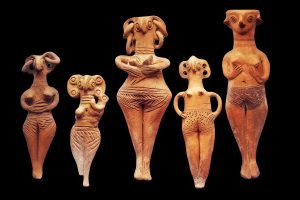
Fertility and Mother Goddess cults in ancient Cyprus were the island's earliest spiritual heartbeat, centered on a powerful female divine force that oversaw birth, growth, and the rhythms of nature. These beliefs weren't about distant deities but a hands-on reverence for life's cycles, helping early communities thrive amid uncertainty. Digging into them reveals how Cypriots turned everyday survival into something sacred, leaving us wondering just how much of that ancient wisdom still echoes today. The Roots of Cyprus's Earliest Beliefs Imagine a time when religion wasn't found in grand temples or holy books, but in the soil under your feet and the changing seasons overhead. That's where Fertility and Mother Goddess cults began in Cyprus - as a practical way for prehistoric people to make sense of a world full of risks like failed crops or harsh winters. These weren't fancy philosophies; they were born from the need to ensure life kept going. The Mother Goddess, often depicted as a nurturing female figure, symbolized the force behind everything that grew or multiplied. She wasn't a queen on a throne but more like the earth's own pulse, connecting humans to the land's bounty. For early Cypriots, from the Chalcolithic period around 4000 BC onward, this wasn't superstition - it was survival wrapped in awe, a way to feel in control of…

Read more