Explore Cyprus with Our Interactive Map

Explore our top stories and discover ideas worth your time.

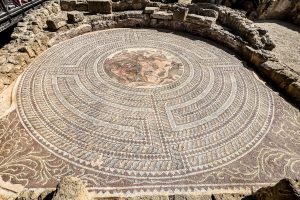
Nea Paphos Archaeological Park Roman Mosaics

Nea Paphos Archaeological Park Roman Mosaics

Nea Paphos Archaeological Park preserves the heart of an ancient city that served as the capital of Cyprus for over 600 years. Located on the southwestern coast near modern Paphos, this UNESCO World Heritage Site contains some of the finest Roman mosaics in the eastern Mediterranean, alongside temples, fortresses, and the remains of a once-thriving urban center. Adobe-Stock-com Historical Background Nea Paphos was founded in the late 4th century BC by Nikokles, the last king of Palaipaphos (Old Paphos), about 10 kilometers inland. The new coastal location offered better harbor access and strategic advantages for trade across the Mediterranean. When Ptolemy I of Egypt took control of Cyprus in 294 BC, he made Nea Paphos the island's administrative capital, a status it maintained through the Ptolemaic, Roman, and early Byzantine periods. Adobe-Stock-com The city reached its peak during Roman rule, from 58 BC onward. As the seat of the Roman proconsul, Nea Paphos became a wealthy urban center with impressive public works and luxurious private homes. According to the Acts of the Apostles, Paul the Apostle visited the city in 45 AD and converted the Roman proconsul Sergius Paulus to Christianity. It makes Cyprus one of the first Roman territories to have a Christian governor. The city suffered severe damage from earthquakes in the 4th century AD, particularly the devastating…

Read more
Cyprus at the Crossroads of the Eastern Mediterranean

Cyprus at the Crossroads of the Eastern Mediterranean

Cyprus sits quietly at sea, but its position has never been passive. For thousands of years, the island has stood close to the main maritime routes linking Europe, the Middle East, and North Africa. Empires did not value Cyprus for its size or population, but for its ability to observe, connect, and influence movement across the eastern Mediterranean. To understand Cyprus is to understand the sea around it, because the island’s history, economy, and regional role have always been shaped by passing ships and shared horizons. wikipedia-com Where Geography Turns into Influence A strategic maritime position is not about domination; it is about proximity. Cyprus lies near the natural crossroads of the eastern Mediterranean, where east–west and north–south sea routes converge. Ships travelling between the Aegean and the Levant pass close by, as do routes linking southern Turkey with Egypt and the wider gateway of the Suez Canal. This location places Cyprus within easy reach of three continents at once. From its shores, maritime connections extend toward southern Europe, the Middle East, and North Africa with minimal deviation. Few islands occupy such a balanced position — close enough to matter, distant enough to endure. An Island Shaped by Moving Water, Not Borders Cyprus has never been a landlocked power, and it has rarely defined itself through territorial expansion. Instead, its…

Read more

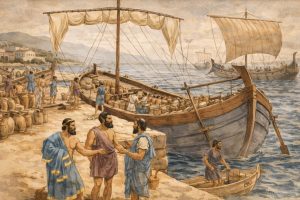
Early Seafaring Shipbuilding Traditions Cyprus

Early Seafaring Shipbuilding Traditions Cyprus

Cyprus did not become connected to the Mediterranean world by chance. Long before written records, its inhabitants learned to cross open water, build reliable vessels, and read the sea as a route rather than a boundary. These early seafaring and shipbuilding traditions allowed the island to turn geographic isolation into advantage, shaping Cyprus into a place of exchange, movement, and outward connection. To understand Cyprus’s early history is to understand how deeply it was shaped by boats, timber, and the confidence to sail beyond the horizon. facebook-com An Island That Learned to Look Outward For early communities, water often marked the edge of the known world. In Cyprus, it became the opposite. Surrounded entirely by sea, the island’s survival depended on crossing it. The coastline offered food, shelter, and access, but it was seafaring that allowed Cyprus to participate in wider networks rather than remain self-contained. This outward orientation emerged early. The sea was not treated as hostile territory to be avoided, but as a practical extension of daily life. Travel by boat became normal long before roads or written maps shaped movement on land. Crossing the Sea Before History Was Written The earliest evidence of seafaring connected to Cyprus dates back more than 11,000 years. Humans reached the island during the Late Epipalaeolithic period, crossing open water from nearby…

Read more