Explore Cyprus with Our Interactive Map

Explore our top stories and discover ideas worth your time.

Fig Tree Bay: Cyprus’s Most Famous Beach

Fig Tree Bay: Cyprus’s Most Famous Beach

Fig Tree Bay is one of Cyprus’s most recognizable beaches, yet its appeal has never depended on novelty or spectacle. Located in the heart of Protaras on the island’s eastern coast, the bay combines clear, shallow water, soft sand, and a naturally sheltered shape that makes it easy to enjoy without effort. It is popular without feeling overwhelming, developed without feeling artificial, and familiar without becoming dull. This balance explains why Fig Tree Bay continues to attract visitors year after year and why it remains just as important to local life as it is to tourism. A Beach Defined by Shape, Not Hype At its core, Fig Tree Bay is a gently curved, sandy bay facing the Mediterranean Sea. Unlike long, exposed coastlines, the bay is semi-enclosed by low rocky edges that soften incoming waves and create consistently calm conditions. The shoreline slopes gradually into the sea, allowing people to wade far out before reaching deeper water. This physical shape is the bay’s greatest asset. It creates a swimming environment that feels predictable and safe rather than dramatic or demanding. The water rarely feels aggressive, and strong currents are uncommon close to shore. These conditions are not accidental they are the result of geography rather than engineering, and they explain why the bay has always been naturally suitable for bathing.…

Read more
The Soli Basilica Frescoes

The Soli Basilica Frescoes

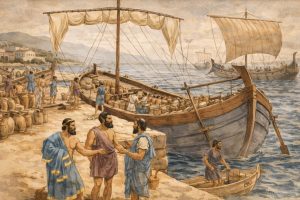
The Soli Episcopal Basilica preserves rare fragments of early Christian wall painting from a period when church imagery in Cyprus was still being invented rather than standardised. Painted above the site’s famous mosaics, the fresco remains show Roman decorative habits being adapted into a new visual language for worship, before later Byzantine rules became fixed. This article explains Soli’s rise as an ecclesiastical centre, what the surviving plaster fragments suggest about the original interior, and why the basilica’s destruction ended up preserving an important artistic transition. Trade, Farmland, Copper, Harbour Ancient Soli, also known as Soloi, occupied a strategic position near fertile farmland, copper-rich foothills, and a natural harbour. This combination sustained the city for centuries, from its legendary foundation in the Archaic period through its Roman peak and into the Christian era. By Late Antiquity, Soli was no longer just a trading hub. It had become an important ecclesiastical centre, serving the surrounding region as Christianity spread across Cyprus. The basilica that rose here in the 4th century was not a modest village church. It was one of the largest early Christian complexes on the island, reflecting both wealth and confidence during a period of profound cultural change. A Basilica Built on Confidence The Soli Episcopal Basilica went through multiple phases, mirroring the development of Christian worship itself. The…

Read more
Sanctuary of Apollo Hylates

Sanctuary of Apollo Hylates

The Sanctuary of Apollo Hylates was one of the most important religious centres in ancient Cyprus, set within the wooded landscape near Kourion. Dedicated to Apollo in his role as protector of forests and nature, it combined Greek religious traditions with older local beliefs and attracted pilgrims for centuries. The sanctuary reveals how religion, nature, and daily life were closely connected in the ancient world. A Sacred Place in the Forest The Sanctuary of Apollo Hylates lies west of ancient Kourion, surrounded by gentle hills and woodland. Unlike urban temples built into city centres, this sanctuary was deliberately placed in nature, reflecting the character of the god worshipped there. Apollo Hylates was not the sun god or musician known from classical myths, but a guardian of forests, wild landscapes, and natural balance. The setting itself was part of the sacred experience, where worshippers felt close to both the god and the land. Roots Older Than the Greeks The origins of the sanctuary reach back to the Late Bronze Age. Before Greek settlers arrived, local communities already worshipped a nature deity connected to trees and the wilderness. When Greek culture spread to Cyprus, this local god was identified with Apollo. Rather than replacing older beliefs, Greek religion absorbed them. The result was Apollo Hylates, a uniquely Cypriot form of the god…

Read more